The woman looked like the rain had been chasing her for days. Not the ordinary kind that falls with indifference, but the kind that seems to know your name, that finds the weak seams in your coat and the soft places under your ribs. When she pushed open the jewelry store door, the bell gave a thin, apologetic ring, as if it regretted announcing her.
Her gray hoodie was saturated, darker in patches where water had pooled. Torn denim clung to her knees. Strands of hair had escaped whatever knot had once tried to hold them back, and those loose strands stuck to her cheeks like wet ink. She stood just inside the entrance, letting the warmth of the shop tug at her, but her posture stayed rigid, like warmth was something she didn’t trust.
Behind the counter, Paul Larkin looked up from a tray of repairs. His shop was small—two display cases, a wall of velvet stands, a narrow safe hidden behind a framed certificate that nobody had ever asked to see. The lights made the gemstones look like they were self-lit, tiny captive suns. Outside, the streetlamp threw a pale cone into the rain, and the night pressed its face to the windows.
He took in her clothes, her careful distance, the way her hands stayed in her sleeves until the last moment. People like her came in sometimes: the ones who carried their shame like a bruised fruit, hoping to trade it for a few bills. Paul had learned to keep his voice neutral. Sympathy had a way of getting you robbed. Cynicism had a way of getting you haunted.
She walked to the counter without browsing. No hesitation, no false interest. She reached into the pocket of her hoodie and placed a gold necklace on the glass. A locket—oval, old-fashioned, the kind that had survived decades by being loved more than it was worn. It lay there as if it had weight beyond metal, as if the air itself pressed down around it.
“How much will you give me for this?” Her voice was quiet, scraped thin, like she’d been speaking only when necessary for a long time.
Paul didn’t touch it at first. He’d seen stolen pieces. He’d seen heirlooms pawned for rent money and engagement rings sold after a betrayal. He’d heard every version of “it was my grandmother’s” and “I just need groceries,” and he’d learned the truth was often irrelevant. The object was real. The story was always negotiable.
He lifted the locket with two fingers, testing its hinge, running his thumb along the clasp. The gold was worn in the places where a nervous hand might rub it. The chain was good—no cheap links, no hollow shine. It wasn’t something a person picked up on impulse.
“Fifty,” he said, too quickly, as if speed could make the decision safer. “Not more.”
He watched for the flinch, the outrage, the pleading. People who needed money fought for it. People who needed absolution told stories. This woman did neither. Her eyes flicked toward the door once, a habit of escape.
She hesitated for the length of a breath that didn’t complete itself. Then she nodded. “Okay. Deal.”
Paul opened the cash drawer. Bills and coins gave their familiar rattle. He slid the money across the glass. Her hand appeared from her sleeve, pale and trembling, and collected it in one quick motion. The transaction should have ended there. Another night. Another sadness. Another item that would end up in a tray labeled “estate,” and eventually in someone else’s love story.
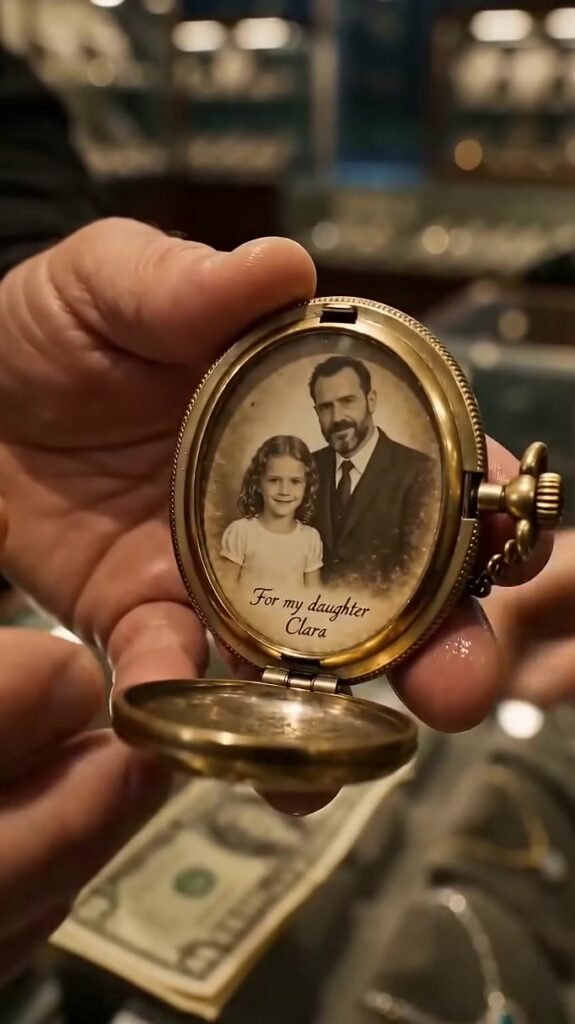
But his fingers had already found the lip of the locket. Habit. Appraisal. Curiosity. He flipped it open.
The hinge was smooth, well-made. Inside, the photograph was old enough to have softened at the edges, the faces slightly faded but unmistakable. A man, younger, smiling with the kind of pride that always feels fragile in hindsight. A little girl, front teeth missing, hair in two uneven pigtails, holding up a handmade paper crown as if she’d been born to rule. Beneath the image, on a thin gold plate, letters had been engraved with care.
For my daughter Clara.
Paul’s hand stopped as if the locket had turned to ice. The shop sounds—rain, the faint hum of the lights—fell away behind a roar in his ears. He knew that inscription. He remembered the day he paid for it, the way he’d argued about the font, the way he’d wanted it to last longer than he ever would. He remembered the weight of the box in his pocket when he’d driven to the school play, and how Clara had squealed when she opened it, and how she’d thrown her arms around his neck hard enough to bruise.
Clara. Missing for seven years. Taken from a bus stop in daylight. The case that had eaten his marriage, his sleep, his faith in doors and locks and ordinary afternoons. The case he revisited in his mind until the memories had become razor-thin and cruel.
“No,” he whispered, and the word came out like a plea.
He looked up, searching for the woman’s face, but she was already moving, already turning toward the exit as if she could feel the air changing. Her hand found the handle. The bell rang again, sharper this time.
Paul lurched from behind the counter. The stool skidded. A tray of rings clinked as he brushed it. He barely noticed. He burst out into the doorway and then into the rain, the cold instantly seizing his shirt, the street smell of wet asphalt and exhaust and something sour in the gutters.
“Wait!” he shouted, his voice cracking. “That necklace—! It belongs to my daughter! My missing daughter!”
The woman froze on the sidewalk. The rain sheeted off her shoulders. For a moment her back was a wall, unyielding. Then her shoulders rose, tense, as if she’d been struck. Slowly, she turned.
Water streamed down her face in rivulets, making it impossible to tell what was rain and what might be something else. Her eyes were wide, not with confusion but with a panic that had nowhere to go. She looked at him like a hunted animal looks at a snare it didn’t see until it was already caught.
Paul took a step toward her and stopped himself, afraid to spook her into running, afraid his own desperation might become a weapon. He held the locket out like evidence, like a prayer. “Where did you get this? Where is she? Is she—” The last word wouldn’t form. Alive. He couldn’t bear to say it and tempt whatever cruel god had been bargaining with him for years.
The woman’s mouth opened and closed once. Her throat worked. She glanced past him, up and down the street, as if expecting headlights or footsteps. When she spoke, her voice was lower than the rain, but it cut through him with surgical precision.
“If Clara is your daughter…” Her breath shuddered. “Then why did she make me promise never to bring this back to you?”
The question hit Paul harder than any confession could have. His mind, always ready to jump to hope, stumbled into a pit of dread. He stared at her, and the streetlamp lit the hollows under her eyes, the bruised purple shadow of sleeplessness. She wasn’t a thief. Thieves didn’t look like this when confronted. Thieves didn’t carry terror as if it had teeth.
“Who are you?” Paul asked, his voice raw. “What do you mean she made you promise? When did you see her?”
The woman’s gaze darted to the shop window, to the warm, safe light he’d taken for granted. “Not here,” she said. “Not in the open.”
Paul’s hands shook as he clutched the locket. He wanted to drag her inside, to lock the door, to call the police, to call anyone who had ever promised him answers. But something in her face warned him: the wrong move would make her vanish into the rain, and whatever thread she held would snap.
“Please,” he said, and the word came out like surrender. “I’ve been looking for her. I never stopped.”
The woman swallowed. “I know,” she whispered, and those two words were somehow worse. As if his grief had been observed. As if someone had watched him from the dark.
She backed a half-step and lifted her sleeve to wipe her mouth, leaving a smear of rain and maybe blood at the corner of her lip. “Clara isn’t… she isn’t a child anymore,” she said. “And she’s the reason I’m still alive.”
Paul’s heart battered against his ribs. “Where is she?”
The woman looked up at the night sky as if it held cameras. “I can take you,” she said, and her voice shook on the word take. “But you have to understand something first.”
Paul leaned in, unable to stop himself. The rain soaked his hair, slid into his eyes. He blinked hard, and the world sharpened around the woman’s next sentence.
“She didn’t disappear,” the woman said. “She was returned. Just not to you.”
Paul felt the ground tilt. Behind him, the jewelry store door swayed in the wind, bell chiming softly like a warning. He stared at the woman, at the money still clenched in her fist, at the torn knees of her jeans, at the way she stood as if waiting for permission to collapse.
“Tell me,” he said, and his voice sounded like it belonged to someone else. “Tell me everything.”
The woman nodded once, grim, as if agreeing to a sentence. “Then put that locket away,” she said. “And don’t say her name out loud again. Not yet. Not if you want to see her breathing.”
Paul’s fingers closed around the gold until it bit into his skin. In the rain, with the shop lights behind him and the street ahead turning into a dark corridor, he realized his years of searching had led him not to an answer, but to a door—and the woman standing before him had come to sell a piece of the truth because she had nothing else left to trade.
And somewhere in the city, Clara—his daughter, his ghost—was still making promises that kept people alive.