When Adrian Vale stepped into the alley, the children were the first thing he saw.
Not the watery gutter cutting through the stones. Not the laundry strung like surrender flags between crooked beams. Not the soot-blackened walls that seemed to narrow as he walked, as if the city itself had decided this passage should feel like punishment.
Children first.
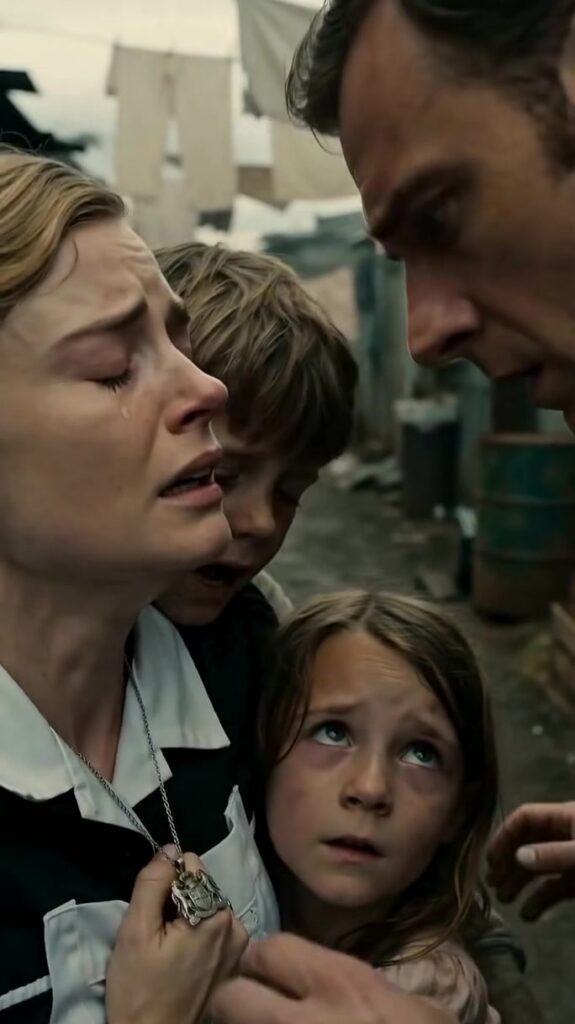
A boy with too-big ears and a face scrubbed only in places, pressed against a young woman’s skirt like it was the last stable thing in the world. A girl in a faded dress, pink once, now the color of old petals, held the woman’s hand with both of hers, solemn as a vow. And the woman—Lina, the maid from his house—stood with her shoulders angled forward, body placed between Adrian and the children with instinctive precision.
The boy’s sobs came in little shuddering bursts. “Mom,” he kept saying, as if the word could build a wall. “Mom, mom—”
Adrian had come here with anger packed tight behind his ribs. He’d followed rumors and a private investigator’s clipped notes, each fact a nail: missing food, a few coins gone, Lina absent at strange hours, Lina lying about where she lived.
He’d rehearsed what he would say in the carriage. He’d planned his voice—quiet, controlled, devastating. He’d planned the dismissal, the warning to other households, the neat removal of a problem.
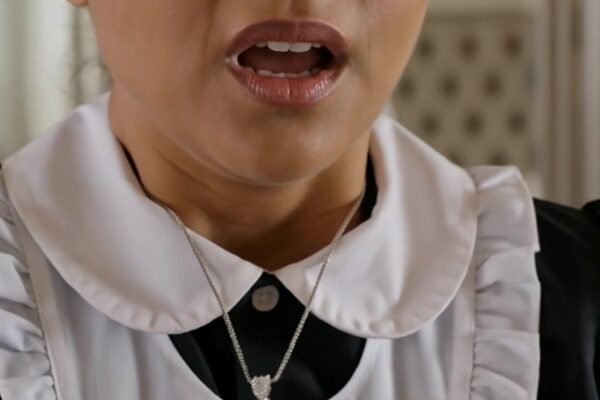
Lina looked up at him and spoke before he could. “Please,” she said, and the word sounded like it scraped her throat. Her hair clung damply to her cheeks, her uniform collar wrinkled as if she’d slept in it. “Don’t send me away. I can explain. I only needed the work.”
Her eyes didn’t carry the slyness of a thief caught. They carried the flat, familiar terror of someone who expected punishment even when she wasn’t sure what for.
Adrian stopped. A strange pause filled him, the kind that comes when a story you’ve told yourself begins to lose its shape.
His gaze moved, unwillingly careful now: the boy’s ribbed collar frayed to threads, the girl’s shoes mismatched, one tied with string. Behind them, a shack door hung open on a single hinge, revealing a darkness that smelled of damp wood and cold ash. A blanket was draped over a broken chair as if it were something worth disguising. Lina’s hem was muddy with the same clay that stained the alley, and there was a hollowness in the boy’s cheeks that made Adrian’s throat tighten.
“What is this?” he asked, and hated how gentle it sounded.
Lina’s arms drew the children closer. She didn’t step away, but she made herself larger, as if she could stretch into a barricade.
The girl stared at Adrian with an unnerving steadiness. She did not cry. She watched him like a judge too small for the bench she’d been seated on.
Adrian took one slow step forward. Lina shifted back in one, immediate, automatic motion, and the flinch landed in him like a slap he hadn’t earned but could not deny.
“I’m not here to hurt them,” he said, because the alley suddenly felt full of invisible weapons and he wanted to put his hands somewhere anyone could see them.
Lina’s laugh was tiny and cracked. “No,” she whispered. “You weren’t supposed to find them.”
The wind threaded between the shacks. A loose sheet of metal tapped softly above them, a patient, hollow sound. The boy sniffed. The girl tightened her grip on Lina’s fingers until her knuckles blanched.
And then Adrian saw it: a glint beneath Lina’s collar, where the uniform’s black fabric parted. A pendant on a chain, worn thin from years of touch. Silver, dulled, but the shape was unmistakable.
His family crest—two interlocked V’s crowned by a small star—etched into the metal like a secret.
His own hand went, without permission, to the ring on his finger. Same mark. Same star.
The world narrowed until it contained only that pendant and Lina’s throat moving as she swallowed.
“Where did you get that?” Adrian asked. His voice had changed. It wasn’t the polished tone he used at dinners, or the clipped command he used with staff. It sounded like something pulled out of him, raw from a place he didn’t show.
Lina’s mouth opened, then closed. Her eyes flicked to the boy, then the girl, then back to Adrian, as if she was measuring how much truth each of them could survive.
“Lina,” he said, quieter now, “why didn’t you tell me?”
Her eyelashes trembled. A tear gathered, refused to fall, then slipped down the line of her cheek with humiliating ease.
The boy peered over her hip, red-eyed. “Mom… is he bad?”
Adrian flinched at the question, at the casual way his existence had apparently been filed under danger. He lowered himself slightly, hands open at his sides. “No,” he said, to the boy and to Lina and to himself. “No. I’m not.”
But even as he said it, the girl shifted her face into the light, and Adrian’s certainty fractured.
Her eyes.
Not merely the color—storm-gray with a thin ring of darker pigment at the edge. The shape was the same as his, heavy-lidded when puzzled, the faint downward tilt at the outer corner that his mother had once called a Vale curse.
He stared at the child, and then at Lina, and then at the child again until the alley seemed to spin.
In his mind, years rearranged themselves like furniture shoved aside. A single night rose from memory: a rainstorm over the east bridge, his father’s funeral, the numbness after too many condolences, the way Lina—then a seamstress at his mother’s dressmaker—had stood under an awning with her hair plastered to her forehead, offering him a cup of hot tea as if warmth could be handed over and accepted like coin.
He remembered the small room above the dress shop. He remembered his own hands shaking, not from desire, but from grief, and Lina’s voice saying, “You don’t have to be alone with it.” He remembered the tenderness that followed and the panic after, the promise to come back, the vow spoken with the arrogance of a man who believed life would pause for him.
Then his mother had fallen ill. Then the estate had demanded him. Then letters had been sent to an old address and returned unopened, and he had decided—cowardice dressed as reason—that it had been a mistake best buried.
The alley made him pay for that decision now.
His mouth went dry. “Are they mine?” he asked.
Lina’s face crumpled as if the question had finally pierced whatever armor she’d been wearing for years. She shut her eyes, and more tears broke free. She did not nod. She did not shake her head. She simply stood there, shaking, holding the children like life preservers while the truth swelled between them.
The boy sensed the shift and pressed harder into her. “Mom,” he whispered, frightened of the silence, “please.”
Adrian took a step forward and forced himself to stop again before Lina could retreat. He looked at the pendant once more, at the crest he’d seen stamped onto letters and cut into stone above the Vale gate. A symbol of legacy, of lineage, of something clean and certain.
Here, it hung against a woman’s skin, worn by fingers that had likely clutched it during nights with no fire.
“I didn’t steal it,” Lina said suddenly, the words rushing out as if she couldn’t bear his suspicion even now. “It was yours. You left it. You dropped it that night, and I kept it because—because it was proof that it happened. Proof I wasn’t imagining it when the months went by and you didn’t come.”
Adrian’s chest tightened. “I—”
“Don’t,” she said, and the command in her voice surprised him more than any plea. “Don’t give me explanations like I’m someone you can soothe with pretty sentences. I lived on explanations for years. I fed them to myself when there was nothing else.”
The girl watched him without blinking. There was a smudge of soot near her temple. Adrian found himself wanting, absurdly, to wipe it away, to fix a mark that didn’t belong on a child’s face. He held still instead, because every time he moved Lina’s muscles tightened in anticipation.
“You worked in my house,” he managed. “All this time.”
Lina’s laugh came again, harsher now. “Because I needed the pay. Because I thought if I stayed close enough you might look at me and remember. And because if I stayed close enough, I could take what the kitchen wasted and bring it here without begging in the streets.” She turned her face slightly, exposing the curve of her cheek where a bruise-yellow shadow lingered. “And because men around here don’t ask nicely when a woman is alone.”
Adrian’s jaw tightened. “Who hurt you?”
“The alley,” Lina said. “The city. Hunger. Fear. Pick one.”
He looked past them at the shack’s interior and saw, on a crate that served as a table, a tin cup with two cracks patched by wire. Three spoons lay beside it. Three spoons for three people.
He thought of his dining room, where silverware sat in velvet-lined drawers and no one ever counted spoons because there were always more.
His anger returned, but it had changed direction.
“I can take you out of here,” he said. The sentence felt too small for what it promised, but it was all he had. “Tonight. Now.”
Lina’s eyes flashed open. “And what would I be, then?” she demanded. “A secret tucked behind your wealth? A charity case? Your regret?”
Adrian swallowed. “Family,” he said, and the word tasted unfamiliar, like a language he’d forgotten he knew.
The boy sniffed, confused, worn out by adult words. The girl’s stare sharpened, as if she could smell a lie.
“I don’t want your pity,” Lina said. Her voice trembled, but she kept it steady with effort. “I wanted you to choose us when choosing us cost something.”
Adrian stared at her. In the polished halls of his estate, choices were made with ink and signatures. Here, choices were made with bodies and hunger.
“Then tell me what it costs,” he said. “Tell me what to do.”
For a moment Lina seemed to waver. She looked at the children. The boy’s forehead pressed into her hip. The girl’s lips tightened, as if she was holding back a question too old for her mouth.
And then the girl lifted her chin, still watching Adrian as if she had been born with distrust and had learned early not to spend it carelessly.
In a small voice, clear as a bell dropped in a silent church, she said, “Mom cries when she says your name.”
The words struck Adrian with a force no accusation could match.
Lina’s face twisted, shame and fury intertwined. “Mara—” she began, but the girl—Mara—didn’t look away.
Adrian felt something inside him split, not into ruin, but into possibility and pain braided together. He stepped back, not as retreat, but as surrender—an acknowledgement that barging into this alley with authority had been another kind of violence.
“I don’t deserve that,” he said, voice rough. “I don’t deserve her tears. Or your fear. Or their childhood.” He looked at the boy. “What’s your name?”
The boy hesitated, then whispered, “Jory.”
“Jory,” Adrian repeated, committing the sound to memory like a prayer. He looked at Mara again. “Mara.”
The girl’s eyes narrowed. “Do you know what that means?” she asked.
Adrian blinked. “No.”
“Mom said it means bitter,” Mara said. “But she named me that because bitter things can keep you alive.”
Adrian’s throat tightened until it hurt to breathe. He glanced at Lina. “I’m going to make this right,” he said, and hated how easy it was to say compared to how hard it would be to do.
Lina’s laugh held no humor. “You can’t buy back years, Adrian Vale.”
“I know,” he said. “So I won’t try to buy them. I’ll live what’s left of them with you, if you’ll let me. And if you won’t, then I’ll still make sure no one touches you, no one starves you, and no one takes from them again.” He paused. “Even if it means my name becomes a weapon turned on my own family.”
At that, something shifted in Lina’s expression—not forgiveness, not even hope, but a wary attention, like a door unlatched one inch.
Above them, the metal sheet tapped again, a patient sound, as if time was still knocking.
Lina wiped her cheek with the back of her wrist, then tightened her hold on the children. “If you come near them,” she said, voice low, “you come gently. You come honest. And you come prepared to be hated.”
Adrian nodded once. It felt like the first true thing he’d done in years.
He took off his ring—gold, heavy, stamped with the crest—and held it out, not as an offering of wealth, but as proof he was willing to bleed something. “Keep it,” he said to Lina. “Not as payment. As collateral. If I lie, sell it. If I vanish, throw it into the river. If I hurt you, use it to cut my name out of your life.”
Lina stared at the ring as if it were a live coal. Then she reached, slowly, and closed her fingers around it. Not accepting him—only acknowledging the weight of what he’d placed in her hands.
Mara watched the exchange, unsmiling. Jory hiccuped a sob and finally quieted, exhaustion taking him like a tide.
Adrian took one step back toward the mouth of the alley, then stopped. “I’ll return,” he said. “With a carriage. With food. With blankets. With a doctor.” He looked at Lina. “And tomorrow, I’ll tell my household the truth before rumor can twist it. I’ll tell them you are not a thief. You are—” His voice faltered, and he forced it steady. “You are the mother of my children.”
Lina’s eyes shut again. This time, when a tear fell, it looked less like defeat and more like grief finally allowed to exist.
Adrian turned away before his composure could crumble in front of them. As he walked out of the alley and back toward the wide, indifferent streets, he felt the city’s air change—cleaner, colder, less forgiving.
Behind him, in the narrow dark, Lina held Jory and Mara as if she could keep the world from touching them.
And for the first time in a long time, Adrian Vale understood that the world was not a thing he owned.
It was a thing he owed.