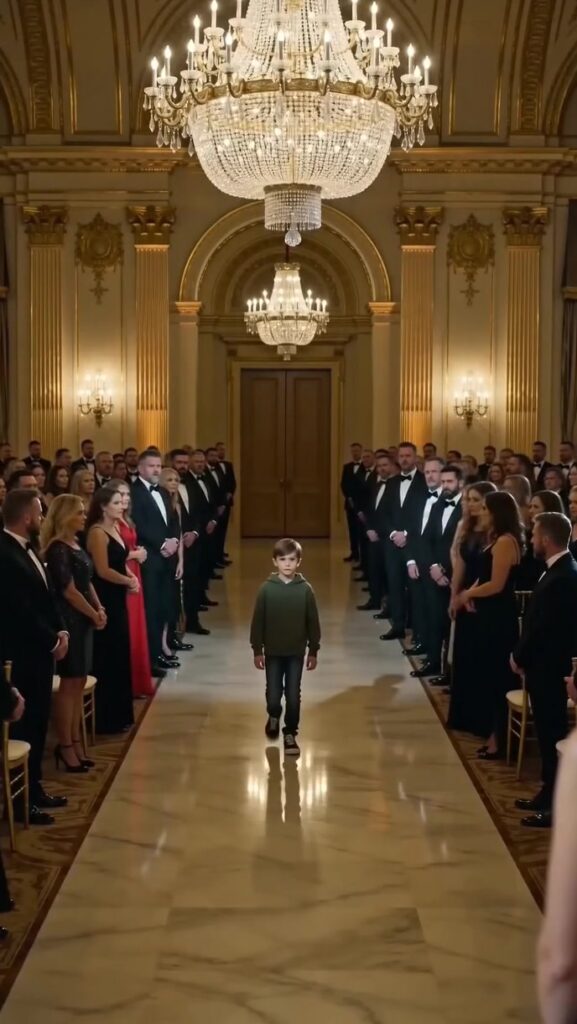
The chandelier burned above the ballroom like a second sun, flooding everything in warm gold—but the room didn’t feel warm at all. The light struck crystal and turned it into fire, yet it only made the shadows sharper: the tight shoulders, the rigid smiles that wouldn’t quite hold, the way people clutched champagne flutes like anchors. Even the music—an obedient waltz—seemed to drift through the air with its throat closed.
At the center of the marble floor stood Victor Halden, host and emperor of the night, in a tuxedo so red it looked wet. He held a microphone in one hand and his daughter’s fingers in the other. Lila’s light-blue dress puffed around her knees like a cloud, and a delicate tiara caught the chandelier’s blaze as if trying to answer it. She had been dressed like the final note in a masterpiece, the proof that Victor Halden’s world could produce something pure.
But her mouth remained closed.
Victor drew in a breath meant for speeches and stockholder meetings, but it came out thin, too human. “My daughter can’t speak,” he said, and the microphone carried the words into every corner where people pretended not to listen. “Doctors don’t know why. Therapists… priests…” His jaw flexed. “If anyone can help her find her voice again, I will reward you. More than generously.”
The offer should have been absurdly theatrical. It wasn’t. It landed like a confession that money had finally met something it couldn’t purchase. Murmurs spread in a nervous tide. A woman in pearls touched her throat. A man with a silver watch glanced at his wife as if she might suddenly volunteer. No one did. They all stared at Lila, expecting a miracle to rise from her small, still body.
Lila’s gaze did not go to them. It stayed fixed on the chandelier, as if she were listening to it hum.
Victor’s fingers tightened around hers, too tight for a father holding a daughter. He didn’t seem to notice. He was staring across the room as if daring someone to solve it, as if daring the universe to contradict him.
That was when a ripple moved at the far end of the ballroom—something not scripted into the evening. A boy stepped forward from the shadow of a column where the hired waitstaff lined up with trays. He wasn’t carrying anything. He wore a green hoodie under a borrowed blazer that didn’t fit right, and the knees of his jeans were faded like they’d seen too many streets. He moved as if he had practiced walking into rooms that hated him.
People made space without meaning to. He crossed the marble aisle that cut through the crowd like a blade, his sneakers whispering on stone polished for expensive shoes. When he stopped a few feet from Victor Halden, he didn’t look at the chandelier, the guests, or the red tuxedo. He looked at Lila.
“I can bring her voice back,” the boy said.
It was spoken quietly. It changed the temperature anyway.
Victor’s face betrayed a flicker—hope, raw and helpless. It vanished so fast it might have been a trick of the gold light. Anger surged in its place, a familiar armor. “Get out,” he snapped, his voice cracking the waltz in half. “This is not a circus act. This isn’t a game for children trying to win money.”
The boy didn’t flinch. He didn’t defend himself. He didn’t glance around to see who was watching him—though everyone was. His calm was infuriating, like someone refusing to be intimidated by power. He held his hands down at his sides, fingers loose, and waited as if Victor’s words were weather that would pass.
Lila moved for the first time. Not much—just the smallest tilt of her head toward the boy. A tear slid from the corner of her eye and vanished into the blue of her dress. She was not looking at her father. She was looking at the stranger as if she recognized the shape of him from a dream.
Victor noticed the glance and stiffened, as if it had betrayed him. “She doesn’t even know you,” he hissed. “No one knows you.”
“She does,” the boy said softly. “Just not the way you want.”
That sentence cut through the room so cleanly that the guests stopped whispering. Even the chandelier seemed to burn quieter.
Victor lifted the microphone again, ready to summon security, to expel the embarrassment from his perfect night. The boy spoke once more, but to Lila this time. “Do you remember the glass room?”
Lila’s lips parted, then closed. Her small hand, still trapped in Victor’s grip, twitched.
Victor’s eyes narrowed. “What did you say?”
The boy’s gaze never left Lila. “The room where they told you to be brave. Where the walls were clean and the air smelled like lemon and fear. Where you learned you could be silent and everyone would stop asking questions.”
Victor’s knuckles turned white. Around them, the guests shifted as if realizing the ballroom had been built over something rotten. “You don’t know anything about my family,” he said, and the words were meant as a command.
The boy finally looked up at Victor. There was no triumph in his face, only a kind of grief that didn’t belong on someone so young. “I know enough,” he replied. “I was in the waiting room that day. My mother cleaned the clinic floors at night. I played with the toy train in the corner while your people signed papers. I heard Lila scream once. Just once. Then it stopped.”
A shudder moved through the room, and it wasn’t the air-conditioning. Victor’s mouth opened, but nothing came out at first. His world, so carefully curated, had been reached by a hand from a place he couldn’t control. “She was ill,” he managed, too loudly. “She was frightened. We did what the doctors said.”
“You did what kept your name intact,” the boy said, not cruelly—simply as if naming a fact. He stepped closer, not to Victor but to Lila, close enough that she could feel him without being touched. “Lila,” he whispered, and his voice was small against the grandeur. “You don’t have to hold it for him anymore.”
Victor jerked her hand back as if the boy had reached for her throat. “Don’t,” he warned.
The boy raised his own hand then, palm open, empty. “I’m not here for money,” he said to the room, and the room believed him because there was no place on him for greed to cling. “I’m here because silence can be a cage, and cages don’t belong to children.”
The chandelier’s gold light trembled—just a flicker, like a candle meeting a draft. Lila stared at the boy’s open palm as if it were a door. Her breath quickened. Her small shoulders lifted, then fell, as if she had been carrying a weight that finally decided to move on its own.
Victor leaned down, voice urgent and private now, the kind of whisper that sounded like love only from a distance. “Sweetheart,” he pleaded, “don’t do this here.”
Lila turned her face up toward him. In the gold glare, her eyes looked older than her tiara. Her lips trembled. For a heartbeat, Victor’s grip loosened, perhaps out of instinct, perhaps out of fear.
And in that thin space—between holding and letting go—Lila spoke.
It wasn’t a perfect word. It was hoarse and broken, like a bird learning its own wings. But it was unmistakably a voice.
“Stop,” she said.
The microphone caught it anyway, though Victor hadn’t meant to. The single syllable expanded through the ballroom and struck every crystal on the chandelier until the whole room seemed to ring with it. Victor froze as if he’d been slapped. The guests gasped, and then—because people never know what to do with truth—some began to clap, eager to turn agony into applause.
Lila flinched at the sound, but she did not retreat into silence. She looked at the boy, and something like relief softened her mouth. Then she looked back at her father, and her next words came steadier, each one pulled from a place deep and dark and long locked.
“I didn’t forget,” she said. “I was waiting.”
Victor’s red tuxedo suddenly looked like a wound in all that gold. His hand hovered between taking her back and letting her go. He stared at his daughter as if she had become a stranger and a verdict in the same breath.
The boy lowered his hand. He did not smile. He only nodded once, as if acknowledging an agreement he and Lila had made without ever meeting: that the night would not end with glitter and lies.
Above them, the chandelier continued to blaze like a second sun. But now, for the first time, the room felt cold for the right reason—the chill that follows when a beautiful thing finally reveals the fire beneath it.