The gate struck its latch with a violence that turned the rain into an audience. The sound snapped across the alley like a shot, and with it came his voice—hard-edged, impatient, finished. “I told you, I don’t have cash. Take the rice and go.”
For a breath she did not move. She stood on the slick cement with rainwater running off her hair and down her sleeves, the little sack pressed to her ribs as though it contained something breakable. It wasn’t heavy—hardly more than a family’s supper for a week—but she held it like a relic. The porch light made her skin look thinner than it had a right to be, as if the years had shaved her down to the simplest shape: bones, stubbornness, and duty.
Her mouth tried to do what it had always done for him—soften the room, smooth the sharpness. The smile that came was small and split at the corners. “Thank you,” she managed, and the word trembled from cold or something deeper. She added his name the way she used to when he was ten and feverish, when she believed naming him could tether him to her. But the gate was already shut, metal and final, and she did not knock again.
She turned away from the house she had once cleaned with her bare hands, the house she had once prayed would become a home again after his father left and the roof leaked in three places. She walked down the alley with careful steps, one foot dragging slightly, shoes soaked through. Rain made the world mercifully blurry. It hid the shine in her eyes the way she had learned to hide everything else: the notices from the utility company, the bruises on her pride, the hunger she ignored so he could eat.
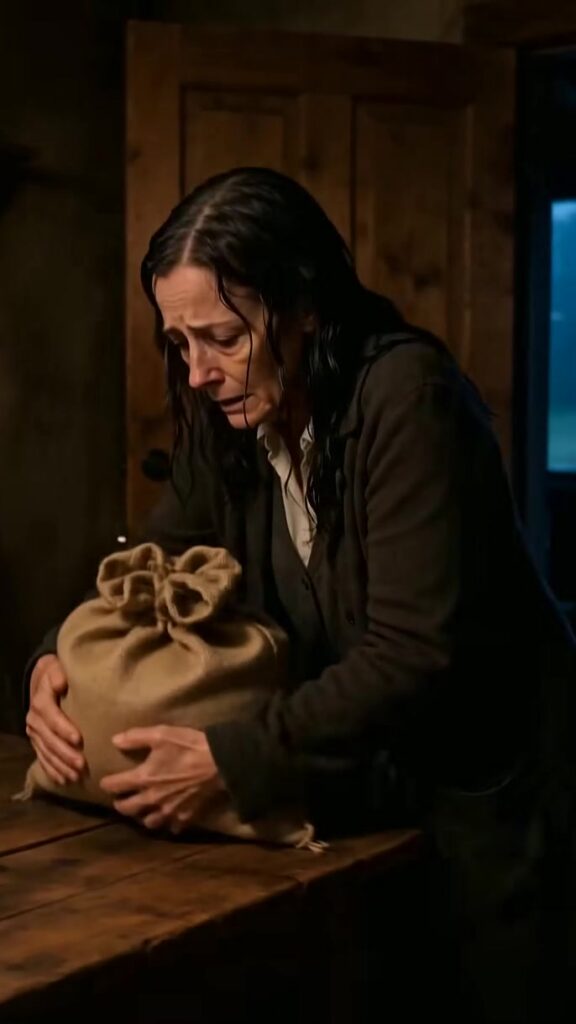
Her place was two streets over, behind a shuttered tailor shop, where the landlord pretended not to see her when she handed over coins. The room greeted her with the smell of damp cement and old cooking oil. A single bulb burned weakly above the table, a tired sun. She set the sack down as if it might crack open and spill not rice but all the years she’d swallowed without complaint.
She stood there a moment, hands hovering. There was a habit in her—one she’d never shaken—of making food last longer by touching it gently, as though tenderness could stretch it. She untied the twine. The rice inside made a soft shifting sound, like rain on a tin roof. She reached in, fingers sifting, and then her hand stopped.
Something solid sat among the grains, wrong and heavy. Her throat tightened. She drew it out slowly. An envelope, thick enough to bow at the edges. Water had not reached it; it was wrapped in plastic, careful as a secret. Her name was written across the front in a familiar slant that made her chest hurt. Not her full name, not the one on documents, but the one he had invented as a child when he couldn’t pronounce the syllables: Ma Lien.
“No,” she whispered, and it sounded like a prayer that had grown tired of answering. Her fingers shook as she opened the flap, expecting, absurdly, a bill, another demand. Instead there was money—more than she had ever held at one time, stacked and banded, the paper smelling faintly of metal and soap. It was not the kind of sum that appeared by accident. It was the kind of sum that required decisions, sacrifices, nights that did not end.
Her knees gave. She caught herself on the table, but her shoulders folded inward as if something had finally been allowed to collapse. She did not sob out loud at first; sound had always been a luxury. Tears came anyway, quick and hot, mixing with rain still clinging to her eyelashes. She pressed the envelope to her sternum, where her heart insisted on beating, stubborn as she was.
Memory came in fragments, sharp as broken glass. The night she sold her wedding ring to pay his school fees. The days she pretended she wasn’t hungry by chewing betel leaf while he ate. The time he found her counting coins under the lamp and asked why she looked scared, and she lied and said she was just tired. And then another memory—recent, different—his face in the market three weeks ago, half-turned away, jaw clenched as he handed a man a folded bundle. She had thought it was a repayment, a debt. She had not understood the shape of it.
On the envelope, beneath her name, a line had been added in smaller letters. She blinked through tears to read it. It wasn’t an apology; he didn’t know how to write those. It was a direction, plain and almost angry, as if emotion were a weakness he refused to admit to. Use this for the landlord. And for the medicine. Don’t come back here again in the rain.
Her breath hitched on something that was almost laughter and almost grief. Of course he could not say it to her face. Of course he had slammed the gate, made his voice a weapon, because tenderness would have undone him. She saw it with a clarity that cut: his cruelty had been a mask held tight to keep his own eyes from betraying him. He had not wanted her to see his hands shaking as he gave away what he’d bled to earn.
Outside, rain threaded down the windowpane in slanted lines. Through the watery glass, the alley light caught the silhouette of a man standing near the corner, half-hidden behind the post where wires tangled. He did not move closer. He did not call her name. He stood as if guarding the door to a world he did not know how to enter, watching to make sure she was inside, watching to make sure she did not turn around and come back.
She wiped her face with the heel of her palm, angry at the tears as if they were another expense. She opened the sack again and poured a little rice into a bowl, the sound steadying her, ordinary and therefore holy. Then she reached for the envelope, smoothed it flat, and put it beneath the bowl like a foundation stone. She whispered into the room, not loud enough for the rain to carry, but loud enough for the walls to learn. “You still are my son,” she said, and the words were both blessing and ache. “Even when you speak like a stranger.”
She waited until the shadow outside faded—until the alley was only rain and empty light. Then, with hands that still trembled but did not fail, she lit the stove. The flame caught with a small hiss, and in that thin warmth she felt something shift: not forgiveness, not yet, but the beginning of a bridge. The gate had slammed, yes, and the echo had sounded like an ending. But on her table, beneath a bowl of rice, lay proof that some endings were only the loudest kind of love trying not to be heard.