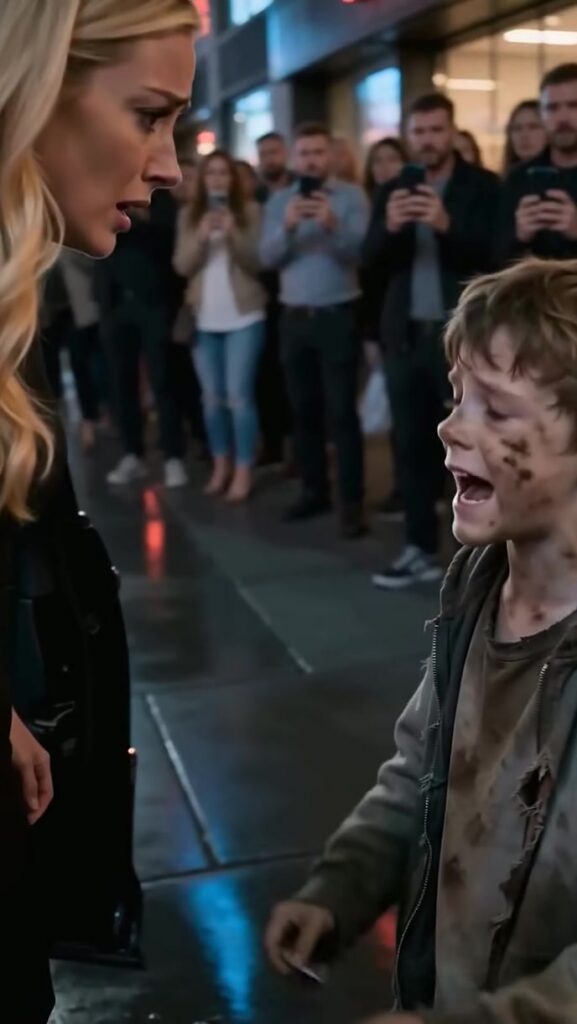
The splash sounded like a slap—thick water, the color of old coins, bursting against the flawless black paint. It ran in ugly streaks down the hood, across the chrome emblem, and pooled at the curb where the city’s neon turned it into oil-slick rainbows.
For a breath, everyone on Hartwell Avenue forgot how to move. A bus hissed to a stop, commuters mid-step. A vendor’s paper cups trembled in his hands. Phones rose as if pulled by strings—glass rectangles pointed at the scene like a jury leaning forward.
The driver’s door flew open with a harsh click, and a woman stepped out as if the car were a stage and the street existed only to carry her. Her coat was pale and expensive, her hair pinned with perfect impatience. She looked at the dripping hood, then at the boy with the empty bucket, and fury sharpened her face into something unrecognizable.
“What is wrong with you?” she barked, voice bright enough to cut through traffic noise. “Do you have any idea what you’ve done?” She strode closer, heels striking the pavement like punctuation. “Who raised you to behave like an animal?”
The boy did not run. He was small for his age, thin in a way that suggested more than missed meals—thin like someone who’d been edited out of the world. His hands trembled around the bucket handle, knuckles white. He stared at her, not at the car, as if the car were merely a prop he’d used to force this moment into being.
“You did this to me,” he said, and his voice surprised him—steady, low, too heavy for a child. The words seemed to crack open the air. “This is your fault.”
Something shifted behind her anger: confusion, then irritation at the inconvenience of it. She flicked her gaze over him, as if searching for a parent to sue, a camera to blame, a reason that made sense. “I don’t know you,” she snapped. “Get out of the way before you make this worse for yourself.”
“Worse?” He let out a laugh that sounded like he’d swallowed glass. “You think this is about a car?” He stepped forward, and the crowd tightened, a ring of breath and curiosity. “You left us. You drove off like we were trash on the roadside. You didn’t even turn your head.”
The woman’s mouth opened, then closed. The fury tried to rebuild itself, but the boy’s words kept hammering. “My mom—” he began, and the syllables trembled—“my mom used to tell me not to stare out the window so much. She said if I watched the street long enough, I’d wear a hole in it and fall through.”
“Stop,” she said, but it came out softer than she intended. Her eyes flicked to the phones and the faces. She hated an audience unless she was controlling it. “Whatever game this is, I’m not interested.”
“It’s not a game.” The boy reached into his jacket pocket, slow enough that no one could accuse him of sudden violence. When his fingers came out, they held something folded and frayed. He smoothed it once with his thumb, as tenderly as if it were a wound. “I brought proof, because no one believes kids when they tell the truth.”
He unfolded the photograph. It was old, its corners rounded with handling, its colors washed into sepia. A younger woman stood in a hospital room, hair loose, eyes tired and shining. In her arms: a newborn wrapped in a blanket with a blue stripe. The baby’s fist was lifted like a tiny protest. The woman in the picture smiled as if she had just discovered a reason to live.
The boy held it up. “That’s you,” he said. “And that’s me.”
Silence dropped over Hartwell Avenue with the weight of a curtain. Even the bus seemed to quiet, its engine idling like a held breath. The woman’s gaze locked onto the photo. Her face drained, then flushed, then drained again. Her hands, so used to signing papers and steering meetings, hovered uselessly at her sides.
“No,” she whispered, as if denial could erase ink. “That can’t be—”
“I know your name,” the boy said, and now the tears he had been holding back rose like a tide. “I know you changed it. I know you moved and didn’t tell anyone. I know you told the judge you were unfit and then got fit again for someone else. I know you sent one letter and it came back because the address was wrong, and after that you stopped.”
Her throat worked. “Who told you—”
“My mom didn’t want to poison me with it,” he cut in. “She tried. She tried so hard to make me grateful. But when she got sick, when she started forgetting words and leaving the stove on, she finally told me the truth because she was afraid I’d spend my whole life thinking I was unwanted for no reason.” He wiped his face with his sleeve, angry at his own tears. “She didn’t even hate you. That’s the part that makes me furious. She said you were scared.”
The woman’s knees seemed to soften, as if her body had heard something her mind couldn’t afford. Her eyes darted, seeking an exit in the crowd, in the traffic, in the sky. “You don’t understand,” she said, voice brittle now. “You have no idea what my life was like then.”
“I do,” he said. “It was like mine. It was small and loud and expensive in all the ways you can’t pay for. But you got to leave.” He lifted the bucket slightly, the water inside sloshing—a pathetic remainder compared to what he carried in his chest. “I didn’t want your money. I didn’t want a mansion. I wanted you to look back.”
A siren wailed in the distance, growing closer. Someone had called it—someone always did, when pain spilled into public. The woman flinched, then glanced at her car as if it could drive her out of consequence. She stared again at the photo, and a sound escaped her—half a sob, half a laugh, the kind that comes from a locked room finally cracking open.
“I held you,” she said, and the words sounded like a confession she’d practiced in nightmares. “I promised you I wouldn’t let anything happen to you.”
“And then you did,” he answered, voice steady again, cruel only because it was true. He took a step back, as if proximity might soften him and he couldn’t afford softness. “So say it. Say you’re my mother. Or say you’re not. Just don’t pretend I’m nothing.”
The siren grew louder, lights reflecting in the wet streaks on the car. The crowd leaned in, hungry for an ending. The woman lifted her hand, trembling, not toward the boy’s face but toward the photograph, as if touching paper could rewrite the past. Her lips parted. Her eyes squeezed shut. When she opened them, they were wet, and for the first time her voice carried no command—only fear.
“I never stopped thinking about you,” she said, and the sentence seemed to cost her years. “But thinking isn’t the same as coming back.”
The boy’s chin lifted. “No,” he agreed. “It isn’t.” He folded the photo with careful precision, as though returning it to its hiding place inside his heart. The siren arrived at the corner, the city waking from its spell. And on Hartwell Avenue, beneath neon and judgment and filthy water, two lives hung in the space between accusation and apology—right before the truth could turn into something neither of them knew how to carry.