The scream shattered the restaurant so cleanly it felt like glass breaking inside every ear. Conversations died mid-syllable. A stemmed glass hovered on its way to a mouth and never arrived. Forks stopped in the air, silver caught in a hard, embarrassed pause.
Every head turned. Not all at once—more like a tide, dragging attention toward the sound. Phones rose, slow and eager, as if the room itself had rehearsed the movement. Screens glowed in the dim, reflecting faces that already looked hungry for a story with a villain.
The villain, apparently, was a young waitress crossing the floor with a tray balanced on one palm. Her name tag read LENA, but almost no one ever said it. In the kitchen they called her “sweetheart” or “kid.” At table seven, she was simply “hey.”
Her step made a faint, metallic click against the tile—soft, rhythmic, unavoidable once you noticed it. She had learned how to walk so it sounded like nothing at all, how to set her weight down gently and roll through the foot like a dancer. Some nights she almost managed it. Some nights, like this one, the room was too quiet and her body was too tired.
“That noise,” the woman snapped, her mouth twisted like she’d bitten something rotten. “Your leg. You’re ruining my meal.”
The words were sharp enough to cut the air into sections. Lena didn’t drop the tray, though her fingers tightened so hard the tendons stood out. Heat rushed to her face, a sudden, humiliating bloom.
“I’m sorry,” she said, the apology coming out reflexively, trained into her like proper posture. “I’ll be more careful.”
She tried to step away. The click followed her, a small betrayal. The woman’s chair scraped the floor in protest. “This is the third time,” she announced, loud enough for the back booths to hear. “Are you always this slow?”
Lena turned back because turning back was part of the job, because leaving without permission was how you got written up, because her rent didn’t care about dignity. She had a habit of smiling when she was scared. Tonight the smile felt like it didn’t belong on her face.
“I’ll—” she started.
“Just go,” the woman said, flicking a hand as if shooing a fly. “And don’t clomp around us again.”
Clomp. The word landed on Lena’s prosthetic like a stamp. She had lost her leg below the knee at sixteen, a wet-road accident that had turned a friend’s laughter into sirens. For years after, she heard phantom footsteps in dreams: the old limb trying to return. In the morning, there was only the carbon fiber and the socket, the straps and the skin rubbed raw at the edges.
She moved away, controlled. She had learned control the way some people learned prayer. Her breathing changed, tight as if she’d swallowed a knot. Behind her, the woman began explaining to her companions, as if narrating a documentary. “It’s disgusting. The whole thing. The noise. Like—like a robot. I can’t eat.”
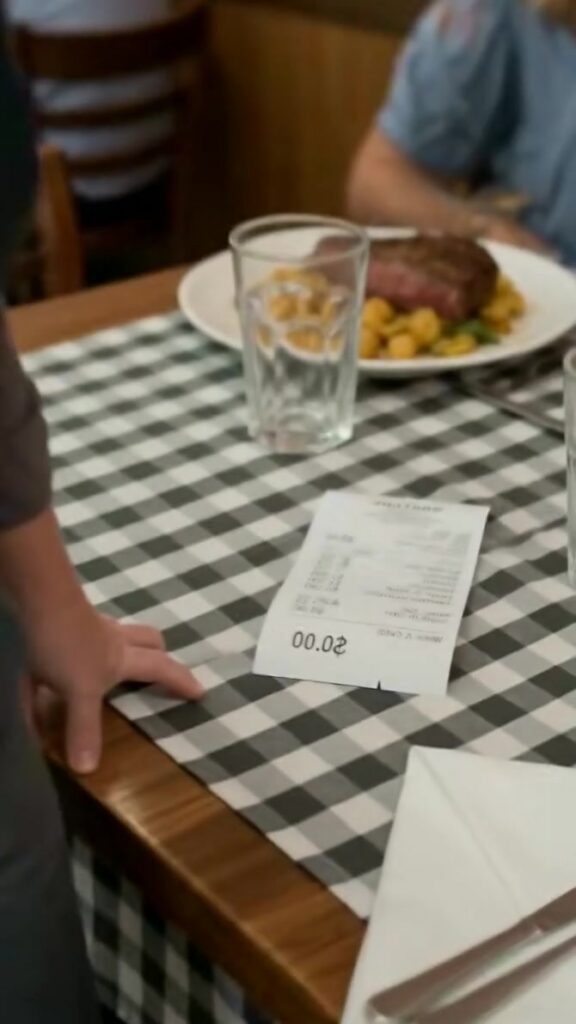
Plates arrived. Time passed in tiny humiliations. Lena refilled waters and kept her shoulders square. She avoided table seven the way you avoid a bruise. But when the check was dropped, the woman made a theater of it. She held the receipt out so it could be seen, turning it slightly for the nearest phone.
“Zero,” she said, and smiled as if she’d accomplished a public service. “You don’t deserve a tip. You’re an eyesore.”
The word eyesore did something strange to Lena—made her suddenly aware of her own body as a thing other people had to look at. She stared at the receipt, at the crisp line where tip should be. Her throat tightened. Tears gathered, bright and furious, but she kept them from falling. Not because she was strong. Because crying in public, she’d learned, made people feel entitled to opinions.
She stood very still, holding her pen like it was the only object in the world that could anchor her. The room hummed. People leaned in as if waiting for the next scene.
Then, from behind her, a voice cut through everything—calm, even, carrying the weight of a door closing.
“Excuse me, ma’am.”
The manager stepped into view. His name was Carlos, though customers rarely asked. He was not a tall man, but there was something in his stillness that made him seem larger than the space he occupied. His eyes moved from the woman’s face to Lena’s trembling hand, and for a moment, anger flickered there—quick, disciplined, banked like a flame in a lantern.
He held a glass jar, the kind used for tips at the register: thick, heavy, half-filled with coins and folded bills. Carlos didn’t ask questions. He didn’t negotiate. He walked to table seven and placed the jar down with a deliberate force that made the silver inside rattle like a warning.
“This,” he said, his voice low but somehow audible in every corner, “is what respect looks like.”
The restaurant inhaled as one. Someone murmured, “Oh my God,” and the phones rose higher. The woman’s confidence drained from her face with the speed of color leaving a bruise. For the first time she looked around and realized she had an audience that was not on her side.
“I—” she began, sputtering. “I’m a paying customer—”
“You were,” Carlos replied. He picked up the check folder between two fingers and closed it softly, like a book ending. “You can settle your bill. But you will not speak to my staff that way.”
The woman tried to laugh, thin and brittle. “I didn’t do anything. She’s making that noise on purpose. It’s—”
“It’s her leg,” Carlos said, and now the words were harder. He did not raise his voice. He didn’t have to. “And she is working. And you are sitting. If you can’t tolerate a person existing near you, you can finish your meal somewhere else.”
Lena felt the room shift, like a compass needle finally pointing true. The shame she’d been holding—carefully, like a hot stone—began to cool. It didn’t vanish. But it changed shape. It became something else: a dense, steady weight in her chest that felt closer to resolve than hurt.
Carlos looked at her then, not at the prosthetic, not at the floor, but at her eyes. “Lena,” he said, using her name like it mattered. “Go take a break. I’ve got this.”
Her lips parted. No sound came out. She nodded once, because nodding was all she could manage without the tears breaking free. She walked toward the kitchen, and yes, her step clicked. But now the sound felt less like a flaw and more like proof that she was still moving.
Behind her, the woman’s chair scraped again, a frantic retreat. “This is ridiculous,” she hissed, trying to reclaim the narrative. “I’m going to write a review.”
“Please do,” Carlos said. “Spell her name correctly.”
In the kitchen doorway, Lena paused. Through the service window she saw the dining room’s faces—strangers suddenly careful, suddenly human. An older man at the bar pushed a few bills into the jar near the register with a guilty softness. A couple at table three exchanged a look and added their own. It wasn’t charity, exactly. It was something like repayment, as if the room was trying to balance a scale it had ignored for too long.
Lena leaned her forehead against the cool metal of the doorframe. The tears finally slipped down, quiet and hot. Not because she’d been humiliated. Because, for the first time in a long while, she’d been defended without having to beg for it.
And as the restaurant’s noise slowly returned—chairs, laughter, clinking plates—her metallic step became part of it. Not an interruption. Not an offense. A note in the music of people living, imperfectly, beside one another.
When she straightened and walked to the back room, the click followed her—steady, precise—and it no longer sounded like something disgusting. It sounded like a metronome setting the pace for whatever came next.