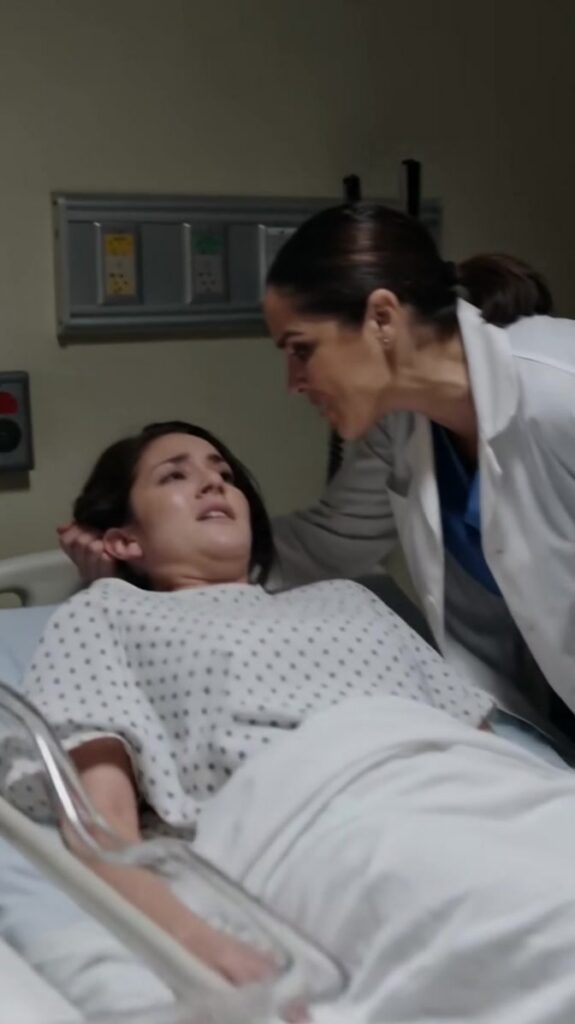
The maternity room was quiet in the way a chapel is quiet—full of small, careful sounds that refuse to become a disturbance. A monitor clicked and sighed in slow rhythms. The overhead light had been dimmed to a buttery dusk, softening the edges of everything it touched: the metal rails of the bed, the plastic basin on the counter, the thin curtain half-drawn like a lowered eyelid. Against the mother’s ribs, a newborn slept in a clear bassinet, swaddled so tightly he looked like a promise wrapped in cotton.
Leona lay on her side, one hand flattened over the ache of her abdomen, the other slack beside her. Sweat had dried in salt lines at her temples. She was drained down to the marrow—an exhaustion so total it felt like being emptied. The birth bracelet on her wrist read a name she’d chosen in a whisper between contractions: Milo. She stared at the letters until they blurred, letting the shapes anchor her, letting the existence of those four letters mean that something in her life had not been taken away.
The door didn’t knock. It opened as if it belonged to whoever stepped through it, and in came the kind of quiet that has teeth. Two women moved into the room without hesitation. One was narrow-shouldered and fast, a storm in a leather jacket, eyes burning like a match struck too close to gasoline. The other was tall and still, her hair pinned neatly back, her expression blank enough to be mistaken for calm. She closed the door behind them with gentle care, a courtesy that made the intrusion worse.
“You thought you could vanish,” the fast one said. Her voice was low, but it carried. She didn’t glance at the baby. She didn’t have to. She already knew where to aim. Leona’s body tried to scoot back on the sheet, as if the mattress were a shoreline she could crawl away from. But she had nowhere to go; the bed rails were up, and her legs trembled with the aftershocks of labor.
The fast woman reached in and took Leona by the hair, winding it around her fist with practiced efficiency, like gathering reins. Leona’s scalp screamed. Her head snapped back against the pillow, the motion dragging pain through her abdomen like a wire. “Where is it?” the woman demanded, breath hot with impatience. “That card. The one you used to open the account. You think the hospital makes you untouchable?”
Leona tried to speak and found only a raw sound. Her throat was dry, her lips split. In the bassinet, Milo made a soft, dream-thin noise and shifted his tiny mouth, searching for nothing.
“Don’t,” Leona managed. She grabbed at the woman’s wrist, fingers weak, nails barely pressing skin. “Please. Not here.”
“Here is perfect,” the woman said. “No cameras in the room. Staff assumes visitors are family. Everybody’s distracted by the cute baby.” She yanked Leona’s head to the side until the nerves in her neck lit up. “You owe us. You ran out on your payments, and then you ran out on us.”
The tall woman stayed near the door. Her eyes moved over the room like she was inventorying it. When she finally spoke, her voice was smooth and careful, as if she was explaining a policy. “This doesn’t have to become a scene, Leona. Give her what she wants. We’ll walk out. You’ll rest. The child will sleep. Everyone stays intact.”
Leona’s stomach lurched. She remembered those words—everyone stays intact—said in a basement office when she first signed papers she didn’t understand, when she believed desperation could be managed like a budget. She remembered the way they had taken her ID “for safekeeping.” She remembered the card that wasn’t just a card: a key to names, accounts, debts that multiplied when you looked away. A thin piece of plastic that let them follow her through every attempt to become somebody else.
“I don’t have it,” Leona whispered. “I left it.”
“Liar.” The fast woman’s hand tightened. The tall woman took a step closer, and her shadow slid over Milo’s bassinet. “You can’t leave what belongs to us,” she said quietly, and for the first time something sharp flickered behind her blankness. “We made you. We can unmake you.”
Outside the room, a cart squeaked past, then faded. Somewhere down the hall, nurses laughed—brief, tired laughter. It sounded like a different planet.
Leona’s lungs worked like a bellows with holes in it. She could smell antiseptic, warm milk, and the faint burnt scent of the fast woman’s cigarette breath. Her body wanted to fold in on itself, to survive by becoming small. That had always been her trick: shrink, soften, comply. She had learned it in childhood, when anger in the house was weather and her job was to not be struck by lightning.
Then Milo stirred again, a tiny fist lifting as if he were reaching through sleep for her. The sound he made was barely more than air, but it struck Leona like a blade of light. She turned her head, as far as the grip in her hair would allow, and saw his face—creased and new, his eyelids purple as bruised petals. He had no idea what any of this was. He hadn’t agreed to inherit her fear.
Something in Leona cracked—not into surrender, but into clarity. The room seemed to sharpen: the rail release latch, the nurse call panel, the thin cord of the bassinet monitor. The emergency button on the wall was only a few inches away from her free hand. She had noticed it when she arrived, the way you notice an exit sign in a theater, expecting you’ll never need it.
“You don’t get to decide when this ends,” the fast woman hissed, leaning so close Leona could see pores on her cheek, the slight tremor of rage around her mouth.
Leona swallowed. Her voice came out steadier than she felt. “I do now.”
She let her hand fall limp for half a second, as if she had finally broken. The fast woman’s grip loosened in satisfied anticipation. Leona took that breath-sized mercy and flung her arm sideways, palm slamming the red emergency pad with every ounce of strength she had left.
For one heartbeat, nothing happened. Then the alarm detonated into the room—an ugly, urgent wail that seemed to shake the air itself. The monitor’s beeps accelerated in sympathetic panic. Milo startled, a thin cry slicing up from his swaddle. Leona’s vision swam, but she kept her eyes open, kept her gaze on the women as if she could hold them in place by refusing to look away.
The fast woman jerked back like she’d been struck. Her confidence drained from her face in an instant, leaving naked calculation. The tall woman’s composure finally cracked; her eyes widened, and her hand moved toward her pocket as if reaching for a tool or a weapon or a phone. The door handle rattled as footsteps thundered outside—more than one set, heavy and fast.
The door flew open with a violent swing. A nurse in scrubs burst in first, eyes wide, followed by a second nurse, then a hospital security guard filling the doorway like a wall. Their attention flicked from Leona’s disheveled hair to the women near the bed to the baby crying. The guard’s hand hovered near his radio. “Step away,” he barked. “Now.”
The fast woman’s mouth opened. No sound came out. The tall woman lifted her hands slowly, palms out, and put on a face that tried to be offended. “This is a misunderstanding,” she began, voice sweetening. “We’re family—”
Leona, shaking, forced herself upright enough to speak. Her scalp throbbed. Her stomach felt like it was held together with thread. But she pointed at them, her finger steady as a judge’s gavel. “They’re not here to see the baby,” she said. “They’re here to take what they stole from me. They’ve been following me. They hurt me.”
Silence slammed down after her words, heavy and undeniable. One nurse moved to Milo, checking his swaddle, murmuring soothing sounds. The other nurse hovered near Leona’s shoulder, protective without touching. The security guard stepped fully into the room, blocking the women from the bed.
The fast woman’s eyes darted toward the hallway, toward escape, toward the bassinet—anything that might give her leverage. The tall woman’s gaze locked on Leona, and in it was a promise that was older than the building they stood in. “This isn’t over,” she said, so softly only Leona heard.
Leona didn’t look away. Her voice came out hoarse, but it didn’t break. “It is,” she answered. “You’re not taking anything from me again.”
Milo’s cry softened into a hiccup. The alarm continued to shriek. Nurses moved, radios crackled, and the guard spoke into his mic, calling for police. The room that had been a sanctuary a moment ago had become a battlefield, bright with fluorescent truth.
As the tall woman was escorted toward the door, she turned her head just enough for Leona to see her lips shape a final word—something like a name, or a warning. The fast woman fought against the guard’s grip, anger spitting out in fragments. But their power had evaporated the moment the alarm sounded. They were just two bodies in a hospital room, outnumbered, exposed.
Leona exhaled shakily and reached for Milo, her fingertips brushing the edge of his blanket. His skin was impossibly warm. He blinked once, as if waking into a world he hadn’t asked for, and his gaze found her. For the first time since the labor began, Leona felt a different kind of pain: the ache of love fierce enough to make her dangerous. And as the footsteps carried the women away, she held that feeling like a shield—thin, trembling, but real.
Down the hall, sirens began to approach, faint at first, then growing louder. Leona watched the doorway, listening, waiting. She knew storms didn’t always pass in one night. But the room was no longer quiet the way a chapel is quiet. It was quiet the way a locked door is quiet—after you’ve finally found the key.