Adrian reached inside his jacket slowly and pulled it out as if the movement itself could wake something sleeping in the fabric. His fingers closed around metal worn smooth by years of thumb and worry. When he brought his hand into the pale afternoon, the old silver lighter caught the weak light and threw it back in a dull, stubborn gleam.
The city around them moved with its usual indifference—buses exhaling at the curb, pigeons skittering across the plaza stones, a man arguing into his phone near the fountain. Yet the moment the lighter appeared, the air between Adrian and the girl tightened, as if the noise had been pulled farther away.
The girl’s eyes filled instantly. Not a gradual shine. A sudden flood, like a dam had given way behind her lashes.
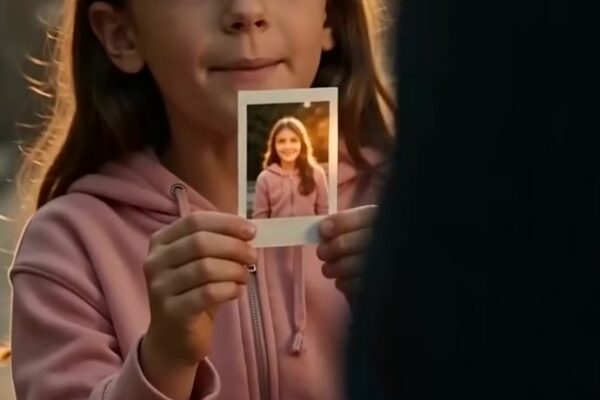
“That’s it,” she whispered, and the words seemed to scrape out of her. She looked like she’d been running for a long time, not just today. A bruise hid beneath the collar of her hoodie. The skin at her wrists bore the faint, angry lines of something once too tight.
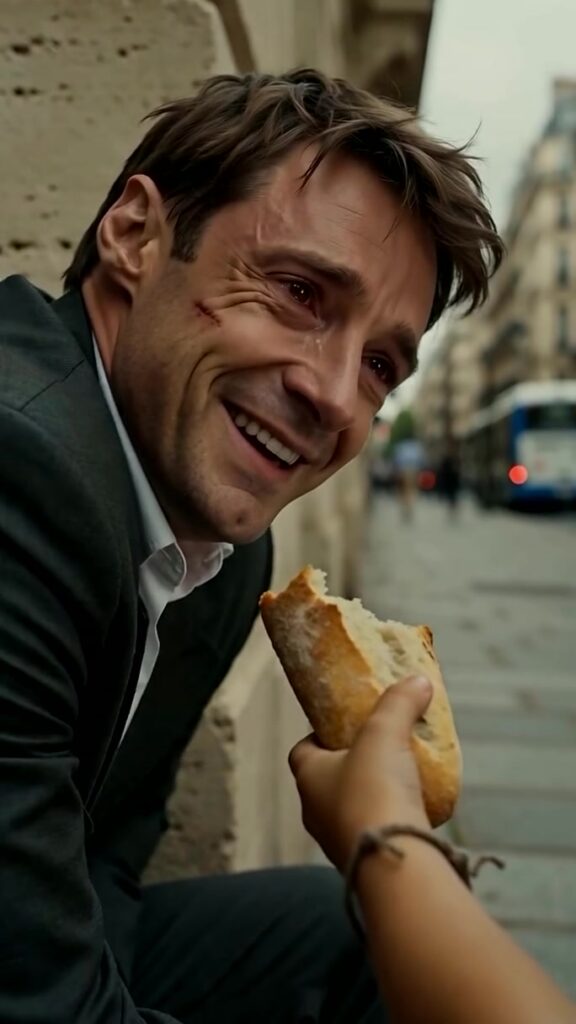
Adrian’s hand began to shake. He tried to still it by closing his fist, but the lighter’s cold weight only reminded him of everything it carried. It was ridiculous, really—how an object no bigger than a matchbox could turn a man’s stomach to water.
He looked from the lighter to the bracelet around the girl’s wrist, a thin band of braided leather threaded with a small charm—an enamel crescent moon with a chip in the blue. A charm he had seen once before, on a different wrist, in a different time. The same crescent, the same chip, like a bite mark left by history.
He looked back up at the girl, and then finally asked the question that had already begun answering itself inside him: “Who are you?”
Her lips parted. Her throat bobbed as if she were swallowing glass. “I—”
Then she froze.
The shift happened not in her face but in her gaze, sliding past him, anchoring on something over his shoulder. Her pupils narrowed, and her fingers clamped around Adrian’s sleeve with sudden strength.
Adrian turned.
Across the street, half-hidden beside a bus shelter, stood a woman in a dark coat watching them. Thin. Pale. Motionless. Her hair was pinned back the way it used to be, severe enough to make her cheekbones look like blades. The glass wall of the shelter reflected passing traffic over her body, as if the city were trying to erase her by layering motion on top of stillness.
And even from that distance, Adrian knew her.
Elena.
The name struck him with the force of a door slammed in a quiet house. He had spent eight years building a life with no rooms that opened onto her. Yet there she was, standing in plain daylight like a thought he hadn’t been able to kill.
The girl’s grip tightened until the seam of his jacket bit into his arm. “Don’t let her run again,” she said, the plea cracking at the edges. Not fear alone—something worse. The certainty of what happened when Elena was allowed to disappear.
Adrian’s mouth went dry. “Again?” he managed.
Elena’s eyes were on the lighter. Even from across the road, Adrian felt it, the way her attention fixed on it with hungry precision. For a moment she did not look at him, not at his face, not at the girl. She looked at the lighter as if it were a key, as if the world could be rearranged around it.
That lighter had once belonged to Adrian’s father—a man who smoked only when he lied. After the funeral, Elena had taken it without asking. She had laughed when Adrian confronted her, flicking it open and closed like a metronome. “You don’t know what you have,” she had said. “You never did.”
Then she had vanished. No note. No apology. No trace that could be held up under a lamp.
Until three weeks ago, when Adrian received a plain envelope with no return address. Inside: the lighter and a scrap of paper with a single sentence in Elena’s neat, merciless hand.
Keep it safe. She’ll come looking.
He had thought it was a taunt, a final cruelty. He had been wrong. The proof was trembling beside him, a girl with Elena’s eyes and Adrian’s own stubborn jawline.
“She said you’d keep it,” the girl murmured, as if reading his thoughts. Her voice had the practiced quiet of someone who had learned that volume could be punished. “She said you’d have it on you. That you wouldn’t be able to throw it away.”
“She?” Adrian asked, though his mind was already stacking possibilities like bricks. “Elena?”
The girl’s gaze flicked to the bracelet. “She gave me this when I was little. Said it meant I belonged to the night, that I’d never be alone.” Her laugh was small and broken. “I was alone anyway.”
A bus rolled between them and the shelter, briefly slicing Elena into fragments of reflected sky. When it cleared, Elena had stepped off the curb.
Adrian’s body moved before his thoughts caught up. He pulled the girl back a step, away from the open edge of the sidewalk, away from the easy path Elena was taking toward them. He didn’t know what he would do if Elena reached them—what words could possibly hold what had fermented in his chest for eight years.
“What’s your name?” he asked the girl, needing something solid, something he could speak into the chaos.
Her answer came like confession. “Mara.”
Mara. The name tasted familiar in a way that hurt. Adrian remembered Elena once murmuring it half-asleep, years ago, when the apartment still smelled like her perfume and coffee. He had asked who Mara was, and Elena had smiled without opening her eyes. “Someone I owe,” she had said.
Elena crossed the street without looking for cars, as if traffic would obey her. A horn blared. Tires hissed. The driver shouted. Elena never flinched. She walked straight through the danger like a ghost who knew she couldn’t be hit.
Adrian’s hand tightened around the lighter until the edges dug into his palm. Its hinge squeaked softly when his thumb brushed it. That small sound was enough to pull Elena’s gaze up at last.
Her eyes met Adrian’s. For a moment, something old and sharp flashed there—recognition, contempt, maybe even relief. She stopped a few steps away, close enough that Adrian could see the faint tremor at the corner of her mouth, the way her skin looked almost translucent in the washed-out daylight.
“You kept it,” Elena said.
Adrian could not stop himself. “Why did you send it back?”
Elena’s attention slid to Mara. The smallest muscle in her jaw clenched, as if the sight cost her more than she wanted to pay. “Because,” she said carefully, “I ran out of places to hide it.”
Mara made a sound—half gasp, half growl. “You told me he’d protect me.”
Elena’s eyes cooled. “I told you he’d be useful.”
The cruelty of it landed with a physical weight. Adrian felt it in his ribs. He saw Mara’s shoulders hunch as though bracing for a blow that didn’t come. Adrian moved without thinking, placing himself slightly in front of her, a shield formed too late but made anyway.
“You don’t get to talk to her like that,” he said, and the words surprised him with their steadiness.
Elena’s gaze returned to the lighter. “Hand it over, Adrian.”
“No,” he said.
Elena smiled—small, precise, almost pleased. “You don’t understand what it opens.”
“Then explain,” Adrian said, and he hated that his voice shook. Not from fear of Elena. From fear of the part of himself that still wanted answers badly enough to bargain.
Elena’s eyes flicked toward the bus shelter, toward the glass panel where a poster advertised some bright, impossible holiday. In the reflection, Adrian saw movement that wasn’t there before—someone lingering behind the shelter, another dark shape, a figure too still. His skin prickled.
“We don’t have time,” Elena said, and for the first time her mask cracked. Panic slipped through, thin as a knife. “They’re here.”
Mara’s fingers dug into Adrian’s sleeve again. “She’s lying,” she whispered. “Or she’s not. Either way, don’t give it to her. It’s what she wants. It’s what they all want.”
Adrian stared at the lighter, at its dull silver body. His father’s initials were engraved on the bottom, nearly worn away. The object felt suddenly less like a memory and more like a detonator.
He snapped it open.
The tiny wheel clicked under his thumb, and the sound was loud in his head, louder than the traffic, louder than Elena’s breath catching. The lid stayed open. Inside, where there should have been nothing but flint and wick, something glimmered—a sliver of glassy black, wedged where it didn’t belong. Adrian’s stomach dropped.
He hadn’t been carrying a lighter.
He’d been carrying a message.
Elena’s eyes widened, and all her control seemed to drain in an instant. “Close it,” she hissed.
Mara’s voice turned fierce. “Don’t.”
Adrian looked from Elena to Mara, from Mara to the street, to the shadow behind the bus shelter that shifted as if deciding whether to reveal itself. He felt the city’s indifference curdle into attention, as though unseen things had lifted their heads at the click of the hinge.
“Who are you?” he had asked Mara.
Now the question twisted and returned, aimed like a weapon at the woman who had once shared his bed and stolen his future.
“What did you put in this?” Adrian demanded.
Elena took a step forward, reaching—not for him, but for the lighter. Her hand shook too, not with weakness but with urgency. “Adrian, if you open it all the way—”
Behind them, glass at the bus shelter spidered suddenly, a delicate crack spreading without impact. The air seemed to lean inward.
Mara’s grip on Adrian’s sleeve became a desperate anchor. “Don’t let her run again,” she said, not as a plea this time, but as a command forged from survival.
Adrian closed his fingers around the lighter and stepped back, placing distance between Elena’s reaching hand and the metal that had already begun changing the day. His heart hammered, not with love, not with hatred, but with the terrible clarity of knowing that whatever happened next would divide his life into before and after.
“You’re not disappearing,” he told Elena. “Not today.”
Elena’s mouth opened—perhaps to threaten, perhaps to beg.
But before she could speak, the cracked glass behind them gave a sound like a sigh, and something on the other side started to press its shape against the world.
Adrian tightened his hold on the lighter, and the afternoon light turned suddenly colder, as if the sun itself had watched Elena approach and decided it didn’t want to be seen.