The air is now different—heavier. Charged. Dangerous. It has weight the way a storm does, the way a lie does when it finally meets the truth. In the back room of the St. Lorne VFW, the fluorescent lights buzzed with an anemic insistence, struggling against the dusk that pressed at the windows like a listening ear.
The camera in Margaret Halloway’s mind—always running, always documenting her mistakes—began its slow push forward through the frozen silence. The long folding table, the stacked metal chairs, the cheap plaque that said HONOR AND SERVICE: all of it felt suddenly staged, like props assembled for a reckoning.
The man in the tailored charcoal suit stepped into the center of the room as though he’d bought it with the rest of the town. His hair was slicked back, his cufflinks caught the light, and his smile had been manufactured for boardrooms and funerals alike. But it faltered now, not because he feared the men in leather along the walls—bikers who hadn’t moved since he arrived—rather because he could not find the familiar obedience in anyone’s eyes.
He took one measured step forward. His shoes clicked once, loud as a gunshot in the hush.
“You think this is some kind of joke?” he asked, voice polished, practiced. The words were meant to land like a verdict.
No one answered. The bikers remained statues, shoulders wide, faces unreadable. Leather vests and patched denim, rings like knuckle-dusters, boots with road grime still clinging to them. They watched him with a patient, almost tender stillness, as if giving him a moment to understand where he’d wandered.
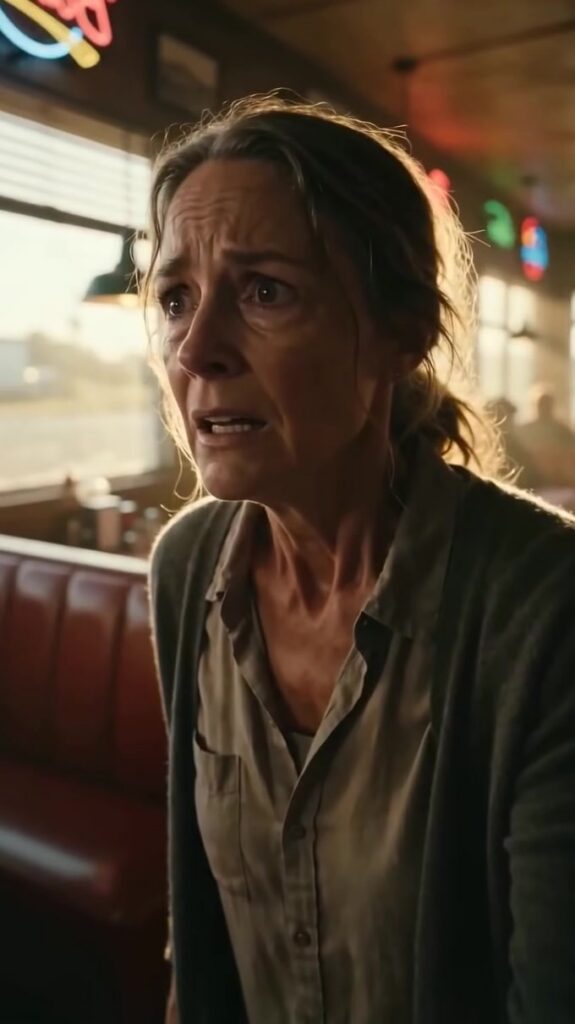
Margaret sat at the table with her hands folded, nails biting her palm. She was sixty-three, small-boned, and tired in a way that had nothing to do with age. She had been called here by a message that simply said, COME NOW. It had been signed with a symbol she hadn’t seen in twenty-seven years: a bear paw in black ink.
Then—movement, finally.
From the far corner, a tall shape stepped fully into the light, and the room’s temperature seemed to change. He was massive, built not like a man who lifted weights but like a man who had carried things that couldn’t be put down: engines, bodies, grief. His beard was iron-gray, his hair cut close, and his eyes held the calm of deep water where something dangerous lived.
Bear. They still called him that. It wasn’t a nickname; it was a recognition.
His voice was low, controlled, each word placed carefully as if he’d learned what language could cost. “You walked into the wrong family.”
Outside, as if the world had been waiting for that line, an engine turned over. Then another. The low rumble rose like a choir warming up. Through the cinderblock walls, it became a vibration you could feel in your teeth.
Margaret’s breath caught. Her chest tightened, and for a moment she couldn’t tell if it was fear or something else—a memory trying to crawl out from under the floorboards. She watched Bear’s face, searching for the boy she’d once known, the boy she’d left behind with a promise she hadn’t kept because surviving had required so many ugly choices.
Her lips parted. Her voice came out smaller than she intended. “…you actually remember me?”
In Bear’s eyes, a micro-flash: pain, recognition, the bruised astonishment of a wound being touched after decades. It was gone in an instant, replaced by a steadiness so absolute it felt like an oath.
The suited man glanced between them, and something in him adjusted—not belief, not empathy, but calculation. He had come expecting a frightened older woman and a few nostalgic sentimentalists. He had not come expecting gravity.
“This doesn’t have to get dramatic,” he said quickly, as though he’d always planned for civility. “Margaret and I have… unfinished business.”
Bear’s gaze didn’t leave him. “No,” Bear said, and the word struck the air like a door slamming. “You have a habit.”
The room shifted again, as though the building itself had leaned in. Soft chaos began: a chair leg scraped, a leather vest creaked, knuckles cracked—quiet, deliberate sounds of men standing. One by one, the bikers rose, not rushing, not crowding. They formed lines without instruction, a slow-moving wall assembling itself.
The camera in Margaret’s mind whip-tilted toward the door at the first shadow that crossed the frosted glass. More men entered in silence, faces wind-chapped, boots heavy. They didn’t speak. They didn’t need to. They filled the edges of the room like water finding every gap.
The suited man’s confidence broke the way thin ice breaks—sudden and irreversible. He took a half-step back, then another. His hands hovered near his sides, uncertain what to do without a microphone, without authority.
“I just came for her,” he muttered, as if saying it quietly might make it less monstrous.
Bear’s head tilted slightly, the motion of a predator considering distance. His voice turned colder, almost gentle. “Then you should’ve stayed away from her son.”
Margaret’s heart lurched. Her son. Ben. The last time she’d seen him, he’d been seventeen, angry and shaking, demanding to know why men in suits kept calling the house, why she flinched at every unknown car, why she’d burned letters in the sink at midnight. She’d sent him away to keep him safe. That was what she’d told herself.
The suited man blinked. “I don’t know what you think you—”
“You know exactly,” Bear cut in. His calm was worse than shouting; it meant he could choose when to stop being calm. “You sent people. You thought the road would swallow him. You thought the years would erase a face. But you forgot something.”
Bear’s eyes slid to Margaret for the briefest moment, and in that glance was a whole history: a cheap motel in 1997, blood on a bathroom tile, Margaret clutching a newborn while a younger Bear paced with a handgun and terror in his mouth. The promise he’d made then. The promise she’d broken when she disappeared with the child, leaving nothing but a false address and a note that said, DON’T LOOK.
“Family remembers,” Bear said.
Silence exploded—not with noise, but with the sudden absence of all pretense. The engines outside rumbled higher, as if the world itself had begun to growl.
Margaret’s tears formed, not from fear now, but from truth. She realized what the bear paw symbol had meant all along. Not a threat. A mark. A claim. A shield.
“Ben is…” she began, voice breaking.
“Ben is alive,” Bear said, and the words were a mercy and a blade. “He’s outside. Listening. Because he needed to hear it from your mouth.”
The suited man’s throat bobbed. “This is extortion,” he said, trying to reach for law like a weapon.
Bear nodded once. “No,” he replied. “This is an ending. You came to collect what you thought you owned. But you don’t own people. You don’t own the past.”
He took one step closer—not rushing, not threatening with posture alone, simply occupying space the way mountains do. The bikers tightened their line without a word. The room’s air grew heavier still, charged enough to spark.
Margaret stood on unsteady legs. She looked at the man in the suit—the ghost of every mistake she’d paid for in sleepless nights. Then she looked at Bear, and in him she saw the boy who’d once whispered, I’ll keep you safe, even as the world tried to chew them both up.
“I’m done running,” she said, surprising herself with the strength in her voice.
Bear didn’t smile. He didn’t soften. He simply turned his head toward the door, where the engines roared and the night waited. “Bring him in,” he said.
And as footsteps approached from beyond the wall of leather and steel, the suited man finally understood the most dangerous thing in the room wasn’t the fists, or the bikes, or even Bear’s controlled rage.
It was memory—alive, unburied, and walking back through the door.