He had everything—numbers that rose when other people’s lives sank, signatures that moved markets, favors owed like quiet debts. He wore control the way other men wore cologne: invisible, expensive, unmistakable when you came too close.
The park was an exception, a small patch of city-green where his driver waited by the curb and no one asked for anything. He came here because the air smelled like cut grass instead of bleach, because the benches didn’t care about quarterly reports, because his daughter liked the sound of pigeons beating their wings.
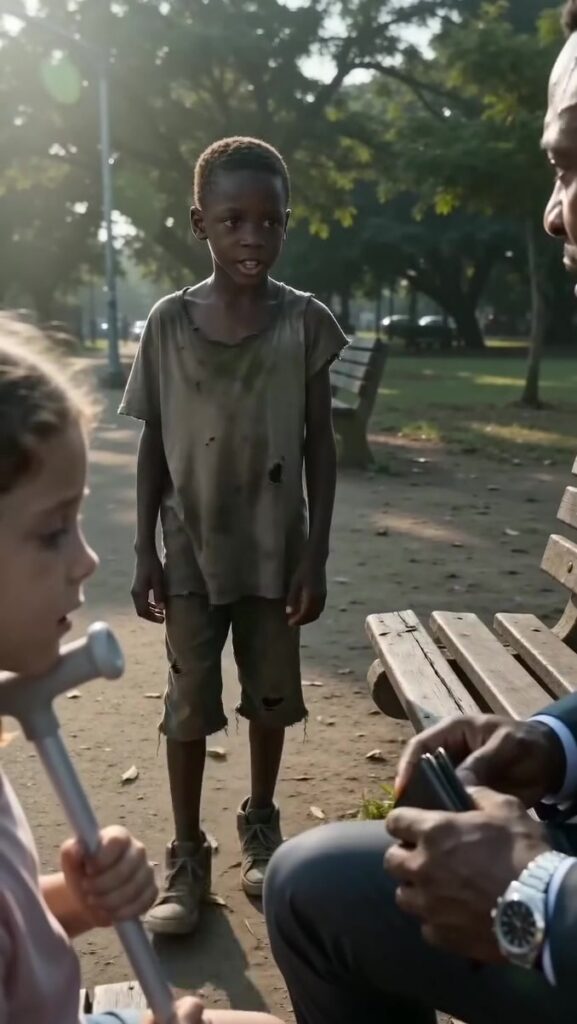
Elena sat beside him with her back straight, her small fingers wrapped around the handle of a white cane that looked too long for her. The cane had been painted with tiny stars by a nurse who tried to smile without pity. Elena’s eyes were open but unfocused, as if she were looking through the world rather than at it.
“Daddy,” she asked, her voice thin as tissue, “is it nighttime already?”
The question struck him like a slap. He kept his face still, practiced at stillness. “No, sweetheart,” he said, and tried to pour warmth into the lie. “Just clouds rolling in.”
Elena nodded as though she’d learned to accept weather she couldn’t verify. Her cane tapped the edge of the path—tap, tap—like a metronome keeping time for a life that had begun to drift off rhythm.
He watched a dog chase a ball, watched a couple argue silently with their hands, watched a man in a suit pretend he wasn’t checking the stock ticker on his phone. The world kept moving. His world had narrowed to doctors and scans and whispered consultations that always ended with the same careful phrases: degenerative, idiopathic, we’re doing everything we can.
And then he felt the shift—one of those changes that has no sound but changes the temperature of your skin.
A boy stood on the path a few feet away. Twelve, maybe thirteen. Too still, too composed for a kid in a park. He wasn’t holding a phone, wasn’t fidgeting, wasn’t looking around to see if anyone was watching. He was watching. Specifically, he was watching Elena.
The father’s irritation rose, automatic, defensive. Every stranger near his daughter felt like a threat. He reached into his jacket and pulled out his wallet, the move so practiced it might as well have been a reflex. Cash often solved what he didn’t want to think about.
“Not today,” he said, not looking up. “Go on.”
No footsteps retreated. No muttered thanks. Silence remained, stubborn as a locked door.
He lifted his eyes. The boy hadn’t moved. Up close, the kid’s face looked wrong—not monstrous, not scarred, just too intent, as if he carried a message that wouldn’t let him blink.
“You shouldn’t hand money to strangers,” the boy said quietly.
The father’s jaw tightened. “Then what do you want?”
The boy’s gaze flicked to Elena’s cane and then to Elena’s eyes, and the father had the irrational urge to cover her, to shield her from being seen. The boy’s voice dropped, careful and precise. “Your daughter isn’t sick.”
The words didn’t register at first. They bounced off the father’s mind like rain on glass. Then they sank in, heavy, impossible.
“What did you just say?” the father asked, and his voice was different now—thin, dangerous.
The boy took one step closer, close enough that the father could see a faint bruise along his collarbone, the kind that didn’t come from sports. “She’s not going blind,” he said. “Someone is taking her sight.”
The park seemed to dim. Even the dog’s barking felt far away, muffled. The father’s heart stuttered and then accelerated, slamming against his ribs as if trying to escape.
“That’s insane,” he hissed. He looked around for security, for his driver, for any adult who could make this boy disappear. “Who are you?”
“It doesn’t matter,” the boy replied. His eyes held something the father didn’t want to name: certainty. “You keep paying specialists. You keep buying the best words money can buy. And you never ask why it started the week after she came home from the clinic.”
The father’s mouth went dry. Elena’s clinic. The private facility his wife had insisted on, the one with the serene walls and the brochures about early intervention and hope.
“Stop talking,” he said, but there was no force behind it. The boy’s words were already inside him, changing the shape of everything.
The boy leaned in slightly, as if sharing a secret that might shatter under sunlight. “It’s your wife.”
For a moment, the father forgot to breathe. The world didn’t explode; it simply rewrote itself. His wife—Marina—laughing in the kitchen, Marina smoothing Elena’s hair, Marina sitting beside him at fundraisers with that perfect, practiced smile. Marina who had mourned every test result with him, who had told him they’d fight together, who had kept his life orderly when his anger wanted to break things.
He shook his head once, hard. “No,” he said, but it sounded like a plea. “No. My wife—”
“Ask her about the drops,” the boy said. “Ask her why the bottle is always in her purse, never in the medicine cabinet. Ask her why Elena’s eyes burn at night.”
Elena stirred beside him. Slowly, she turned her head, not toward the boy exactly, but toward the space where his voice came from. Her expression tightened, like an animal sensing a storm. “Daddy?” she asked, and the single word carried fear he’d never heard from her before.
The father’s hand closed around hers so tightly her small fingers flexed in surprise. “It’s okay,” he whispered, though he didn’t know if it was. He forced himself to look at the boy. “Why would she do that?”
The boy’s face did something like flinch, a brief crack in his composure. “Because she needs you blind,” he said, “and she can’t do that if you’re watching her.”
“That doesn’t make sense,” the father said, but it did, in a sickening way. Control wasn’t a thing he owned alone. Control was a currency in his marriage, traded in smiles and silences. Marina knew how to steer him. Marina knew how to soften his edges. Marina knew how to keep him busy.
The boy reached into his pocket and produced a crumpled receipt, the kind that comes with pharmacy purchases. He held it out like a piece of evidence in court. The father took it with fingers that had signed contracts worth billions, now trembling over cheap paper.
The receipt listed eye drops—an uncommon brand, a chemical name he didn’t recognize—purchased repeatedly, every few days, always in cash, always at different locations. The dates made a line through time, and that line began the same week Elena’s symptoms started.
The father’s stomach turned. He could hear his own pulse in his ears. He wanted to tear the paper, to tear the boy’s mouth shut, to tear reality back into the shape that was safe.
“How did you get this?” he demanded.
The boy’s eyes held his. “I was there,” he said. “Not for her. For someone else.”
“Someone else?” The father’s voice fractured. “What are you talking about?”
The boy glanced away for the first time, toward the playground where children swung and screamed with the careless joy of the unthreatened. “My little sister,” he said softly. “She used to ask if the lights were off when they weren’t.”
The father’s breath caught. The boy’s stillness made sense now—not calm, but grief frozen into a shape he could carry. “What happened to her?”
“She stopped asking questions,” the boy said. “And my mother stopped smiling.” He looked back at Elena, and something like urgency sharpened his voice. “You have time. I didn’t.”
The father’s mind raced, grabbing at details he’d dismissed: Marina insisting on giving Elena her drops personally, Marina discouraging him from attending certain appointments, Marina telling him to let her handle the medical bills because it was ‘easier.’ The way Marina’s gaze had lingered on his phone when he thought she was asleep. The sudden new locks on her study door. The prenuptial agreement she’d convinced him wasn’t necessary to revisit after the merger.
He had always believed he was the only one in the room who understood strategy.
He looked down at Elena. Her eyes were glossy, irritated; her lashes stuck together as if she’d been crying. “Does it burn?” he asked her, gently.
Elena hesitated, then nodded. “Sometimes. Mommy says it’s the medicine working.”
The father’s throat tightened until it hurt. He stared at the cane. At the small hands that had learned to navigate darkness that should never have been hers.
“Daddy?” Elena whispered again. “Are we in trouble?”
He tried to answer, but the words wouldn’t come. For the first time in his life, his money felt like paper. His power felt like theater. His control—his precious, relentless control—evaporated in the open air of a public park.
The boy stepped back. “If you confront her too soon, she’ll change the plan,” he warned. “She’ll make it look like an accident.”
The father’s head snapped up. “What plan?”
The boy’s face was bleak. “The one where you don’t get to take Elena away.”
The father stood so quickly the bench creaked. The world tilted. In the distance, his driver looked over, alerted by the movement. The father forced himself to breathe, to think. Think like the man who had built empires and broken rivals—not with fists, but with patience and proof.
He knelt in front of Elena, touching her cheek with a tenderness that felt like a vow. “Sweetheart,” he said, steadying his voice as if it were a bridge. “We’re going to go home soon. But first, we’re going to visit someone who will check your eyes without Mommy there. Okay?”
Elena’s brows knit. “Will Mommy be mad?”
He swallowed the rage and fear that tasted like metal. “Mommy won’t be mad,” he lied. “Mommy will understand.”
He turned to the boy, who was already retreating, melting back into the park’s ordinary motion as if he’d never been there. “Wait,” the father called, panic rising. “I need your name.”
The boy paused without turning fully. “Names don’t matter,” he said. “What matters is what you do with fifteen seconds.”
Then he was gone, swallowed by the crowd of strollers and joggers and laughing children, leaving the father holding a receipt like a weapon and a daughter’s hand like a lifeline.
He had come to the park to pretend the world was gentle. He left understanding that gentleness was a story people told when they didn’t know who was writing their ending.
As he guided Elena toward the waiting car, the clouds above the city thickened, and for the first time he couldn’t tell whether the light was fading—or whether someone had simply decided to turn it off.