The first thing Celeste Marrow noticed was the light—how it fractured through the glass cases and climbed the walls like water. The second thing she noticed was the grip on her arm.
“Miss, you can’t come back here,” a security guard snapped, dragging her past velvet ropes and glossy displays. The soles of her shoes skidded across marble so polished it reflected her face in broken flashes: hair loose, cheeks flushed, eyes bright with the kind of panic that looks like guilt if you want it to.
It was early evening at Argent & Vale, the kind of store that smelled of orchids and money. A handful of clients turned, clutching champagne flutes and tiny branded bags. A woman in a beige coat covered her mouth as if a scandal were contagious.
“I’m not stealing,” Celeste said, breathless. “I’m not—please. I just need to speak to him.”
At the far end of the showroom, beneath a chandelier that seemed to float like a frozen firework, a man in a charcoal suit turned at the commotion. His hair was perfect, his posture calm, his expression mild in the way that made people relax around him. Reed Halloway.
Reed had the kind of face that belonged on charity gala invitations. People trusted him instinctively—the soft smile, the expensive restraint. He was also, if the whispers were true, engaged.
Celeste felt the room narrow to him, the way a throat narrows around an unspoken word.
“Reed,” she called. “Reed, please.”
He didn’t flinch at the sound of his name. He took one measured step forward, then another, as if the store were a stage and he knew precisely where the spotlight would land. Beside him stood a woman whose dress looked poured on, pale gold against her skin—Sloane Avery. The future bride. Her fingers were curled around Reed’s arm like a claim.
“Stop,” Reed said quietly, not to the guard but to Celeste. He didn’t raise his voice. He didn’t have to. “You’re making a scene.”
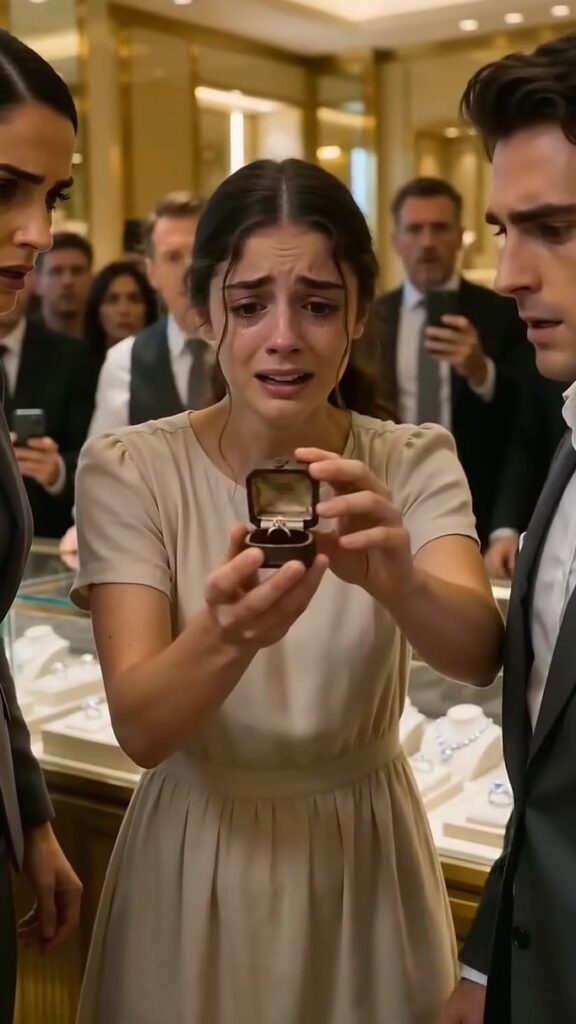
Celeste swallowed. Her left hand was clenched around something small and battered, the only thing she’d brought into this cathedral of newness: an old ring box, its edges cracked, its hinge partially sprung. Once, it had been burgundy velvet. Now it was faded like dried blood.
“I’m not here for money,” she said. “I’m here for the truth.”
A murmur rippled through the room, thin and eager. In luxury stores, people came to buy silence—polished stones, clean lines, no story attached. A woman being dragged in with an antique ring box was the kind of story that got whispered into watches and cufflinks.
Reed’s smile tightened at the corners. “She’s been contacting me,” he said to the store manager, a severe woman with a sleek bob and a tablet held to her chest. “Threatening to expose private information unless I pay her. It’s blackmail.”
There it was—an accusation cleanly delivered, with just enough disappointment to make it believable.
Sloane’s eyes widened, then narrowed. “I knew it,” she whispered, loud enough for the front row of onlookers. “I knew someone was trying to ruin us.”
Celeste felt the words hit her like cold water. Blackmail. The kind of label that made strangers lean back from you. The guard’s grip tightened, emboldened by Reed’s calm certainty.
“No,” Celeste said. “No. He’s lying.”
Reed’s gaze flicked to the ring box in her hand, then away. It was the smallest movement, but it carried something sharp underneath, like a blade flashing beneath a sleeve.
“Celeste,” Reed said, as if they were old friends and she was simply unwell, “go home. Don’t do this to yourself.”
That was his trick: to make her look unstable. A messy woman in an immaculate room. A story that ended with security escorting her out and everyone returning to their purchases with a new anecdote to tell over dinner.
Celeste drew a breath that trembled in her ribs. She raised the ring box in both hands like an offering and a weapon. “I’m not leaving,” she said, louder now. “Not until you look at this.”
“Take it from her,” Reed said, still composed.
The guard reached for the box. Celeste jerked back. The hinge squeaked, threatening to spill its secret before she was ready, and the sound cut through the showroom like a nail dragged down glass.
“Don’t touch it,” she said. “You don’t get to touch it.”
A small crowd had formed now—customers, a pair of associates in black, even a jeweler stepping out from the back with a loupe still looped around his neck. Phones were half-lifted, pretending not to record while recording anyway.
Celeste looked straight at Reed. “This ring was buried with my mother,” she said.
The words changed the air. Not because they were dramatic—though they were—but because they were specific. Real. Heavy.
Reed’s throat moved. His eyes fixed on the box again, and this time he couldn’t hide the reaction. A flicker of recognition. A tightening at the jaw.
Sloane frowned. “What does that even mean?”
Celeste’s fingers pried the box open.
At first, it looked like a ring—an old gold band, dull with age, set with a stone that wasn’t a diamond, not even a gem anyone would brag about. But it had presence, the way artifacts do. Something in it belonged to another life.
The room fell quiet in the strange way crowds do when they sense a moment crossing into something irreversible.
Then Celeste tipped the box slightly, and what everyone had assumed was the lining lifted. It wasn’t fabric at all. It was paper, carefully folded, compressed by years of hiding. A thin strip, the edges darkened, the ink faded but legible.
She used her thumbnail to tease it free. The paper resisted like a held breath, then came away.
“Read it,” Reed said quickly, voice suddenly sharper. “Whatever game you’re playing—”
“It’s not a game.” Celeste unfolded the strip with slow care. Her hands steadied as if the paper itself anchored her. “It’s a name.”
The jeweler took an involuntary step forward, as though instinct pulled him toward anything old and valuable. The manager leaned in, tablet forgotten. Even the guard’s grip loosened.
Celeste held the paper up so the nearest people could see. In neat handwriting, there were dates, a hospital name, and one line underlined twice.
REED HALLOWAY — BIRTH NAME: REIDAN VOSS.
A sound went through the crowd—not quite a gasp, not quite a whisper. A ripple of recognition among the well-connected. Voss was an old family name, but not one said fondly. It belonged in court records and charity scandals, in the kind of articles scrubbed from the internet if you paid enough.
Sloane stared at the paper as if it had grown teeth. “No,” she said. “That’s not—Reed’s father died in—”
“In prison,” Celeste said, and it hurt to speak it, like pressing on a bruise. “For fraud. For taking money from widows and pension funds. For disappearing people’s savings and calling it a ‘restructuring.’”
Reed’s face had gone almost blank. Too blank. A mask lowered in a hurry.
“You don’t understand,” he said, voice low, urgent, meant for her alone. “We can talk. Not here.”
“We did talk,” Celeste said. “I wrote you. I called you. You ignored me until it was inconvenient.”
She looked around the showroom, at the people who had been ready to believe the easiest story about her. “My mother cleaned houses,” Celeste continued. “She cleaned for the Voss family when I was little. She used to come home with her hands raw from bleach, and she would still braid my hair and tell me I deserved a life that wasn’t borrowed.”
Her throat tightened, but she pushed through. “She saw things she wasn’t supposed to see. Papers. Names. Transfers. She told your father she was going to report it. Two weeks later, she was hit by a car on a rainy night. The driver was never found.”
The store felt colder. The chandelier’s light seemed harsher, suddenly clinical.
“That’s insane,” Reed said, but his eyes had gone glassy with calculation, not outrage. “You’re accusing me of murder?”
“I’m accusing you of being exactly who you are,” Celeste said. “A man who changes his name and buys new suits and pretends the past can’t reach him.”
Sloane’s grip on Reed’s arm loosened, her face blanching. “Reed,” she whispered. “Tell me that isn’t true. Tell me your name isn’t—”
He didn’t look at her. He looked at the paper, then at the ring, as if measuring the weight of evidence versus the weight of charm.
Celeste lifted the ring between finger and thumb. “My mother kept this because she took it from a drawer in the Voss house the night she decided she would speak. She told me it was insurance. She told me if anything happened to her, I would find the box.”
She swallowed hard. “I found it after the funeral, hidden in the hem of her coat. And inside was this. Your old name. Your true name. The name you buried with her.”
The manager’s voice came out thin. “Mr. Halloway… is this correct?”
Reed’s mouth opened, then closed. In that pause, the room made its choice. People didn’t need a confession to smell one. They stepped away from him, subtly at first—an inch, a foot—creating space the way water parts around something toxic.
Celeste felt, for the first time in years, that she was not being dragged. She was standing.
Reed’s smile returned, but it was wrong now—too practiced, too late. “Sloane,” he began, turning to her as if she were still his shield.
Sloane backed away, her hand flying to her throat. The diamond on her finger caught the chandelier light and flashed like an alarm.
“Don’t,” she said. “Just—don’t.”
Celeste placed the unfolded paper back into the box with care, as though tucking a child into bed. Then she looked at Reed and let her voice drop into something steady and final.
“You called me a blackmailer,” she said. “But all I brought was what you left in the ground. And I’m not here for your money, Reed. I’m here to make sure you never get to pretend my mother didn’t exist.”
Outside, sirens began to rise—distant, uncertain, becoming real. Someone had finally made a call. The store’s perfect calm cracked like glass under stress, and in the fracture, Celeste saw fear bloom across Reed’s face for the first time.
He had built his life on the assumption that graves stayed closed.
Celeste tightened her grip on the broken ring box, and as the crowd watched him with new eyes, she understood something her mother had tried to teach her long ago: even the richest rooms have corners where truth can hide—until someone is brave enough to open the box.