The father had learned to hate false hope the way some men learned to hate the sea: slowly, by being dragged under too many times. Hope had a particular sound when it collapsed—like the soft snap of a promise nobody intended to keep. It lived in hospital corridors and charity pamphlets, in well-meaning strangers who leaned toward his daughter as if pity were a currency that could buy her back her legs.
He hated the careful phrases. The bright-eyed “There’s always something new in trials,” spoken by people who didn’t have to carry a child from bed to bath. He hated miracle stories delivered like prayer requests, the kind that ended with a smile and a request for patience. He hated the way his daughter, Mara, pretended she believed them for other people’s sake, then cried into her pillow when the house went quiet.
And he hated—most of all—the look on her face when she heard someone promise her a future and she dared, for one reckless second, to imagine it.
That look was what made him cruel.
They were on the way home from physical therapy when the boy stepped into their path. The afternoon had the gray, late-season weight of rain that couldn’t commit to falling. The sidewalk was narrowed by construction fencing; the ramp down to the street had been blocked by a careless pallet. Mara’s wheelchair wheels clicked and snagged over uneven pavement, and he was already angry at the world’s constant refusal to make room for her.
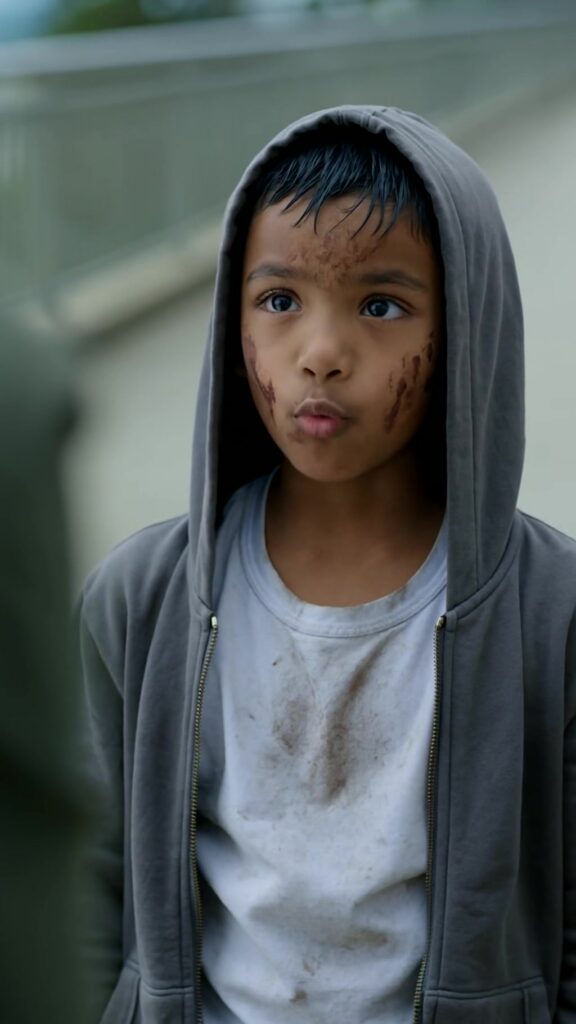
The boy looked like he’d been slept on by life. Torn hoodie, dirt smudged across one cheek, sneakers eaten at the toes. His eyes were steady though—too steady, like they had already seen the worst part and didn’t expect surprise anymore.
He didn’t ask for money. He didn’t apologize for stopping them. He just said, in a voice that carried no performative gentleness, “I can make her walk again.”
The father’s body went cold so fast he felt it in his teeth. Instinct moved him between the boy and the chair, one hand gripping the wheelchair handles as if someone might snatch Mara away. “Stay away from my daughter.”
The boy didn’t flinch. No retreat, no bargaining, no offended bravado. His calm was infuriating. “I’m not here to hurt her,” he said.
“Doctors couldn’t do it,” the father snapped, heat rising to cover the cold. “Surgeons. Therapists. People who didn’t learn medicine from the street. And you think you can?”
Mara had been watching the boy’s face, not with fear but with something the father couldn’t name at first. Her lips parted, and her fingers tightened around the armrests until the knuckles blanched. Recognition—yes, that was it. Like a song you haven’t heard in years but still know the chorus.
A tear slipped down her cheek. The father saw it and felt anger sharpen into something protective and desperate. “Mara, don’t,” he warned, as if she were stepping toward a cliff.
The boy swallowed once. “Your mother told me this would happen,” he said.
The words hit the walkway like a dropped plate. For a moment there was no sound except the distant hiss of tires on wet asphalt. The father’s breath stalled. His wife had been dead for three years, buried under a stone that he visited often enough to wear a path in the grass.
“Don’t say her,” he whispered, and then louder, shaking, “Don’t use her name.”
The boy reached into the pocket of his hoodie. The father’s muscles bunched, ready to shove, to strike, to do whatever it took to stop the next cruelty. But the boy’s hand came out holding something small that caught the dull daylight: a silver charm shaped like a music note, its chain broken, one link twisted as if it had been pulled too hard.
The father’s vision tunneled. He knew that charm. He had watched his wife, Elena, rub it absentmindedly when she was thinking, the way some people worry a ring. She’d worn it on the night of the accident, the night the road slicked with sudden rain and the truck ran the red light and their world split into before and after.
“Where did you get that?” he demanded. His voice didn’t sound like his own; it sounded like a stranger trying to keep himself from screaming.
The boy’s fingers trembled around the charm. “She gave it to me,” he said. “Not… not the way you’re thinking. She—” He hesitated, then looked past the father to Mara, as if asking permission to continue. “She said if I ever found you, I had to ask what was hidden under the wheelchair seat.”
Mara’s breath caught. She made a small sound, half sob, half laugh, the kind grief drags from the lungs without asking. “Dad,” she whispered. “Wait.”
The father stared at his daughter. “Mara, honey, don’t let—”
“Please.” Her eyes were wet but fierce. “Just… check.”
He wanted to argue. He wanted to crush the charm under his shoe and chase the boy away with his rage. But Mara’s gaze held him. It was the same gaze she’d had as a toddler when she insisted on climbing a staircase alone: terrified, determined, begging to be trusted.
His hands moved as if controlled by someone else. He knelt behind the wheelchair, heart hammering, fingers searching the underside of the seat cushion. He found the strap first, then the seam, then something taped flat against the frame—hidden where no casual glance would ever notice. The tape was old, yellowed. He peeled it back slowly, hearing his own breathing like a storm in his ears.
A slim envelope slid into his palm. His name was written across it in Elena’s handwriting—sharp loops, the kind she’d used to label lunch bags and holiday cards. His throat closed so tight it hurt.
Mara leaned forward. “Dad?”
He opened it with a trembling thumb. Inside were three things: a folded letter, a small key, and a photograph already creased from being carried. The photograph showed Elena in a hospital bed, face pale, eyes shining with a fierce, urgent love. Her wrist—his breath snagged—wore a band with a patient number. Beside her, half in frame, was a boy with wide, startled eyes and a bruise blooming along his jaw. The same eyes as the boy standing on the sidewalk now.
The father looked up slowly. The boy’s expression had softened, grief pressing lines into his young face. “She didn’t want you to find me like this,” the boy said quietly. “But she didn’t want me to disappear either.”
The father’s hands shook so hard the letter rattled. “Who are you?” he managed.
“Cal,” the boy said. “My name is Cal.” He swallowed, as if the next words were stones. “She… she said I was your son.”
The world narrowed again, but this time it wasn’t anger—it was the vertigo of a truth you didn’t know you were missing. The father’s mouth opened and closed. Elena had been pregnant once before Mara, he remembered suddenly, a loss early on, a silent grief they never named out loud. He remembered her one spring growing quiet after volunteering at the hospital, coming home with eyes too bright, saying only, “Some stories don’t end when we think they do.”
His gaze dropped to the letter. Mara’s fingers had crept to his sleeve, clutching him like an anchor. He unfolded the paper, and Elena’s words rushed up at him from the page—curved ink, familiar as her voice in his ear.
He couldn’t read it all at first; the lines swam. But one sentence rose clear, brutal, and tender: If you ever start to believe the world can’t surprise you with anything but pain, remember that I hid this because I needed you to live long enough to open it.
He pressed the letter to his chest. It felt like being struck and held at the same time.
Cal’s eyes flicked to Mara. “I didn’t come to sell you a miracle,” he said. “I hate those, too.” His voice cracked on the last word, and the father realized he wasn’t calm because he didn’t care—he was calm because he’d already practiced being rejected. “She told me there’s a place where the past is stored. Not… not magic. Records. Evidence. Something you didn’t see that night. She said it mattered. She said it could help.”
“Help her walk?” the father asked, bitterness trying to crawl back into his throat, familiar as a wound you can’t stop touching.
Cal shook his head once. “Not like that.” He looked at Mara as if speaking to her was the only honest thing left. “She said you deserved the truth about why it happened the way it did. She said the driver wasn’t the whole story. She said there was someone else.”
Mara’s tears fell steadily now, but her face was brighter, as if a locked door inside her had finally clicked open. “Dad,” she said, “it’s not hope if it’s the truth.”
The father stared at the small key in his palm. It was old brass, stamped with a number. A locker key, maybe. A storage unit. A safety deposit box. Elena’s final hand reaching forward from the past, not promising miracles—only answers, and a son he never knew existed, standing in the rain with dirt on his face and his mother’s charm trembling in his fingers.
False hope had always asked him to believe in things that asked nothing from the world. This felt different. This asked him to move, to open something, to face what he’d avoided because grief was heavy and questions were heavier.
He rose slowly and stepped aside, no longer shielding Mara from Cal but making room for him. His voice came out rough and raw. “Where’s the place?”
Cal exhaled, like he’d been holding his breath for years. “I know how to get there,” he said. “But I need you to come with me. Both of you.”
The father looked down at Mara. Her hands were still on the armrests, but she wasn’t gripping them like prison bars anymore. She was holding herself steady like someone about to roll forward into a world that had changed shape.
He nodded once, and in that small motion he felt something unfamiliar stretch inside him—not a promise, not a cure, not a stranger’s pity. Something harder. Something earned. The possibility that the story he’d been living wasn’t finished, and that Elena’s last act had never been to leave them with hope, but with a door.
And for the first time in three years, he was willing to open it.