The teller almost didn’t look at him. The morning line had the usual shape—people with pressed collars and tight mouths, a woman tapping her nails against a leather folder, a contractor smelling faintly of rain and drywall. The bank’s marble floor reflected the chandelier like a polished lake. Under that glow, a boy in a faded denim jacket was a smudge of ordinary.
He stood too still for a child and too quiet for anyone who wasn’t hiding. His hair was damp at the fringe as if he’d run through mist and then decided, mid-stride, to stop being a boy. When the next customer stepped away, the teller—Graham Voss—shifted his practiced smile toward him without letting his eyes fully land.
“Next,” Graham said, already reaching for a deposit slip.
The boy didn’t move closer until Graham lifted his gaze. Their eyes met and something in Graham’s stomach tightened, like a knot remembering how to be tied. The boy’s face wasn’t familiar; it couldn’t be. But his stare was composed in a way that made Graham feel judged, as if the child had arrived with an appointment Graham had forgotten.
“What can I do for you?” Graham asked, crisp, professional. He tried to keep the impatience out of it and failed.
The boy didn’t answer. He leaned forward, braced both hands on the counter, and hoisted a canvas sack onto the marble. The sound wasn’t the soft thump of schoolbooks or gym shoes. It was the hard, dense landing of weight that belonged in a safe or buried under floorboards. The nearest customer glanced over. The security guard by the glass doors straightened without fully committing to attention.
Graham’s fingers paused above the keyboard. He felt the bank’s air shift—more oxygen drawn, less exhaled. “What is that?” he said.
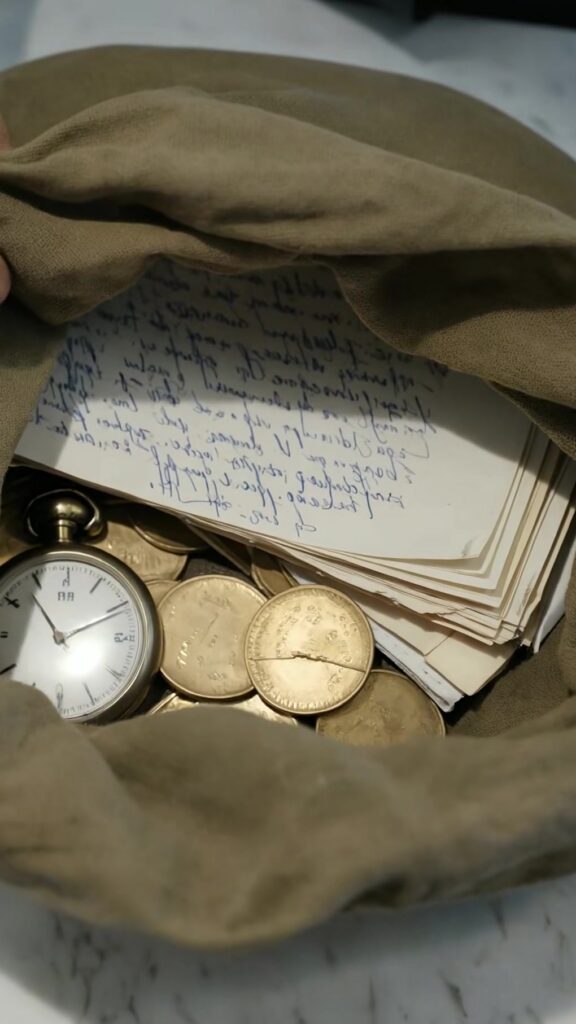
The boy’s hands worked the frayed drawstring with deliberate care. When the mouth of the bag opened, the smell of old paper rose—dust, ink, something faintly metallic. He tipped it enough for Graham to see the contents without spilling them. A stack of handwritten documents bound by twine. A scatter of heavy coins the size of silver dollars, but yellow and dull with age. And on top, as if placed there to command the eye, an antique pocket watch with an engraved lid and a chain worn smooth where fingers had worried it.
Graham’s breath caught. His polite mask didn’t slip so much as shatter. He had seen that watch once before, and only once, yet it returned in his mind with the clarity of a flashbulb: after-hours, the lobby lights lowered, the echoing footsteps of a man who wasn’t a customer and didn’t intend to be. The watch had clicked open and shut in the man’s palm like a metronome counting down Graham’s courage.
Graham had been younger then, a junior clerk kept late to reconcile ledgers. He remembered the man’s coat—dark, water-spotted—as if he’d stepped out of a storm. He remembered the false name spoken with an accent that didn’t belong to any place Graham could name. He remembered being told, gently, that a safety deposit box would be rented tonight, immediately, and that paperwork could be corrected later. And he remembered looking at the watch, not for its beauty but because it was the only part of that night that seemed ordinary enough to hold on to.
Now it lay on his counter in front of a child.
“Where did you get these?” Graham asked, though his voice had turned thin.
The boy finally spoke. His voice was steady, too low for his age. “They were my dad’s,” he said. “He said if something happened, I should bring them here. He said you would know.”
Graham’s hands went cold. The boy’s eyes were a brown so dark they looked black in the lobby light. Graham couldn’t stop searching the boy’s face for echoes of a man he hadn’t allowed himself to remember. The jawline was different. The nose smaller. But the gaze—the calm, the weight behind it—was the same gaze that had once watched Graham sign a form with shaking fingers.
Graham’s chair rolled back an inch as his knees bumped it, and he forced himself to sit properly again, to pretend this was an ordinary transaction. He reached for the documents, but his fingertips hovered, as if the ink might bite. “What is your father’s name?” he asked, then realized he didn’t want the answer spoken aloud.
The boy shook his head once. “He told me not to say it here.”
Graham swallowed. He glanced toward the guard, then to the cameras perched like small black birds at the ceiling corners. Twenty years ago there had been no cameras in the back corridor near the vault. That had not been an accident. Nothing about that night had been an accident.
He drew one page from the stack and read the top line. The letters were faded but legible, the kind of script taught by stern teachers and used by men who expected their words to outlast them. The header made Graham’s stomach drop. It was a company name that had officially dissolved—on paper, in newspapers, in the bank’s own sanitized records. A name attached to a disappearance that had turned into a rumor and then into a silence so thick it became policy.
Graham heard the branch manager’s voice from years ago: Leave it. Certain accounts are not to be discussed. Certain boxes do not exist. Certain nights never happened.
The coins slid slightly when the boy adjusted the bag, and one of them rolled just enough for Graham to see an imprint: a crest, worn but unmistakable. Not minted for commerce. Struck as proof. A token of membership. A payment for a debt.
“Did your father tell you anything else?” Graham asked, keeping his voice low. He leaned forward as if discussing overdraft fees, but his heart was hammering with the frantic energy of a man who has stepped onto a familiar road only to realize it leads to the edge of a cliff.
The boy nodded. He reached into his jacket pocket and pulled out a folded note. The paper was creased so many times it looked tired. He placed it on the counter between them like a chess move.
Graham unfolded it with care, each motion measured, as if haste would set off an alarm. A single sentence had been written in heavy strokes, the letters pressed deep. Graham read it once, then again, because his mind refused to accept what his eyes had already seen.
If my son is standing in front of you, it means they found me before I could reach the vault.
Graham’s face went numb. The word they had no name and needed none. In the years after that night, there had been whispers—about men in suits who used the bank’s private elevator, about polite phone calls that turned into career-ending demotions, about a colleague who asked the wrong question and then, quietly, moved away and never answered messages again. Graham had survived by learning when to stop seeing things.
But here was a boy who had brought seeing back into the world.
“How long ago?” Graham managed.
“Yesterday,” the boy said. “He didn’t come home. And someone came to our apartment while I was at school. They were inside when I got back. I left out the back stairwell.” He said it without dramatics, as if reading a grocery list, but his fingers gripped the strap of the canvas sack until his knuckles lightened.
Graham’s eyes flicked to the guard again. The guard was pretending to watch the street. Graham could see the subtle set of his shoulders, the way he leaned his weight to one foot—ready to move if asked, ready to misunderstand if told the wrong story.
Graham leaned closer. “Listen to me,” he said softly. “I’m going to do exactly what your father told you I’d do. But you have to do exactly what I tell you next.”
The boy didn’t blink. “Okay.”
Graham slid the watch toward himself with a motion that looked casual to anyone watching, then palmed it beneath the counter where his fingers could feel the familiar engraving. It was warmer than it should have been. Like it had been carried against a pulse.
He opened his computer not to the customer interface but to a screen no teller was supposed to access without management credentials. His hands moved on memory. He had hated himself for remembering, for never fully forgetting the sequence of keys. Beneath the standard accounts and ordinary boxes there was a layer of the system that didn’t show up on audits. A catalog of ghosts.
He typed the false name from twenty years ago. He expected an error. He expected a locked warning. Instead, a single record appeared, as if the bank had been waiting, patient as stone, for the return of what it had swallowed.
Box 8C-13: ACTIVE. STATUS: HOLD FOR VERIFICATION.
Verification. Graham’s fingers tightened. His throat felt full of cotton. He glanced at the boy and saw, for the first time, something flicker behind his calm—an ache of fear, held down with sheer willpower. Not the fear of a child lost in a bank, but the fear of someone who knows he has been hunted and is counting minutes like heartbeats.
Graham closed the screen. He forced his face back into a neutral expression and raised his voice just enough to be normal. “I’m going to have a supervisor assist you,” he said, as if this were about the bag’s contents being unusual but not dangerous. He picked up his phone under the counter and dialed an internal extension that hadn’t been used in years.
It rang once. Twice.
A voice answered, old and careful. “Voss,” it said. Not a question. A recognition.
Graham’s mouth went dry. “There’s… a minor at my station,” he said, letting the code words do their work. “He brought something that belongs in a private room.” He glanced at the watch hidden beneath his hand. “And he brought a message.”
Silence stretched, thick as velvet, then the voice said, “Do not move him to the back corridor.”
Graham’s stomach turned. “Why?”
“Because the corridor is where they’ll be waiting,” the voice replied. “Stay where the cameras can see you. And whatever you do, do not open the bag again.”
Graham looked up. Through the glass doors, a dark sedan had just pulled into the curb lane and stopped. Two men stepped out, neither of them hurried, both of them dressed in the kind of neat anonymity that made them forgettable until you realized you were the thing they had come for. One of them glanced at the bank’s sign with the bored look of a man checking a schedule. The other lifted his eyes to the lobby, and Graham felt the gaze like a finger pressing against his spine.
Graham’s hand closed around the hidden watch. He stared at the boy, and the boy stared back, quiet as a held breath.
“Your father was right,” Graham whispered, barely moving his lips. “You came to the one place that remembers.”
Outside, the men started toward the doors, and the bank’s polished calm became, in Graham’s mind, a stage just before the curtain rises—every light in place, every exit suddenly important, and every second heavy enough to be its own kind of currency.
Graham swallowed, kept his smile pinned to his face like a fragile badge, and said, loud enough for anyone to hear, “Just one moment, please.”
Then, under the counter, he clicked the antique watch open—and listened for the sound his memory insisted it would make, the sound that had haunted him for two decades: a second hand moving, yes, but also something else. A faint, hidden latch. A promise inside metal.
As the sedan’s men reached for the door handles, the watch’s lid shifted in Graham’s palm, and he felt, unmistakably, the edge of a folded strip of paper tucked into a compartment he’d never known was there.
Graham’s heart lurched. The boy’s father hadn’t only left a warning. He’d left an escape route—if Graham was brave enough to take it.
Graham met the boy’s eyes one more time and made his decision before the doors could open.