The street had a way of grinding names off people. It wore them down until they were only shapes moving through dust and heat, only shadows hunting shade. The buildings leaned like exhausted men, their paint long surrendered to sun and soot. And she fit into it the way a cracked cup fits the palm—useful, overlooked, and held together by habit.
Everyone called her Mera, though she could no longer remember if that had been her name first or only what remained of it. She cooked from a cart that had once belonged to someone else, a squat stove bolted to scrap wood, its legs uneven on the broken pavement. Her apron was a map of past meals: oil stains, smoke scars, a dark splash where she once cut herself and kept stirring anyway. Her hands were rough, nails short, fingertips toughened by years of heat and cheap knives.
And still, whenever the boys arrived, her face softened as if it remembered a gentler life. Three of them, always in the same order: the tall one with his shoulders squared too early; the middle one who scanned the world like it was always trying to steal from him; and the smallest, whose hunger lived in his bones and made his limbs tremble even when he stood still. They sat on the curb with the careful posture of children who had learned not to take up space, as if the city might charge them rent for air.
Mera noticed everything. She noticed the bravado that tasted like fear in the oldest boy’s jokes. She noticed the way the second boy wrapped half his bread in a rag and hid it in his shirt without meeting her eyes. She noticed the smallest boy’s hands that day—shaking so badly the spoon tapped against the tin bowl, clinking like a tiny bell announcing his weakness to the street.
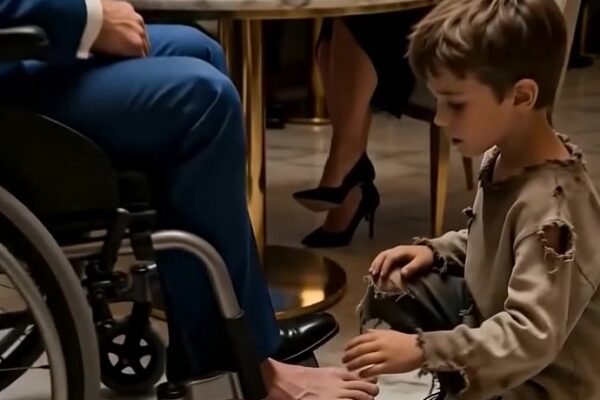
Without a word, she placed her own spoon in his palm. It was bent at the handle from some long-ago accident, cheap metal that had survived more days than it deserved. He tried to lift it. His wrist wavered. The stew slid back down with every attempt, humiliation pooling at the corners of his mouth. Something inside Mera tightened—a familiar ache, the kind adults carried when they had once been children and had promised themselves they would never watch another child lose a battle with food.
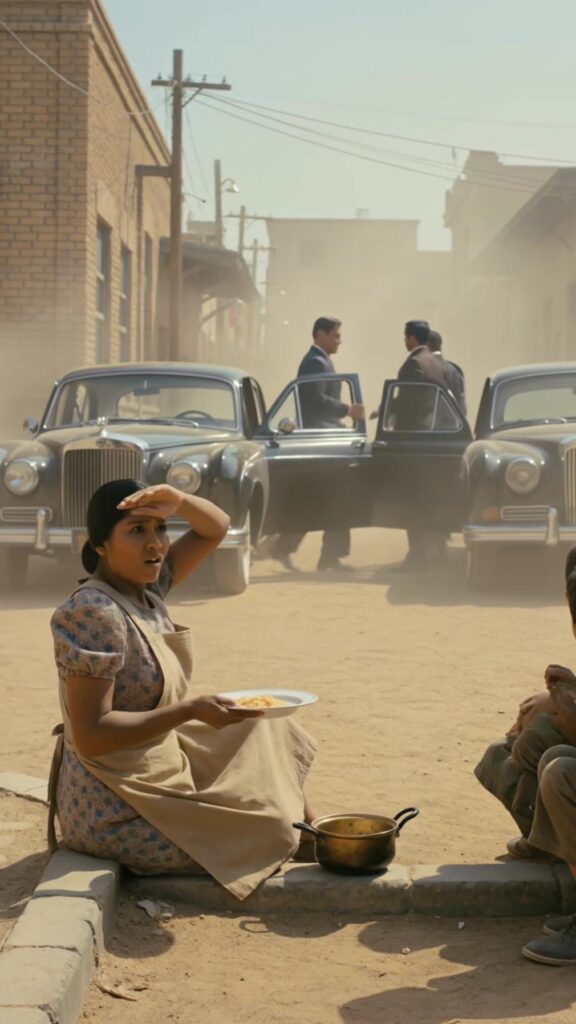
She set down her own plate in front of him, the one she used when the cart closed and she ate whatever was left. “Eat,” she said, voice flat because softness was expensive. The boys ate like tomorrow was a rumor. The oldest swallowed too fast; the middle one chewed as if he was afraid the meal would be snatched away mid-bite; the smallest clutched the bent spoon with both hands and finally got a mouthful down. Mera watched them with a sadness that had matured past tears.
Then came the sound that did not belong. Engines—smooth, deep, arrogant—rolling down her defeated street as if it were a runway. Two black vintage cars broke through the dust and stopped hard behind her cart. For a heartbeat the neighborhood held its breath. The boys froze with food still in their mouths, eyes wide, bodies ready to bolt.
Doors opened. Three men stepped out, suits tailored sharp enough to cut. They moved like people who were accustomed to being obeyed, their calm a kind of weapon. Mera’s hand closed around the serving spoon at her stove, the nearest thing she had to a defense. She stood between the curb and the boys the way a thin wall stands between fire and wood.
“Who are you?” she demanded, her voice steady only because fear had lived with her too long to startle her now.
The man in the center did not answer immediately. He held out his hand. In his palm lay an old bent spoon—cheap, worn, twisted at the handle. Mera’s breath snagged as if the air had turned to cloth. She knew that spoon. She had lost it years ago. Lost it the same night the boys vanished.
“You gave me this,” the man said softly, and the words landed with the weight of truth. “When my hands couldn’t hold anything.” He lifted his gaze to hers. Not at her apron, not at the stains or the tired lines, but at her eyes as if he had been looking for them his whole life.
The smallest boy—no, the smallest boy grown tall—stepped closer. His eyes were the same, but steadier now, carrying the kind of control that came from surviving rooms worse than this street. Behind him, the other two men watched with a fierce restraint, as if emotion was something they had learned to handle carefully, like hot metal.
Mera’s lips parted. No sound came. She saw, suddenly, three thin faces layered beneath three adult ones: the brave act, the hidden bread, the shaking hands. Her knees weakened, and she gripped the cart’s edge.
“We never forgot you,” the man with the spoon said. “Not the food. Not the way you stood in front of us when men came looking. Not the way you used your own plate as if your hunger was less important than ours.”
One of the other men turned toward the cars and nodded once. The trunks opened. Mera flinched—her mind already filling them with the things the poor were always taught to expect from the powerful. But inside were crates of food, sealed boxes of medicine, bundles of blankets, and a locked leather case that looked too expensive to be near her cart at all.
She stared, confused and trembling. “Why?” she managed, the word raw in her throat. “Why come back now?”
The man’s jaw tightened. He looked down at the bent spoon as if it were a key that could open a door he had kept nailed shut. “Because before we give you anything,” he said, voice lowering, “we owe you the part of the story we buried.”
He took a breath, and Mera saw in that simple motion a memory pulling him backward. “The night we disappeared,” he continued, “we didn’t run because we wanted to. Men were coming—men you’d already chased away twice with nothing but your voice and a ladle. You told us to hide behind the water barrels. We did.” His eyes glossed, not with weakness but with anger that had nowhere to go. “We heard them asking for you. We heard them say your name like a threat.”
The oldest man—once the boy who pretended to be fearless—spoke then, his voice rough. “We saw you hand them a sack,” he said. “Coins you didn’t have. You bought us time with money you needed to live.”
Mera’s throat tightened. She remembered that night like a bruise. The men had called themselves collectors, claiming she owed a debt from a husband who’d died and left only problems. They’d promised to take the boys, not because the boys belonged to her—none of them truly did—but because hunger made children easy to steal.
“After they left,” the man with the spoon said, “we tried to run back to you. But the middle one—” he nodded at the man beside him, “—saw someone watching from the alley. A truck. The same men. They’d waited.” His fingers curled, white at the knuckles. “We fought. We were small. They took us anyway.”
The second man’s eyes were dark, steady. “We told ourselves you’d come,” he said. “But then we were moved. Sold. Renamed. Placed in a house that taught us how to survive by becoming useful to people who liked to own things.” He glanced away, shame flashing like a knife. “We learned skills. We learned violence. We learned how power works.”
Mera’s heart hammered as if it wanted to break out of her ribs. “And the spoon?” she whispered.
The man with the spoon looked at it as if it were sacred. “It fell from my pocket when they dragged me,” he said. “I found it later in the truck. I kept it. It reminded me that there was a world where someone gave without taking. It reminded me there was a woman on a ruined street who treated hunger like a child you could soothe.” He lifted his gaze again. “It saved something in me.”
He gestured toward the open trunks. “We built ourselves into men they couldn’t throw away. We took back what was taken from us. Not cleanly,” he admitted, and the honesty made the air sharper. “Not without blood on our hands. But we got free.” His voice steadied. “And we spent years looking for you. Streets change. People disappear. But this spoon stayed the same, and so did the memory of your face when you gave it to me.”
Mera stood in the dust, her serving spoon hanging at her side, unable to decide whether to cry or strike them for leaving her with a silence that lasted years. “So what now?” she asked, because she had survived by asking practical questions. “You bring food and blankets and think it balances the scales?”
The oldest man shook his head. “No,” he said. “We bring it because people here are hungry. Because this street is still tired. Because you shouldn’t have had to carry all of it alone.” He nodded toward the locked leather case. “And because we’re not here only to repay you.”
The man with the spoon stepped closer, gentle in a way that looked strange on a man dressed like a storm. “We’re here to tell you the rest,” he said. “The part we couldn’t risk saying in letters. The part about who owned us.” His eyes narrowed toward the end of the street, scanning shadows that might be listening. “Those men who took us never forgot you either, Mera. They kept your name like a loose thread. And lately, they’ve started pulling.”
He placed the bent spoon on her cart, beside the pot that still steamed. The metal clicked softly, a sound small enough to be missed, yet loud enough to change the room of her life. “We came back,” he said, “not just to give. We came back to stand in front of you this time.”
Mera looked at the three men, then at the boys on the curb who were watching with frightened awe, and finally at the spoon—her old, stubborn piece of metal that had traveled through darkness and returned like a witness. For the first time in years, her chest filled with something heavier than hunger.
“Then tell me,” she said, voice low and steady as a simmering pot, “what’s coming.”