The first laugh was the sharpest because it came from someone who didn’t even bother to look up.
It started as a snicker behind a flute of champagne, then spread like spilled liquor across the chandelier-lit lobby of the Marroway Hotel. People turned their faces the way they turned away from puddles on the sidewalk—reflexive, practiced, offended by the reminder that the world had corners where comfort didn’t reach.
The boy stood at the center of it, small in a coat that hung like it belonged to an older brother who’d vanished. Soot lived in the lines of his hands. His hair had the rough, wind-tossed look of someone who never knew where he’d sleep. The marble under his shoes was so polished it reflected him back—an unwanted smudge interrupting the lobby’s perfection.
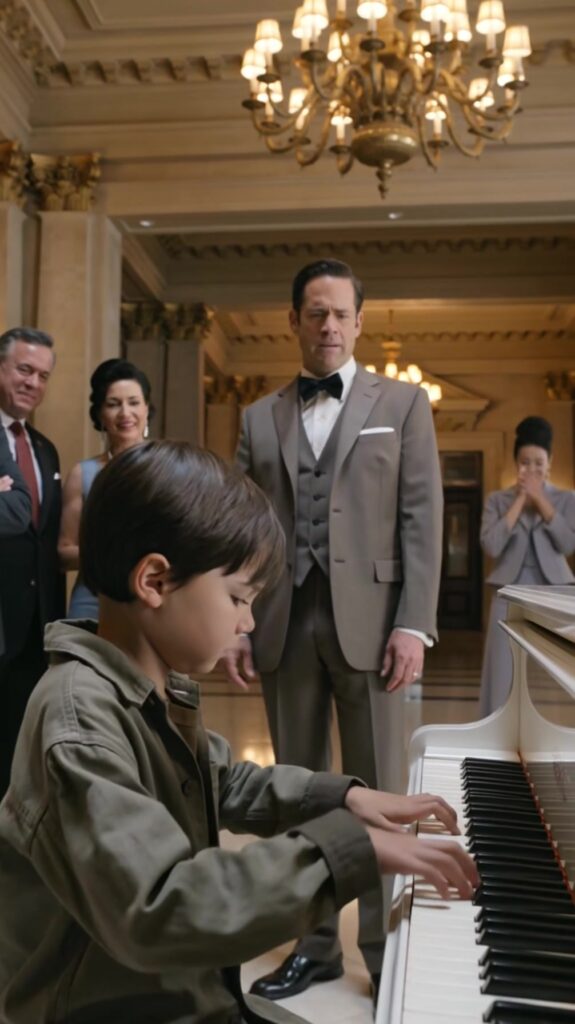
At the far end, the grand piano sat like a black animal at rest, its lid raised, its surface slick with the reflections of gold light. Guests drifted around it as if it were part of the décor, like a fountain or a painting that belonged to nobody and therefore to everyone.
A man in an ash-gray suit stood near the bar, the sort of man whose cufflinks had likely never been touched by human worry. His hair was ironed into place. His watch was the kind that didn’t simply tell time but announced it. He lifted his glass as if delivering a toast to the whole room, and his smile landed on the boy with the ease of a boot pressing down on a cigarette.
“Play something,” he said, voice loud enough to be heard over the clink of silverware and the soft murmur of expensive conversations. “One song. If you impress me, maybe you won’t sleep under a bridge tonight.”
A ripple of laughter followed, thin and polite, the kind that pretended it was harmless because it was shared.
Near the staircase, a woman in a dark dress shifted her gaze to the ornate carpet, as though she could pretend she hadn’t heard. A bellboy froze halfway through adjusting a guest’s luggage cart. The pianist who usually played evenings at the Marroway—an older man with tired eyes—stood back as if the boy’s presence had pushed him into the shadows.
The boy didn’t argue. He didn’t beg. He didn’t even glare. He moved with a quietness that made the lobby’s laughter seem suddenly too loud, too eager.
He climbed onto the bench. His feet barely brushed the floor, toes searching for leverage. For a breath, he sat still, facing the keys as though listening to something that wasn’t yet sound.
Someone raised a phone, expecting a spectacle. Someone else whispered a joke. The rich man’s glass caught the chandelier light and flashed like a blade.
Then the boy lowered his hands.
The first notes were so gentle they seemed accidental—like the piano had sighed. The melody drifted out into the lobby as if it had been hiding inside the instrument all along, waiting for the correct touch to wake it. It wasn’t flashy. It wasn’t the kind of piece meant to show off. It was something older than performance, something that remembered.
The laughter faltered.
The sound grew, not louder so much as fuller, as if the music were building a room inside the room. The notes braided together with aching care, fragile and sure at once. There was a pause that felt like a held breath, and then a chord that turned the air thick and bright, as though the chandelier light had become audible.
Forks stopped midair. Conversations thinned to silence. The lobby’s constant motion—waiters gliding, guests strolling, money circulating—stuttered and stalled.
The rich man’s smile fell away as if it had been wiped clean. His eyes narrowed first with irritation, then with something colder, something that came from a place where confidence could not follow.
He took a slow step toward the piano.
Then another.
Color drained from his face. His glass lowered without him noticing.
Because the melody, for all its beauty, carried a shape that wasn’t simply musical. It was a memory with edges. It was a tune that didn’t belong in this lobby, among chandeliers and polished marble. It belonged to a different night, years ago, when the air had smelled of rain and panic and the future collapsing.
He had heard it only once before.
On the night his child vanished.
His lips parted, and a sound escaped him—half whisper, half confession. “No…” The word trembled as if it might break. “That song—”
The boy didn’t look up. His face was blank, but not empty. It was the stillness of someone holding a door shut against a storm. His fingers moved with a precision too clean for someone who had learned on the streets. He played as if the piano were not a luxury but a weapon he had carried for years, waiting for the right moment to draw it.
The rich man stopped a few feet away, staring at the boy’s hands as though they were proof of a crime. His voice cracked again, lower now, meant for no one but himself and the music. “That song was never written down.”
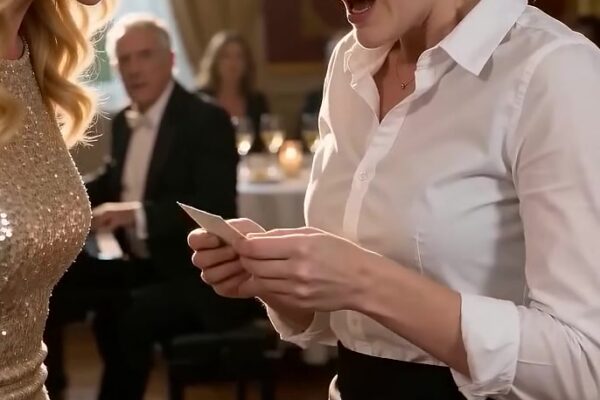
In the blurred distance, near a table set with white roses, the rich man’s wife gripped the edge of the linen so hard her knuckles bleached white. Her smile, worn all evening like jewelry, slipped. Her eyes were fixed on the boy with the terror of recognition—recognition not of a face, but of a consequence finally arriving.
The man noticed her. He followed the line of her gaze, then looked back to the boy. His breathing grew shallow. A small shake moved through his jaw, the first crack in a life built on controlled expressions.
The melody climbed toward its end, delicate as a thread pulled tight. It circled back on itself, repeating a phrase that felt like a name spoken softly over a sleeping child. Then the boy struck the final chord and let it ring until it thinned into the high ceiling and disappeared.
No one applauded. No one dared to move. Even the chandelier seemed quieter.
The boy lifted his hands from the keys and sat for a moment, as if listening to the silence he had created. Then he raised his eyes.
They were not the eyes of someone asking for pity. They were the eyes of someone who had learned that pity was just another kind of hunger.
He looked at the rich man and spoke with a calm that made the words heavier than any shout. “Then ask your wife,” he said, “why my mother was buried with your family ring.”
The glass slipped from the rich man’s fingers. It struck the marble and shattered, the sound startlingly loud in the stunned lobby. Clear shards skittered like ice across the floor, catching light in sharp flashes.
The wife recoiled as if the words had struck her physically. She took one step back, then another, heel catching on the edge of a carpet. Her hand went to her throat, fingers trembling at the base of her pearl necklace.
“He was never supposed to find you,” she whispered.
The sentence didn’t belong in this room, yet it fit too perfectly. It settled over the guests like dust falling after a collapse. The bellboy’s lips parted. The woman by the staircase pressed a hand to her mouth, eyes wide. Somewhere near the bar, someone’s phone screen dimmed, forgotten.
The rich man stared at his wife, then back at the boy, as if trying to decide which of them was the stranger. His mouth moved soundlessly before words finally formed, raw and disbelieving. “Find—”
The boy slid off the bench. Up close he was even smaller, but the lobby now seemed to arrange itself around him, obeying his gravity. He stood beside the piano, one hand resting lightly on its glossy edge as if it were a gravestone.
“You offered me one night indoors,” he said. “I didn’t come for that.”
He turned his palm upward. In it lay a ring, dull gold worn smooth on the underside, the kind of piece passed down with stories attached to it like chains. For a second the chandelier light caught it, and the room saw what it meant: proof. A promise broken. A history someone had tried to bury.
The rich man swayed, the way people do when their bodies realize something before their minds can accept it. “Where did you—”
“From the earth,” the boy replied, voice steady as the last note he’d played. “From the place you thought no one would dig.”
The wife made a small, strangled sound, and her eyes darted around the lobby as if searching for an exit that hadn’t existed all along. Guards near the entrance shifted, uncertain, looking toward the rich man for instructions. But he couldn’t seem to command anything—not his staff, not his face, not the world that had just rewritten itself in front of him.
The boy’s gaze didn’t waver. It held the man like a verdict.
Outside the revolving doors, traffic moved and city lights blinked, indifferent. Inside, under chandeliers and wealth, the air felt thin. The music was gone, but its shape remained, hanging like a question no one could swallow.
And in that unbearable pause, the Marroway Hotel—so used to polishing away imperfections—was forced to watch as the stain it had mocked began to speak its name.