The first snow had started as a polite dusting and then turned mean, the way winter always did when it sensed celebration. By the time the limousines lined the curb, the city was a blur of headlights and ice. Inside the wedding hall, though, everything looked untouched by weather—crystal chandeliers throwing prismatic light, linen so white it seemed to glow, and an aisle framed with arches of roses that smelled like expensive promises.
People arrived in layers of velvet and fur, carrying their laughter like an accessory. This was not just a wedding. It was an announcement. The groom’s family owned half the skyline. The bride’s family owned the other half. Wealth was in the walls, in the polished marble, in the musicians hired from a conservatory whose name alone was a ticket to status.
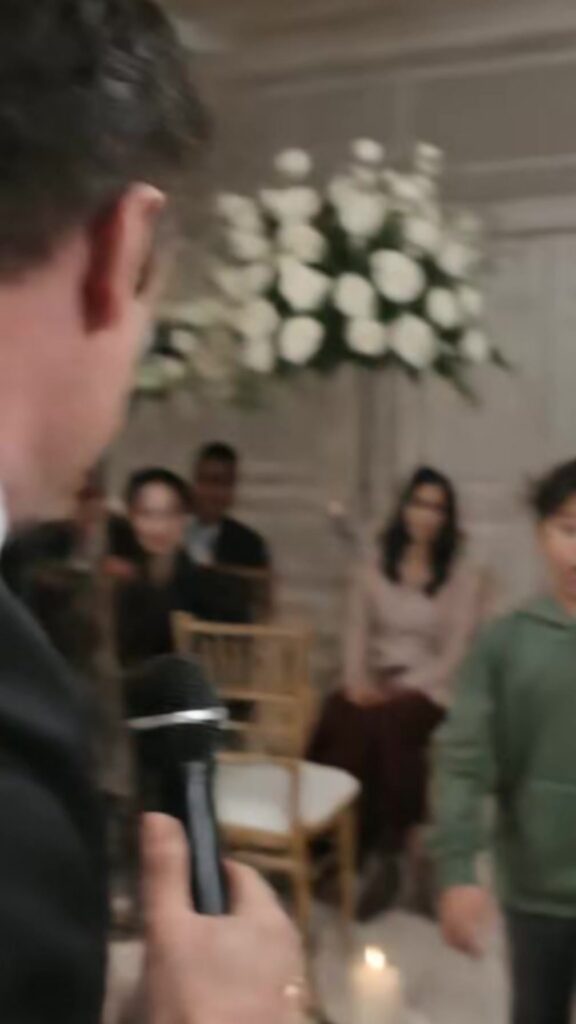
Yet the room never quite warmed. Not because of the cold outside, but because of the man standing near the flowered arch with a microphone in his hands. Alistair Rowe looked as though he had aged ten years since the last time most of these guests had seen him. His suit fit perfectly, but it could not hide the tremor in his shoulders. Beside him, a small girl clutched his sleeve with both hands. Her dress was pale blue, the color of winter sky just before dusk, and she held onto him as if gravity itself might be taken away.
The wedding planner had begged Alistair not to speak. Tonight was meant to be about the bride and groom. But Alistair had insisted. “I owe her,” he’d said, and no one had pressed him for a name. In the end, there was a compromise: he would speak before the vows, briefly, and then step back into the crowd like any other guest. A clean moment in a choreographed night.
When the music lowered, the hall quieted with a collective obedience. Alistair raised the microphone. His fingers were white around it. A few heads turned toward his daughter, Cecily, because everyone knew she hadn’t made a sound in nearly a year. Some had heard rumors—some cruel, some sympathetic. That she was stubborn. That she’d been spoiled. That a physician had tried hypnosis. That a priest had tried prayer. That Alistair had flown her to clinics where the walls were painted like cartoons, as if color could coax words out of her.
But the truth was simpler and worse: Cecily had been the last to see her mother alive.
It had happened here, in this hall, before the roses had been replaced and the chandeliers cleaned. A year ago the place had been dressed for a different wedding—another alliance, another contract disguised as romance. Alistair’s wife, Miriam, had been one of the patrons, the kind of woman who could command a room without raising her voice. She’d taken Cecily by the hand and led her toward the dressing rooms to fix a fallen ribbon. They were gone for no more than minutes. Then someone screamed. Miriam was on the floor, her pearl necklace scattered like spilled teeth, her eyes fixed on a point above everyone’s heads. The official explanation was sudden failure of the heart—tragic, unpredictable, nobody’s fault. But Cecily had stared at the flowers and swallowed her voice so completely it seemed to vanish from her body.
Alistair lifted the microphone closer, as if he feared the silence might steal it. “My daughter hasn’t spoken since that night,” he said, and his voice carried to every corner, skimming over crystal and silk. “I’ve tried doctors and time and every bargain a desperate man can think of.” He looked down at Cecily, and for a moment his expression slipped into raw pleading. “If anyone can bring her back to me—if anyone can make her speak—I will give everything I have.”
Gasps moved through the crowd like a drafted breeze. People who prided themselves on restraint couldn’t help it; even the musicians lowered their instruments as if the sentence had stolen their cue. Alistair’s words were obscene in their vulnerability. Money in that room was a weapon, a shield, a language. To offer it like an alms was to admit it could not do what love should.
Cecily’s small hands tightened on his sleeve. Her eyes were wet, but no sob came. She looked toward the flowered arch with a strange concentration, as if the roses were whispering something she couldn’t translate.
That was when the boy appeared at the far end of the aisle.
He was alone, without a parent in sight, and his clothes were wrong for the place. A green hoodie, damp at the shoulders from snow, and sneakers that left small dark prints on the runner. For a moment, the guests assumed he was a delivery kid who had wandered in by mistake. An usher started forward. But the boy didn’t hesitate. He walked with the steady confidence of someone who had already pictured the room and memorized the distance.
He stopped in front of Alistair and Cecily beneath the chandelier’s cold light. Up close, his face was too sharp for his age, his eyes too knowing. He didn’t glance at the roses or the guests. He looked only at Cecily.
“I can help her,” he said.
The simplicity of it angered Alistair instantly. Grief often becomes fury when it’s brushed by hope. “Get away from her,” he snapped, voice cracking on the edge of a shout. “You have no idea what you’re talking about.”
The boy didn’t flinch. “I do,” he said quietly. “I was here.”
Something in the hall shifted—attention tightening, like a rope pulled taut. Alistair’s mouth opened for another rebuke, but Cecily’s head moved, just a fraction, toward the boy. Her gaze found his as if it had been searching for it for months.
He reached into the front pocket of his hoodie and pulled out a small object wrapped in tissue. He held it out to Cecily without stepping closer. “You dropped this,” he said. “That night.”
Cecily stared. The tissue unwrapped itself in her mind before her fingers ever touched it. A tiny silver charm—an enamel bird with one wing slightly chipped. Miriam had worn it on a bracelet, a private joke between mother and daughter because Cecily used to insist birds could talk if you listened long enough.
Her lips parted. The room leaned forward in a shared, unspoken hunger. Alistair’s breath caught so hard it sounded like a sob.
The boy waited, patient as a judge.
Cecily made a sound—thin, frayed, like a thread pulled from fabric. It wasn’t a word yet, but it was a voice. She swallowed, her throat working as though speech was a foreign mechanism. Then, with the charm shaking in her small palm, she forced the first syllable into the air: “M—”
Alistair dropped to one knee so fast his suit pants creased. “Ceci,” he whispered, and it was both her name and a prayer.
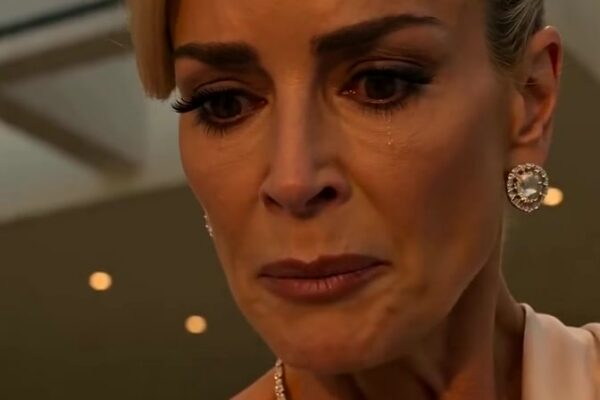
Cecily blinked hard, and tears rolled down without noise. She looked at the boy again, as if the shape of his face was a key, and something inside her unlocked not because she was brave, but because she was tired of carrying the secret alone.
“Mom… didn’t fall,” she managed, the words scraped raw from a throat that had forgotten how to form them. The shock in the room became physical; several guests recoiled as though the air had turned to glass. Cecily’s voice trembled but did not vanish. “Someone… pushed her.”
Alistair went rigid. His eyes flicked to the roses, to the arch, to the polished floor where a year ago pearls had scattered. “Who?” he asked, and the question held an entire year of denial.
Cecily’s gaze slipped past him, past the boy, toward the front row where the wedding party sat poised like statues. There, among satin and diamonds, the bride’s aunt—an influential woman with a smile like a sealed envelope—kept her hands folded neatly in her lap. She did not move, but the muscle at her jaw twitched.
The boy’s voice cut through the swelling murmur. “She thought Miriam was going to stop the deal,” he said, still calm, as if he had rehearsed the truth until it no longer shook him. “I saw her grab her arm near the flower stand. I tried to tell someone, but they pushed me out. Told me to disappear.”
Alistair stared at the aunt, and the room felt suddenly smaller, as if the walls had inched closer to trap them with the revelation. “You,” he said, not loudly, but with a deadly certainty that made the word heavier than shouting.
The aunt rose slowly, the smile gone. “This is insanity,” she began, but the hall was no longer hers to command. The guests who had been silent out of politeness were silent now out of fear. Phones appeared in hands like weapons. The musicians sat frozen, their instruments abandoned.
Cecily tightened her grip on her father’s sleeve again, but this time it was not to keep him from leaving. It was to keep herself from falling. Her second breath was steadier. “She told me to run,” Cecily said, and in the saying, she reclaimed the moment that had been stolen from her. “She told me… to be loud.”
Alistair’s face crumpled, grief breaking and reforming into something else—rage sharpened by purpose. He pulled Cecily into his arms, careful not to crush her, and looked up at the sea of wealthy witnesses who had believed a convenient story. “You heard her,” he said. “All of you heard her.”
Outside, snow continued to fall, indifferent. Inside, in front of the flowers that had once framed a lie, a child’s voice returned and turned the night inside out. And the most painful moment of the wedding was not a toast gone wrong or a lover’s regret. It was the sound of truth finally spoken—soft, small, and impossible to take back.