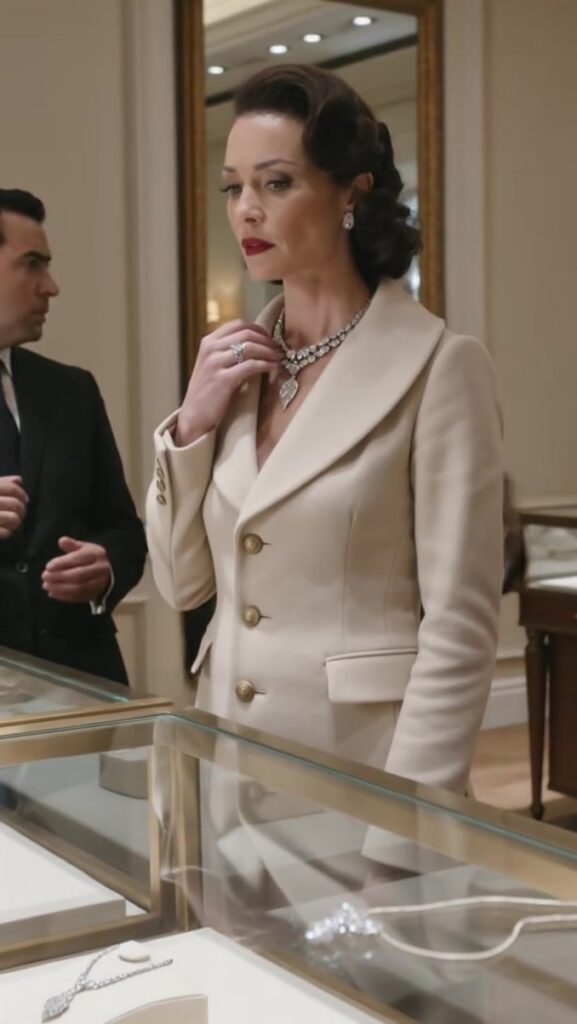
The jewelry boutique was quiet, polished, and impossibly expensive. Silence here wasn’t an accident—it was curated, padded into the carpets and stitched into the velvet chairs. Crystal chandeliers scattered cold light across glass counters until every diamond looked like a captured star. Even the air seemed filtered, sweet with gardenia and money.
Women drifted between displays like swans: wrists heavy with bracelets, throats bare as if waiting for coronation. Near the wall of mirrors, a woman in a pearl-colored suit admired herself with the absent, practiced confidence of someone who had never had to ask. A necklace lay against her skin: a warm antique gold chain holding a pendant shaped like a tear—opal in the center, haloed by tiny garnets so dark they looked almost black.
She tilted her chin, watching the opal flash blue in the chandelier light, as if it had always belonged to her.
Then the door flew open.
The bell didn’t chime so much as cry out, a thin, startled sound that didn’t belong. A tired woman stepped inside, shoulders pulled tight against the world as if she’d forgotten how to take up space. She wore no perfume, only the sharp weather clinging to her coat, and she walked straight to the main counter like a person following a line she’d drawn in her mind.
She slammed an old necklace onto the glass.
The sound cracked through the boutique—too loud, too raw, a violence of truth in a room built for softness. The necklace looked wrong on the pristine surface: tarnished links, a pendant dulled by years, the opal cloudy as milk, the garnets chipped at their edges like bitten nails.
Every head turned. Even the saleswoman with a clipboard forgot to smile.
The tired woman’s voice shook, but it carried.
“Tell her to stop wearing what was buried with my mother.”
For a moment, the boutique held its breath. The elegant woman by the mirrors went completely still, her fingers flying to her throat. Her nails were manicured to a pale pink, delicate as shells, and they pressed against the pendant as though to hide it inside her.
“Ma’am,” a saleswoman began, too quickly. Panic fluttered in her eyes. “There must be some misunderstanding—”
“I watched them close the coffin,” the tired woman cut in, stepping closer, grief burning through her exhaustion like a live wire. “I watched the lid lower. I watched the dirt fall. That necklace was on her neck. She asked me—before she couldn’t talk anymore—to make sure it stayed with her.”
Whispers moved through the boutique, subtle at first and then spreading like spilled ink. Someone murmured a name—someone else’s, not the tired woman’s—and the syllables carried the weight of headlines.
The rich woman turned slowly. Her face had drained to a careful pale, but her posture stayed upright, defiant by habit.
“You’re insane,” she said softly. It wasn’t cruel. It was worse—dismissive, as if madness were merely an inconvenience she could step around. “This piece came from a private collection. It was purchased legally.”
The tired woman’s hands clenched at her sides. “Legally,” she repeated, like tasting something bitter. “Is that what you call taking from the dead?”
“Security,” the saleswoman whispered into a hidden earpiece, voice trembling. Another employee hovered near a phone, uncertain whether to call the police or a manager.
Before anyone could decide, a door behind the counter swung open and an elderly jeweler hurried out, drawn by the fracture in the boutique’s hush. He was small, shoulders bent by decades of careful work, and he wore a loupe on a chain like a priest wears a symbol of office. His hands were stained faintly with polish, the permanent shadows of craft.
“What is this?” he asked, but his eyes had already fixed on the old necklace on the counter. He reached for it as though he couldn’t help himself.
The tired woman didn’t flinch when he touched it. “That belonged to my mother,” she said, quieter now, the fight still in her but tangled with fear. “It went into the ground with her.”
The jeweler lifted the chain carefully, as if it might snap from being looked at. Then he looked past it—to the pendant at the rich woman’s throat. His breath hitched. He stepped closer, and the sales staff backed away instinctively, making space for whatever was about to be revealed.
He raised his loupe, peering at the clasp of the old necklace. Then at the clasp of the one around the rich woman’s neck. He leaned in, closer, until his white eyebrows nearly brushed the woman’s skin.
All color drained from his face.
His fingers began to shake so badly the loupe clicked against the metal.
“Impossible,” he whispered, as if the word might undo what he saw. “This hidden marking…”
The rich woman’s confidence faltered. “What are you doing?”
The jeweler didn’t answer her. He lowered the loupe and looked at the tired woman as if seeing her for the first time. “This marking was custom-made,” he said, voice broken, “for only one family.”
The boutique seemed to narrow, walls inching inward. Even the chandeliers felt suddenly heavy, like they were watching.
The rich woman swallowed. Slowly, with a motion that looked rehearsed in her mind but never practiced in real life, she unclasped the necklace and let it fall into her palm. She stared at it as if it had grown teeth.
The tired woman stepped closer, tears filling her eyes until the lights fractured into halos. “Then ask her,” she said, pointing with a shaking hand, “how it ended up on her throat before I even knew who my father was.”
The jeweler’s head snapped up. “You don’t know?”
“I know my mother wouldn’t tell me,” the tired woman said, the confession ripping out of her. “I know I found letters she hid behind the pantry tiles. I know the signature was burned off like it was poison. I know the funeral director told me the necklace wasn’t on her when they prepared her—and then he pretended he’d said nothing.”
The rich woman’s lips parted. Her eyes were glossy now, not with tears but with calculation—like someone scanning for exits.
“This is absurd,” she whispered, but it sounded less certain than before. “I bought it from an estate broker. I have documents.”
The jeweler took the necklace from her palm with reverence that looked almost like fear. “Documents can be written,” he said, and his voice had hardened into something old and sharp. “But this… this was carved beneath the clasp so only a maker would know. It isn’t a serial number. It’s a vow.”
He held up the old necklace and then the one she had worn, turning them so the light struck the hidden engraving. “Two halves,” he murmured. “It was meant to be separated. Not lost. Not sold.”
The tired woman blinked. “Two halves?”
The jeweler’s throat worked. He looked past both women, as if remembering a room that no longer existed. “Because this necklace was never buried with your mother alone,” he whispered. “It was made for a pair.”
Silence crashed down, deeper than before. Somewhere in the back, a machine hummed—a safe, a refrigerator, a world continuing indifferently.
The tired woman’s voice came out small. “A pair,” she repeated. “You mean—”
“A man and a woman,” the jeweler said. “Two names engraved. Two pieces forged to lock together under the pendant. When joined, it formed a crest—one no one outside that family would recognize. Your mother came here once, many years ago. She asked me to remove half.”
The rich woman flinched as if struck. “She asked you to—why?”
The jeweler’s gaze was heavy on her. “Because she said the other half was dangerous.” He turned to the tired woman. “And because she wasn’t the only one being buried that day.”
The tired woman stared, heart hammering so loudly she could almost hear it echo against the glass. “My mother was alone in that grave,” she said, but the certainty in her own words felt suddenly thin.
“Not in the ground,” the jeweler said. “In the story. In the promise. In the betrayal.” He held the two clasps close together and, with trembling hands, slid them into alignment. The metal clicked—soft, precise. A tiny emblem appeared between his fingers, a crest that had been hidden for decades. “This belongs to the Valen family.”
The boutique customers murmured; the name carried weight, old money and older scandals. The rich woman’s breath caught.
“You wear their heirloom,” the tired woman said, voice rising again, fury returning like a tide. “So tell me whose grave you robbed. Tell me why my mother died with an empty neck.”
The rich woman stared at the crest, and something in her face shifted—defiance cracking to reveal fear beneath. “I didn’t rob anyone,” she said, too quickly. “I was told—”
“By whom?” the tired woman demanded.
The rich woman’s gaze flicked toward the back room, toward the private office where accounts were kept and names were spoken only when doors were closed. She swallowed hard, as if the truth were a stone she might choke on.
Then the jeweler, voice barely audible, added the last piece like a blade sliding into place: “If you want to know how it ended up here,” he said, “you must stop looking at the woman in the mirror. You must look at the man who ordered it unearthed.”
The tired woman’s tears fell at last, hot and unstoppable. “My father,” she whispered, not as a question but as the sudden shape of every missing year.
Behind the counter, the phone finally rang—sharp, insistent. The saleswoman answered with a shaky hand, listening, and her eyes widened. She glanced at the boutique door as if expecting it to burst open a second time.
“Mr. Valen is on his way,” she said, barely forming the words. “He says… he says there’s been a mistake.”
The rich woman’s knees softened, and she caught herself against the glass display. The tired woman didn’t move. She stood with her mother’s tarnished chain on the counter between them, the air thick with perfume and panic, and she waited for the man who had written himself out of her life to walk into the light.
Because now she understood: the necklace wasn’t just stolen. It was summoned.
And whatever lay buried with her mother had never been only jewelry.