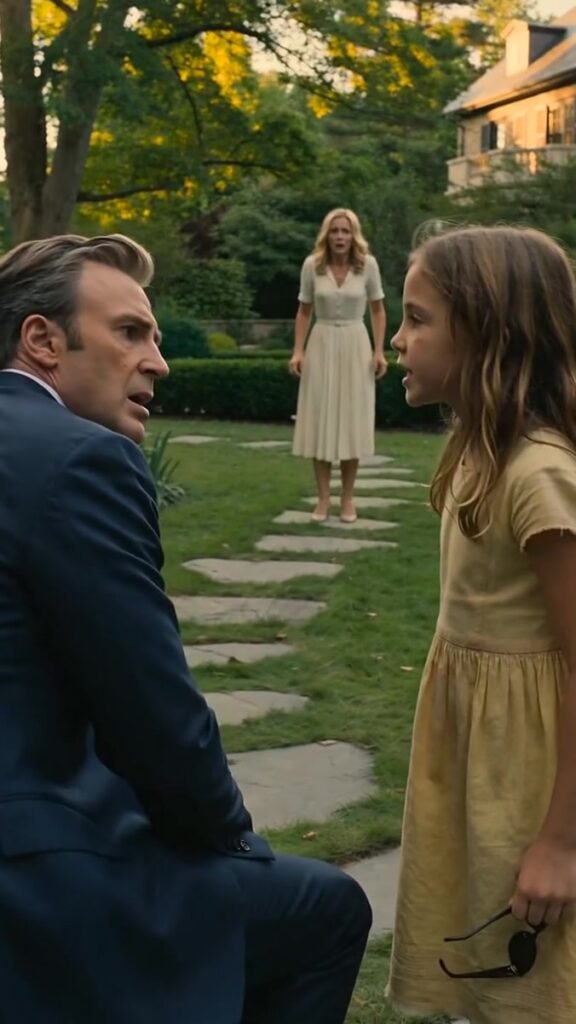
The garden looked too peaceful for a lie. It wore its calm like a tailored jacket: clipped hedges, obedient roses, and a stone path that never dared to crack. Late sun slipped through the plane trees in warm coins of light, and the air smelled of watered soil and something sweet enough to be trusted. Behind it all, the estate rose in pale limestone, quiet and costly—one of those houses where even the shadows seemed trained not to confess.
Edmund Hale sat on the bench as though he’d been placed there by design. Navy suit, silver watch, hands folded with the faint impatience of a man used to being waited on. Dark glasses hid his eyes. Everyone in the county knew the story: the accident, the miracle that spared his life but stole his sight. The sympathy had been immediate, generous, and—over time—useful. People spoke softer around him. They lied more carefully, believing the lie would land on darkness and disappear.
Near the terrace doors, Maris Hale lingered with a glass of water she didn’t drink. Blonde hair pinned neatly, pearls at her throat, the exact expression of a devoted wife smoothing her own worry into elegance. She watched the garden the way one watches a stage before the curtain rises: attentive, prepared, ready to cue the next act.
The act was interrupted by a child in a yellow dress.
She came through the boxwood arch without asking permission of the grounds, small and urgent, the hem of her dress smudged with dust as if she’d crawled under fences to get here. Her shoes were scuffed; her hair had been brushed once and then argued with. She walked straight to the bench and stopped so close her shadow touched Edmund’s knee.
Without hesitation, she pressed her palm to his forehead—too blunt to be affectionate, too steady to be a game. Edmund flinched as though struck. His fingers bit into the bench slat.
“You can see,” she said, and her voice had the rawness of someone who had cried until the tears turned into something harder. “You’re pretending.”
The garden didn’t change, but the peace in it suddenly felt staged. A robin on the lawn went quiet. Edmund’s throat tightened once, twice, as if he were swallowing a response he hadn’t rehearsed.
“What did you say?” he asked, the words coming out sharper than his public mourning ever allowed.
The girl didn’t repeat herself. She reached for his face and pulled the sunglasses away in a single decisive motion.
Edmund’s eyes opened fully—clear, alert, the blue of glass held up to daylight. Not the gaze of a broken man, but the quick focus of someone who’d been watching everyone else while they assumed him helpless. For a beat he sat frozen, exposed by the smallest hand in the garden.
Across the path, Maris stiffened. One hand rose toward her mouth too late, not a gesture of surprise but of containment, as if she might keep something from spilling out if she pressed hard enough. She did not move toward her husband. She moved back, one step, and then another. It was a retreat practiced in miniature.
The girl followed Edmund’s line of sight and pointed at Maris with an accusing finger that didn’t tremble. “It’s her,” she said.
Edmund’s head turned. His expression shifted—not to anger, not yet, but to calculation. He’d spent years performing blindness. Now he had to perform disbelief without letting the performance show.
“Explain,” he said to the girl, but his eyes did not leave Maris.
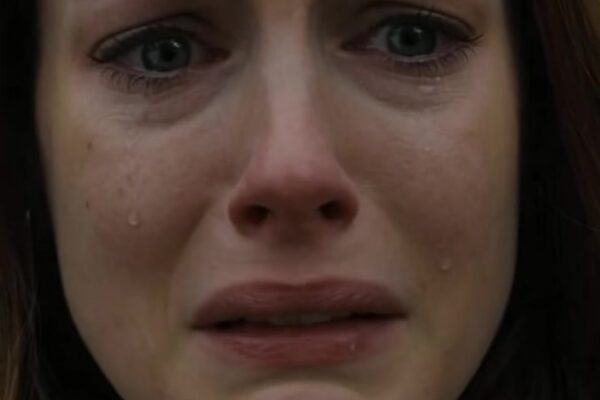
The child’s lips quivered. Tears gathered, caught along her lashes, and still she stood like a nail hammered into the ground. “She puts it in your drink,” she said. “In the tea. Every morning.”
Maris gave a sound that might have been a laugh if it hadn’t broken at the end. “Edmund, don’t listen to—”
“What?” Edmund’s voice cut through hers. He rose halfway, the bench creaking under the sudden shift of weight. His hand gripped the wood so hard the tendons stood out. “What is she talking about?”
Maris took a step forward as if to close the distance, then stopped, caught on a wire of fear. Her eyes flicked toward the house, toward the terrace, toward any witness she could claim as a shield. There were none close enough. Only the polite hedges, the obedient roses, and the child who had brought a truth that did not match the scenery.
“This is absurd,” Maris said, but the words were too large for her mouth. They fell heavy, like objects dropped in water.
The girl reached into her pocket and withdrew something small. Sunlight struck silver. A tiny medicine spoon, old-fashioned, the bowl worn smooth with use, the handle engraved with the Hale family crest: a stag and a crown. It looked like it belonged in a glass case, not in a child’s fist.
Edmund’s gaze locked onto it. “Where did you get that?”
The girl swallowed. “From the pantry,” she said. “From the jar behind the flour. She thinks no one looks there.” Her voice tightened as if she were forcing the words through a narrow opening. “I saw her. I was cleaning. I was supposed to be quiet.”
Something in Edmund’s face shifted—an old strain, long hidden under the mask of injury. “Cleaning,” he echoed, and now his eyes went to the girl’s wrists. The skin there was marked faintly, as if from tight elastic or rough fabric. Not bruises exactly, but evidence of a life that didn’t fit the garden’s luxury.
“What’s your name?” he asked, softer.
“Lina,” she said. “Lina Gray. My mum works here. She said I shouldn’t come near you. She said you were… delicate.” Lina’s chin lifted. “But you’re not delicate. You’re dangerous. Just not the way they tell people.”
Maris made a small, helpless motion with her hands, the pearls at her throat rising and falling with a quickened breath. “Edmund, she’s a child. Someone has filled her head with nonsense—”
“Someone,” Edmund repeated, and there was a bitter humor in it. He extended his hand. “Give me the spoon.”
Lina placed it in his palm. The silver felt cool against his skin, a fact too real to be dismissed. He turned it over, thumb tracing the crest as if reading a language he had forgotten how to trust. His eyes flicked to the terrace doors, where the afternoon tea tray would appear soon, precisely on schedule, carried by staff trained to smile through whatever they didn’t understand.
“How long?” he asked Lina, and now his voice was low enough that the garden itself had to lean in to hear.
“Since before you ‘went blind,’” Lina whispered. “I heard her on the phone. She said it was working. She said you’d never see the papers you signed. She laughed.” Lina’s breath hitched. “She laughed like it was funny to steal your eyes.”
Maris’s face whitened. For an instant, her composure slipped, and underneath it Edmund saw a different woman: not devoted, not fragile, but furious at being caught. “You don’t understand,” she said, and her voice sharpened into something like hatred. “You were never meant to keep it all. You were always meant to hand it over.”
Edmund straightened fully, no longer leaning on the bench. The pretense had fallen away, and what remained was a man who had been letting everyone else think him harmless. He looked from the spoon to his wife, then to the garden’s immaculate quiet as if seeing it for the first time—not as peace, but as camouflage.
Footsteps sounded from the terrace: the soft clink of porcelain on a tray, approaching exactly when it always did. Edmund held the silver spoon up at eye level. “Bring the tea,” he called, his voice calm now, almost pleasant. “And Maris—don’t step back again. If you’re innocent, you’ll want to be close enough to watch me drink.”
Maris’s mouth opened, but no sound came. Lina stood beside the bench, still small, still dirty at the hem, but unmovable. In the golden late light, the garden kept pretending to be serene. Edmund watched the tray near, watched his wife’s fear bloom, and understood with a clarity that made his stomach cold: the lie had been planted here like every other thing, watered daily, meant to look beautiful until it strangled him.
He turned the spoon in his fingers and waited for the first cup to be poured.