By the time the man noticed the girl under the bridge, she had already decided not to trust anyone with clean shoes. Down here, you couldn’t keep them spotless unless you belonged to the kind of world that drove above her—warm, sealed, and certain it would never crack.
She sat on a slab of concrete where yesterday’s rain still gathered in dark seams. A coat swallowed her thin frame, sleeves hiding her hands like she was trying to erase them. Between her arms was a sheet of paper, pulpy at the edges, the ink blurred into bruises. Her cup—once for coffee, now for luck—held a few tarnished coins and more rainwater than charity.
Overhead, traffic moved with the steady indifference of a river. The bridge trembled now and then, and dust sifted down like ash. Wind tunneled through the pillars, carrying wet metal and the sour smell of the river that didn’t look like any river in stories.
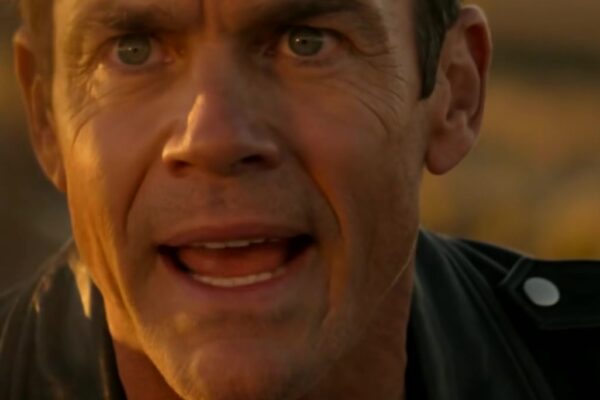
The man saw her late, the way people saw suffering: at the last possible second, when it was unavoidable. He stopped mid-step. Clean shoes. Not expensive, not flashy—just clean, as if mud were a rumor. His coat was neat, his hair combed back. He looked like the kind of person a stranger might approach in a station, asking for directions with relief.
He crouched a careful distance away, placing his palms on his knees so his hands were visible. His voice came out soft, practiced soft, a tone that had been rewarded before.
“Hey,” he said, as though greeting a skittish animal. “Are you here with someone?”
The girl didn’t answer. Her gaze tracked his shoes first. It always did. Then it moved up the line of him, cataloging: clean collar, clean hands, a watch with no scratches. The details didn’t comfort her. They formed a warning.
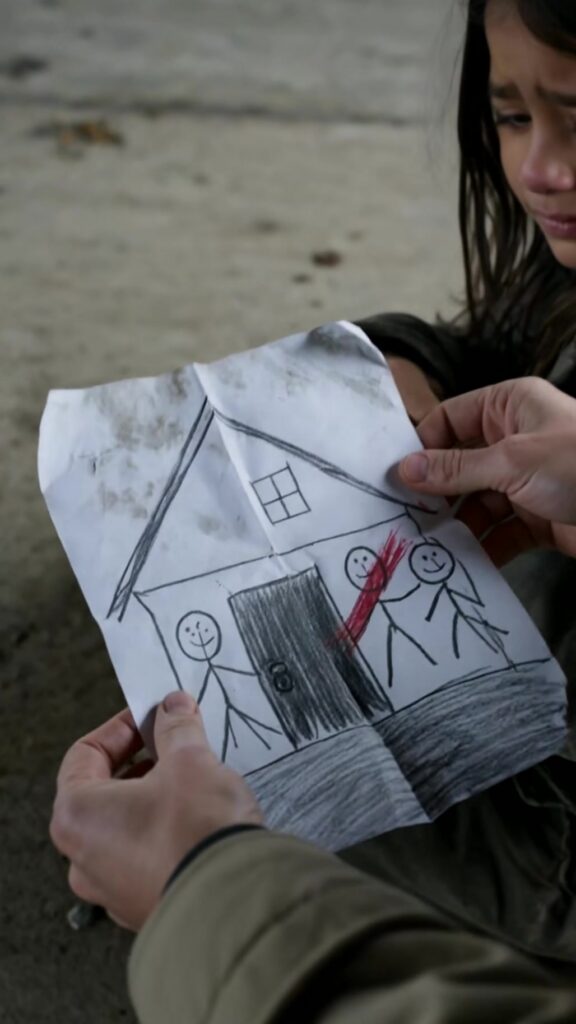
She lowered her eyes to the paper, and her fingers—pink and stiff—worked at folding it open. She treated it like it might tear if she breathed wrong. When she flattened it across her knees, the image showed itself: a crooked house with a basement door like a black mouth; three stick figures; one of them attacked with red wax so hard the paper was scuffed through.
He leaned in despite himself. He tried to keep his expression calm, but something shifted in his face, a flicker of recognition that lasted only a heartbeat.
“That’s…,” he started, then stopped. “Did you draw this?”
She watched him without blinking. Then, slowly, she turned the sheet over. The back was scribbled with uneven letters, as if written while someone’s hand was being tugged away. The sentence wasn’t a plea. It was an instruction.
If he finds me, show this to the woman with the silver cross.
The man’s breath caught. He looked up toward the bridge, as though the words had pulled a thread through the air and something might come falling down. For a moment he seemed smaller, the gentleness cracking to reveal a tightness underneath, like a cord drawn too far.
“Where did you get this?” he asked.
She didn’t answer that, either. She waited, patient in a way only the abandoned become. She waited for the part that always came next.
When he shifted, his collar moved. Something pale flashed at his throat, just a glimpse, but enough. A small cross on a chain, bright against his skin—silver, clean, polished like it had never been touched by dirty hands.
The girl’s eyes rose to his, and whatever hope a stranger might have expected wasn’t there. No relief. No softening. She looked at him with the certainty of someone who had already finished the story in her head.
“You came first,” she said, her voice hoarse as if it had been unused for days. “That’s how it goes.”
The sentence hit him harder than the note. It wasn’t accusation. It was memory.
He forced himself to smile, but his mouth didn’t obey. “My name is Daniel,” he offered, like a coin slid across a counter. “I’m not here to hurt you. I help people. I work with a shelter—”
“Clean shoes,” she muttered, almost to herself. “Always.”
Above them, tires hissed on wet asphalt. Farther down under the bridge, where the shadows thickened, an engine turned over—slow, deliberate, as if someone had been waiting with the key already in the ignition. The sound didn’t belong to the river or the road. It belonged to intent.
Daniel’s eyes darted toward it. His shoulders stiffened. “Listen,” he said, lowering his voice, “we can get you somewhere warm. You don’t have to stay here.” He extended a hand, palm up. The gesture was textbook safe. It was also, she thought, exactly what the last man had done before he grabbed her wrist.
She clutched the damp drawing to her chest. “You didn’t ask the right thing,” she said.
“What’s the right thing?”
“You didn’t ask why it says ‘if he finds me.’” Her gaze flicked to the silver cross at his throat again. “You saw it and your face changed.”
Daniel swallowed. The bridge hummed. The engine down the way idled now, purring like a big animal that had caught a scent.
“I know a lot of people wear crosses,” he said carefully. “It doesn’t mean—”
“It means the woman thinks she owns you,” the girl cut in. “Or she owns what you do.” She spoke like someone reading from a report. “She sends you out. You’re the soft part. You make people move.”
Daniel’s hand twitched, then steadied. “You’re making assumptions. I’m just trying to help.”
She let out a sound that might have been a laugh if it hadn’t been so small. “Help is loud. Help brings a blanket and a sandwich, not a necklace that matches a note.”
His eyes flicked, just once, to the chain. The silver caught the little light under the bridge like a blade.
“Who wrote that note?” he asked at last, as if he could choose the question now and regain control.
“A girl with a bedroom that didn’t have a lock,” she said. “A girl who learned that basements have doors for a reason.” She pressed her thumb against the red-scarred stick figure on the drawing. “A girl who thought a symbol meant safety until she learned symbols can be uniforms.”
Daniel’s face tightened. It was the look of a man standing at the edge of a confession, deciding whether the drop would kill him. “I don’t know you,” he said, but the words weren’t strong enough. “And you don’t know me.”
“I know your shoes haven’t been in the river,” she replied. “I know you didn’t have to sleep sitting up. I know you didn’t have to decide which lies sounded believable enough to keep your teeth.” Her voice sharpened. “And I know you looked at that cross-out like you’ve seen it before.”
The idling engine crept closer, its tires crunching on gravel. A pair of headlights swept across the concrete pillars, turning the under-bridge world into a moving stage. Daniel’s head snapped toward the light. His hand dropped from offering to warning—an instinctive gesture, as if he could shield her without touching her.
“Stay behind me,” he said.
The girl didn’t move. She tightened her grip on the drawing and leaned back into the shadow where the bridge’s support met the ground. It was the only place the headlights couldn’t reach directly.
“If you were truly helping,” she whispered, “you’d be dirty.”
Daniel’s eyes flashed, something like shame, something like anger. The car rolled into view—dark, too polished for this place. A figure sat behind the wheel, face hidden by the windshield glare. The passenger door clicked as if it had been unlocked long before.
Daniel rose slowly, his clean shoes stepping into a puddle without hesitation, as if he could buy trust with grime. “Don’t,” he said to the car, though he didn’t know if the girl meant the driver or him. “This isn’t how it’s supposed to go.”
The girl watched him, still and calculating. In her head, she sorted him into the only categories that had ever mattered: danger you can see, and danger that smiles. She looked at his shoes, now splashed with dark water, and felt nothing soften.
Because shoes could be dirtied in a second.
Trust took longer to ruin—and even longer to earn back.
As the car door opened and cold light spilled onto the concrete, she slid the drawing deeper into her coat, hiding the instruction against her heart like a match she couldn’t strike yet. Then she raised her chin, eyes steady, and decided she would not be led anywhere without proof that the person offering the hand was willing to lose something more than cleanliness.
Above them, the city kept moving, oblivious. Below, under the bridge, the story narrowed to a single breath: who would step into the dirt first, and whether it would be enough.