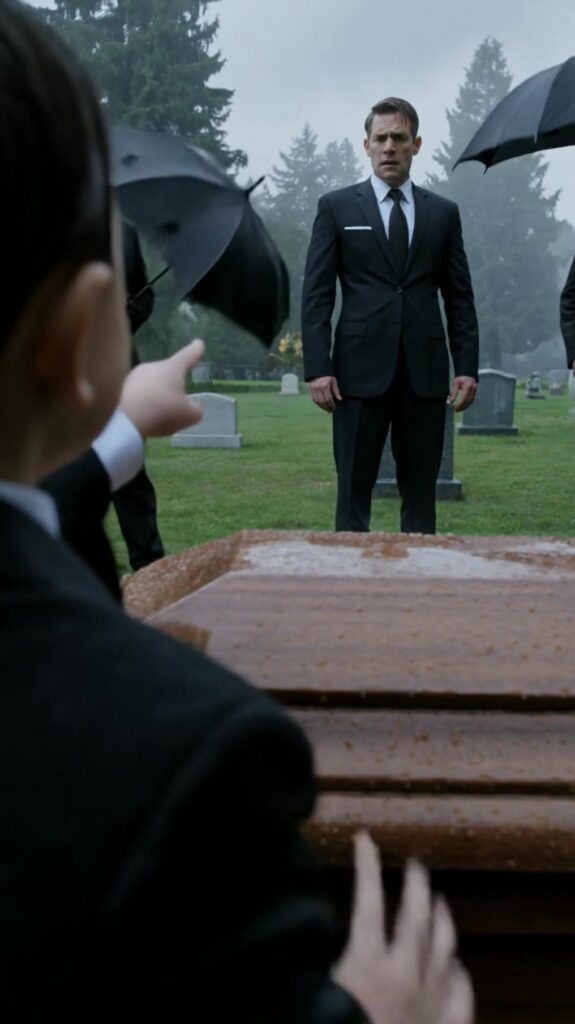
At first, it was just a funeral. The kind the town of Larkhill knew how to perform with its eyes shut: gray umbrellas in neat rows, wet shoes sinking into a tired lawn, the minister’s voice measured to the pace of a metronome. Even the rain sounded polite, tapping the coffin lid as if asking permission.
They had buried a man they all claimed to recognize. Malcolm Crowe—real estate, church donor, sponsor of the Little League scoreboard—had lived with his name on plaques and his smile on campaign flyers. His widow, Celeste, stood at the head of the grave like a statue carved from restraint. Her jaw held steady. Her pearls didn’t tremble. The only movement she allowed herself was the occasional press of her gloved fingers to her son’s shoulder, a quiet command: stay still, stay quiet, don’t make this harder.
Macy Crowe, eight years old and too thin for his black suit, stared at the coffin as if it might blink. Rain slicked his hair to his forehead. He looked neither shattered nor numb; he looked awake. A wakeful child at an event designed to make everyone sleepwalk through grief.
The minister began the last part, the closing of the lid already tightened, the final lines shaped to smooth the crowd back into their lives. Two men from the funeral home took their positions, hands on the lowering straps.
“Don’t close it.”
The voice was small, but it cut through the rain as if the sky itself had spoken. Heads turned in unison. Someone coughed. Someone else murmured a warning. Celeste’s fingers dug into her son’s shoulder.
“Macy,” she whispered, the word carrying both prayer and threat. “Enough.”
He didn’t look at her. His eyes stayed on the coffin. “Don’t close it,” he repeated, louder now, his voice trembling at the edges but not breaking. “He’s not my father.”
The cemetery went rigid. The air thickened with the kind of silence that has weight. The minister’s mouth stayed open a fraction too long, his practiced sympathy caught on an unexpected hook. A man near the front—Graham Holt, Malcolm’s law partner—made a sound of disbelief and stepped forward as if to block the boy from his own words.
“This is not the place,” Graham said, his tone carefully calm, the kind used on people who might explode. “Macy, buddy, you’re upset. Let’s—”
“I’m not upset,” Macy said. “I’m right.”
Celeste’s face finally moved. Not into tears—into something sharper. “Macy,” she hissed, too low for anyone except those closest to hear, “we talked about this. You promised.”
Macy turned then, and the look he gave his mother wasn’t childish. It was old, like a person who has waited too long for the truth and cannot afford to wait another minute. “You lied to me.”
The words landed harder than the rain. They scattered into the crowd, into mouths that would repeat them later over coffee and behind curtains. You could almost see people recalculating their memories: the perfect family photos, the annual gala, the speeches about legacy.
Graham’s eyes flicked to Celeste. He shook his head once—subtle, urgent. A warning. Celeste didn’t shake back. She lifted her chin, holding the line as if her posture could keep the world from shifting.
“Tell them the truth,” Macy said. “He told me before he died.”
A ripple moved through the umbrellas. The rain intensified, as though it had been waiting for permission to become more honest. Celeste’s lips parted, and nothing came out.
Graham stepped closer to her, speaking under his breath with the false gentleness of a man who believed control was the same as care. “Celeste. Not here.”
But Macy spoke again, and this time he reached into the inside pocket of his coat with hands that did not fumble. “He said I’d have to be brave,” he told them. “He said you’d try to stop me. He said to wait until everyone was watching.”
Celeste made a sound—half gasp, half plea. “Where did you get that?”
“From him,” Macy said, and his gaze returned to the coffin. “He put it there. He told me which side.”
He moved with purpose toward the casket, and for a moment no one stopped him—not the funeral attendants, not the minister, not Graham. It was as if the entire crowd was bound by the same unspoken rule: a child’s certainty is dangerous; if you touch it, it might shatter and cut you.
“Sweetheart,” Celeste said, finally louder, voice cracking against her will. “Please.”
Macy ignored the plea and ran his fingers along the seam near the left hinge. He pressed. A small panel gave way with a soft click that sounded impossibly loud. From within, he drew out an envelope, edges already damp, sealed with a dark wax stamp pressed into an unfamiliar symbol: a simple circle bisected by a line, like an eye that refused to blink.
Everything stopped. Even the rain seemed to hesitate, as though curious.
Graham’s color drained. “No,” he said, the word slipping out raw. “That isn’t—Macy, give that to me.”
“He said not to,” Macy replied, and the tremor in his voice became rage. “He said you’d try.”
Celeste reached out, then froze with her hand midair. It was the first time she looked truly frightened—not of grief, but of exposure. Her eyes tracked the envelope like it was a live coal.
Macy held it up, the way children hold up a trophy or a broken toy to prove what happened. “He wrote it for everyone,” he said. “He said you wouldn’t let me have a dad. He said you wouldn’t even let me have the truth.”
“You do have a father,” Celeste said, voice unraveling. “You have—”
“No,” Macy cut in. “He said I have a name I don’t know. He said the man in this coffin is a stranger.”
Someone in the second row began to cry. It wasn’t Celeste. It was Mrs. Carden from the church office, who had always sworn Celeste was a saint. The sound cracked open something in the crowd. Murmurs started—questions, protests, the soft violence of curiosity.
The minister cleared his throat, helpless. “Perhaps… perhaps we should move this—”
“Read it,” Macy demanded. He looked at the adults like they were the ones being unreasonable. “He wanted you to hear it.”
Graham took a step toward him, and Macy stepped back, planting himself beside the coffin as if guarding it. In that posture, with rain streaking his cheeks, he looked like a sentry at the gate of something buried too long.
Celeste’s shoulders sagged, the first crack in her controlled shape. “Macy,” she whispered, and her voice was no longer command. It was confession. “You don’t understand what you’re opening.”
“I understand,” he said quietly. “I’m opening the thing you closed.”
For a long moment, nobody moved. They all stood balanced on the edge of a story they had not known they were in—one where the dead left instructions, where a child became the messenger, where a funeral was not an ending but a trapdoor.
Macy broke the wax seal with his thumbnail. The sound was small, intimate, and final. He unfolded the paper, rain spotting the ink, and he looked up once at the faces waiting for the next lie or the first truth.
At first, it was just a funeral. Then the letter began, and the town of Larkhill learned what Malcolm Crowe had taken into the ground with him—and what he had decided, at the last possible moment, to pull back out.
Macy drew a breath, and read.