At first, it felt like nothing. Just another Thursday with rain bleeding down the windowpanes and the heavy, familiar stink of sweat trapped in the old boxing gym’s walls. Coach Diaz had been here since dawn, taping knuckles, barking corrections, snapping towels at daydreamers. The bell rang. Gloves smacked leather. A radio in the corner muttered about traffic. Nothing new ever happened in places like this—just people trying to become someone else.
The front door squealed and let in a thin slice of gray daylight. Diaz didn’t look up at first. He was watching one of his amateurs drop his left hand again and again, like the kid wanted to invite a hook to the jaw. Diaz clapped once, sharp as a slap. “Hands up!”
Then the room shifted in that way it does when an unfamiliar body enters it. A boy stepped inside, not more than fourteen, hair too long, hoodie too big, shoulders narrow but squared with a kind of stubbornness that didn’t match his size. He didn’t pause to scan the room. He didn’t gawk at the heavy bags or the ring or the men who looked like they’d been chiseled by disappointment. He walked straight through the noise as if it were fog.
One of the older fighters, leaning against a post with his wraps half-done, called out with a grin. “Hey—lost?”
No reply. No flinch. The boy kept walking.
Diaz finally turned, irritated by the audacity of silence. The kid stopped just outside the ring apron and looked up at him, eyes dark and still. Diaz had seen that look on men who’d run out of choices.
“You looking for someone?” Diaz asked.
“Are you Coach Diaz?” the boy said.
Diaz’s mouth twitched. In this neighborhood, “Coach” was a badge and a target. “Depends,” he said. “Who’s asking?”
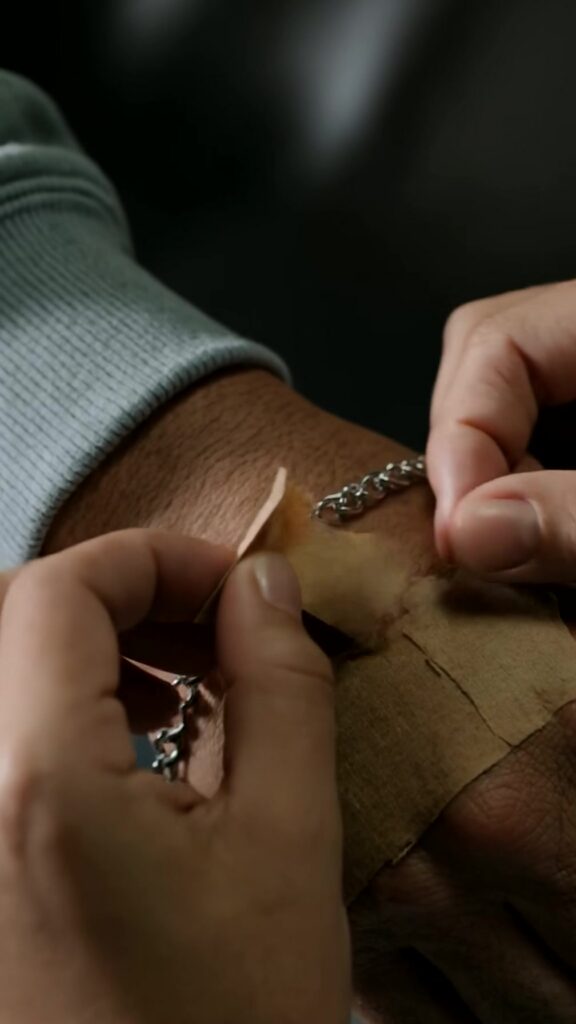
The boy slipped one hand into his hoodie pocket, slow enough to show he wasn’t reaching for trouble and steady enough to suggest he didn’t fear it. He brought out a ring and held it flat on his palm. Not gold. Not flashy. A plain band, silver dulled to the color of bone, the inside rim nicked by years and the faintest engraving on the face—so worn it was more memory than metal.
Diaz’s breath caught before he could control it. He knew that ring. He had known it the way a man knows a scar he didn’t earn. The gym seemed to inhale with him: the slap of gloves softened, the radio faded into static, even the heavy bag swung quieter. Men stopped mid-wrap. A sparring pair paused with their foreheads pressed to their gloves.
“My dad said you gave him this,” the boy continued, voice level. “Before his last fight.”
Diaz stepped closer without meaning to. In the overhead lights, the ring looked smaller than it had any right to be, like something that should have been lost in a drain or sealed in a box at the bottom of the ocean. He stared at the faint engraving until it sharpened into something he could read again: GHOST. He’d had it made in a shop that didn’t ask questions, paid cash, and slid it into a hand that shook for the first time in Diaz’s memory.
Diaz’s voice dropped, scraping on gravel. “Kid… what’s your father’s name?”
The boy didn’t blink. “Tommy ‘Ghost’ Reyes.”
It wasn’t just the name. It was the way it landed. Like a body hitting canvas. Like a door slammed on a life that had been nailed shut years ago. Men shifted their weight, suddenly busy with nothing. Someone coughed too loudly. Nobody looked Diaz in the eye.
Tommy Reyes. The one they said had danced through punches like smoke, the one who smiled as if he knew the ending and refused to share it. The one who took a fight that wasn’t on any official card, in a venue that didn’t exist, against an opponent no one would admit to seeing. The one who walked into the back hallway after the final bell and never walked out again. The one Diaz had trained until his hands bled and then sworn, the night everything went wrong, that he would never say his name out loud again.
Diaz swallowed. “Where’d you get that?”
“From my mom,” the boy said. “She kept it in a tin with photos and a ticket stub that doesn’t have a date.” He paused. “She didn’t want me to come.”
“Smart woman,” Diaz muttered, but his eyes didn’t leave the ring. Because it wasn’t only familiar—it was accusing. It was a receipt.
The boy lifted his chin. “She said you’d tell me my dad died because he wouldn’t quit.”
Diaz’s jaw tightened. “I didn’t say he died.”
That made the boy’s gaze sharpen, like a blade finding the seam in armor. “So he’s alive?”
Diaz looked past him at the gym. At the kids hitting bags like they could punch their way into better lives. At the men who kept coming back because the world outside was louder and crueler. At the ring in the boy’s palm, heavy with all the promises Diaz had broken.
“Listen,” Diaz said quietly. “That night—”
“I’m not here for your story,” the boy cut in. “I’m here for his.” He leaned closer, so the noise that had returned—gloves, breaths, squeaking shoes—couldn’t pry their words apart. The boy’s voice dropped to a whisper, and the words slid into Diaz’s ear like ice.
“He didn’t disappear,” the boy murmured. “He called us. Last week.”
Diaz froze so hard it felt like his bones locked. The gym kept moving around him, unaware of the crack that had just opened in the floor.
“That’s not funny,” Diaz said, but it came out thin.
The boy’s hand closed around the ring, knuckles whitening. “He said you’d pretend you didn’t hear his name. He said you’d act like the past is a closed door. But he told me to find you anyway.” The boy’s eyes glinted with something that was not hope—hope was too soft for this. “He told me the ring would make you listen.”
Diaz’s throat worked. “What did he say?”
The boy didn’t look away. “He said, ‘Tell Diaz the debt isn’t paid. Tell him they’re coming back for what I took.’”
Diaz felt the air drain from the room again, as if the building itself remembered the fear it was built on. The last fight hadn’t been about belts or pride. It had been about money that didn’t belong to anyone honest. Tommy had taken it—stolen it, won it, Diaz had never known which—and then vanished. Diaz had thought the danger died with Tommy’s name.
But the boy wasn’t finished. He leaned in one more inch, the smell of rain clinging to his hoodie, and whispered the sentence that snapped Diaz’s world clean in half.
“And he said,” the boy breathed, “you’re the reason he couldn’t come home.”
Diaz stared at him, the words ringing louder than any bell. In the distance, someone laughed at a joke that didn’t matter. Somewhere, a timer beeped. Diaz’s hands—hands that had wrapped champions and patched up losers—trembled as he reached for the ring. The boy didn’t give it up. He held it tight, a small fist full of history.
Diaz forced himself to speak. “What’s your name?”
“Mateo,” the boy said. “But he called me ‘Little Shadow.’”
That nickname hit Diaz like a hook to the ribs, because Tommy had once joked that every ghost needed a shadow, something to prove they’d existed. Diaz had laughed then, careless. Now it felt like a curse.
Diaz stepped back and looked around his gym—the only kingdom he’d ever managed to keep. The faces watching him were wary, curious, hungry for drama. Diaz made a decision that tasted like blood.
“Everybody out of the ring,” he barked, voice cutting through the room. “Now.”
Gloves dropped. Mouthguards came out. Men obeyed, not because they understood, but because the tone in Diaz’s voice carried a memory of violence.
Diaz turned back to Mateo. “You came here alone?”
Mateo’s jaw hardened. “I can handle it.”
“No,” Diaz said, and for the first time the word sounded like care instead of control. “You can’t.” He nodded toward the office at the back, where the door was scarred from old fists. “Come on. You’re going to tell me everything he said. Every word. And then I’m going to tell you what your mother never could.”
Mateo didn’t move immediately. He opened his hand and finally placed the ring on the edge of the ring apron, like an offering or a threat. Diaz watched it settle, a circle that could be a promise or a trap.
At first, it had felt like nothing. A kid walking into a gym. A name from a dead chapter.
Now Diaz could hear the past breathing behind the walls, waiting for him to open the door he’d nailed shut with silence.
“Coach,” Mateo said softly, and there was steel under it, “are you going to help me find him?”
Diaz stared at the ring, then at the boy. The answer cost him more than money, more than fear. It cost him the lie he’d lived on for years.
“Yeah,” Diaz said. “But you’re not going to like what we find.”