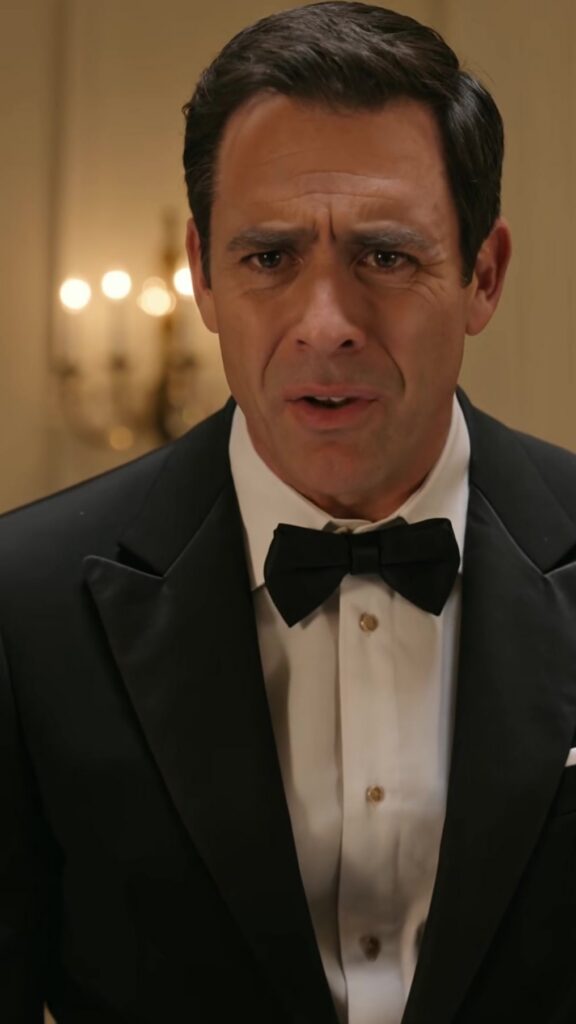
No one invited him. That was the first thing everyone noticed—before the string quartet swelled, before the chandelier crystals trembled with light, before the champagne turned mouths loose and careless. The Aldens were hosting one of their winter galas, a ritual meant to prove that money could be inherited like bone structure, and the guest list was as precise as a ledger. Names were checked twice. Coats were taken with practiced smiles. Doors remained guarded by men who knew the difference between a philanthropist and a petitioner.
So when the boy stepped in from the snow-dark entryway, the room tilted. He wore a thin jacket that had forgotten the shape of its own seams, and shoes that had learned every crack in the city. His hair was damp, either from melted flakes or from having been washed in a sink somewhere. He was wrong for the room the way a candle is wrong for a storm.
The second thing everyone noticed was that he didn’t care.
He crossed the marble floor as if it belonged to him and all the polished surfaces were only waiting for his footprint. Heads turned. A laugh slipped out, quickly smothered. Whispers traveled along bare shoulders and cufflinks. The quartet, playing a waltz too sweet to be honest, kept their eyes on their music, as if glancing up would make them complicit.
He didn’t look left or right. He walked straight through the tangle of gowns and tuxedos, past the ice sculpture shaped like a swan, past the velvet rope that marked the boundary of the dance floor, until he stopped in front of the girl in the blue dress.
She sat slightly apart on a settee upholstered in pale green, a forced centerpiece. Her dress was a color that made people say “striking” while their eyes flicked away. The fabric was cut to make her look fragile, a porcelain daughter for a porcelain house. Her hair had been pinned with careful cruelty. If she moved too much, the pins would bite.
Clara Alden—daughter, donation, darling. There were rumors about her that floated like dust in sunlight: she’d been sick as a child; she’d been sent away; she’d gotten hurt; she’d done something unforgivable. Tonight she was back, brought out like a preserved rose to prove something had survived.
The boy stood before her and said, plainly, “Let me dance with her.”
It wasn’t loud. It didn’t need to be. The words fell into the room and made everything else quiet around them. Even the laughter in the far corner thinned into silence, as if it had suddenly remembered manners.
Clara’s father turned from where he’d been speaking to a senator’s wife. Harold Alden’s smile had been crafted from handshakes and contracts; it vanished in a practiced instant. He looked the boy up and down as though assessing a stain.
Harold gave one short laugh, clipped and cold, like a door latch snapping shut. “This isn’t a joke,” he said.
The boy didn’t flinch. He didn’t apologize. He didn’t explain himself. He didn’t even look at Harold. His gaze stayed on Clara, steady as a hand held out over water.
“I know she wants to dance,” he said.
The room shifted—an almost imperceptible ripple, but real. A woman lowered her glass. Someone’s fan stopped moving. The air remembered it could be sharp.
Clara’s expression changed first. It was small, the movement of the mouth and the softening around the eyes, but it was unmistakable. Hope tried to surface, thin as a bubble, and everyone seemed frightened it might pop and leave a mess no one knew how to clean.
Harold’s voice hardened. “Why should I let you near her?” he asked, but it was not a question. It was a warning disguised as courtesy.
The boy breathed in, and for the first time it seemed he was listening—to something deeper than the music, deeper than the murmurs. “Because she can dance,” he said, quietly, as if it were not a compliment but a fact carved into stone.
No one moved. No one spoke. The sentence did something inside the room: it loosened an old knot, tugged a thread people had been ignoring.
Clara blinked slowly. Her hands, folded in her lap like they’d been instructed, twitched. Her fingers made a tiny, unconscious pattern against the fabric, as if remembering steps.
Harold’s jaw flexed. “She doesn’t dance,” he said. It landed with the blunt certainty of an official statement. “Not anymore.”
The boy lowered his eyes just enough to see Clara’s hands. “She does,” he replied. “You just don’t let her.”
A gasp fluttered somewhere. The senator’s wife took an involuntary step back. People were not accustomed to being spoken to like a truth was not negotiable.
Harold’s gaze sharpened, searching for the angle, the scam, the threat. “Who are you?” he demanded.
The boy hesitated, and in that brief pause there was something almost human and young in him. “Eli,” he said at last. “Just Eli.”
Clara whispered the name as if it had been hidden in her ribs. “Eli.” It was barely sound, but it changed her posture. Her shoulders lifted, not with fear, but with recognition.
Harold stared at Clara as though she had betrayed him by remembering. “You don’t know him,” he snapped, the words aimed at her but meant for the entire room. “You’re tired. You’re overwhelmed.” His hand reached for her shoulder like a claim.
Clara flinched—not away from Eli, but away from her father’s touch. That flinch was a crack in a carefully maintained façade. It was the sound of porcelain threatening to become something else.
Eli stepped closer, not boldly, but with a reverence that made it harder to accuse him. He extended his hand. His palm was rough, the kind of roughness earned honestly. “If you want,” he said to Clara. “Only if you want.”
The quartet faltered. One violin held a note too long, trembling. It sounded like a held breath.
Clara’s eyes filled, not with tears yet, but with a pressure behind them. Her gaze moved from Eli’s hand to her father, to the ring of watchers, to the doors guarded by men who would obey a nod. She looked like someone waking up in a room she’d been sleeping in for years and discovering the locks on the outside.
Her fingers rose a fraction, then stopped. A tremor ran through them. Fear, practiced and precise, reached for her wrist like a chain.
Harold’s voice dropped, low enough to be intimate and lethal. “Clara,” he said, and in that single word was the weight of family, reputation, debt. “Don’t.”
Eli didn’t speak. He didn’t plead. He didn’t challenge Harold with another declaration. He simply kept his hand where it was, unwavering, as if he understood that some battles are won by waiting.
Clara inhaled. The sound was soft, but it cut through the room. Then she did something no one in that house expected: she uncurled her fingers from her own lap. Slowly, as if testing whether the air would punish her, she lifted her hand.
Her fingertips hovered over Eli’s palm, close enough to feel the heat of him. Close enough for everyone to see the decision forming. The hope on her face looked dangerous now—not fragile, but sharp.
Harold’s mouth opened, perhaps to call for security, perhaps to speak a name that would end this. But before he could, Clara’s fingers touched Eli’s hand.
The contact was light, almost nothing. Yet it rang through the room louder than any toast. Clara stood, the blue dress shifting like water, and for a moment she looked taller than the chandelier light, taller than her father’s anger, taller than the rules that had built this evening brick by brick.
Eli guided her—gently, carefully—toward the edge of the dance floor. He didn’t pull. He didn’t lead like an owner. He moved as if she were the one steering, and he was simply there to keep her from falling.
Then, as the quartet scrambled to find the waltz again, Clara took her first step. It wasn’t perfect. It was real. Her foot slid, found the beat, and remembered. The next step came easier. Her shoulders relaxed. Her hands stopped trembling.
And there, in the heart of the gala, under a chandelier that had witnessed countless rehearsed smiles, Clara Alden began to dance—not for the guests, not for her father, not for the charity cameras waiting in the hall, but for herself.
Harold Alden watched, frozen, as though the room had turned against him. In a way it had. Because everyone could see it now: the girl in blue had never been broken. She had been held down.
Eli’s eyes stayed on her face as they moved. Not triumph. Not pity. Only recognition, like he had come here to return something that had been taken.
No one invited him, and yet he had arrived like an answer. And as Clara’s steps grew surer, it became impossible to pretend this interruption was a mistake. It was a reckoning, dressed in worn cloth and quiet courage, turning in time with the music.
Just as Harold took a step forward, as if to reclaim the night by force, Clara lifted her chin and met his eyes over Eli’s shoulder. The look she gave her father was not defiance. It was absence—an emptiness where obedience had been.
The next turn brought Clara closer to the crowd, close enough for them to see the tremble of joy at the edge of her mouth. Close enough to understand that something had already changed, and no amount of wealth could buy it back.
And when Clara’s smile finally broke free—small at first, then undeniable—the room realized the most frightening thing of all: she wasn’t asking permission anymore.