It began with a sprint.
One moment the diner was its usual middle-of-nowhere lull—chrome stools, a jukebox that didn’t quite remember the song it was playing, and the slow, steady hiss of a coffee pot—and the next, the bell over the glass door screamed like it had been slapped.
A little girl shot inside as if the air outdoors had teeth. She couldn’t have been more than eight. Her sneakers squealed against the tiled floor. She didn’t scan the room for safety like a child who’d gotten lost. She scanned it like someone trained not to be seen, and still failing.
Her eyes cut past the waitress, past the truckers, past the couple in the corner fighting quietly over a torn sugar packet. She didn’t look back at whoever she’d outrun. She didn’t look at anyone at all—except him.
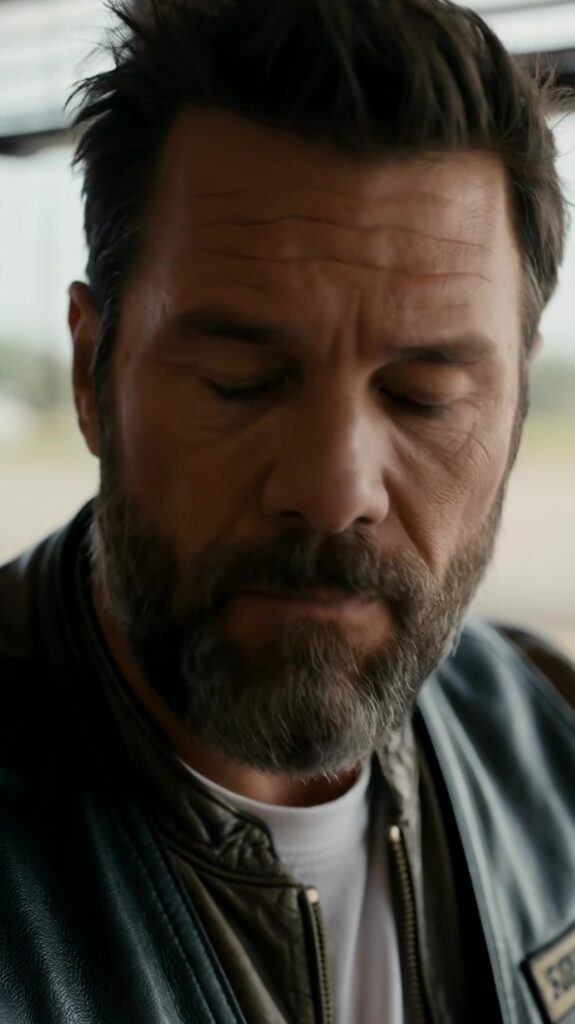
Cal Mercer sat alone in a booth that had learned his shape over the years. His vest smelled faintly of leather and road dust, his helmet rested beside a half-eaten slice of pie, and his knuckles were nicked from a life that had never stayed soft for long. He’d stopped here because the highway had started to blur and because the diner’s neon sign always made him think of a lighthouse.
The girl crossed the room in a straight line, as if pulled by a rope only she could see. She reached his table, grabbed a fistful of his vest, and held on like she might fall through the floor if she let go.
Her hands trembled. Not from cold. From consequence.
“Please,” she said, voice too quiet for a sprint like that. “Pretend you’re my dad.”
No tears. No stuttered story. No name. Just that raw plea, delivered like a code phrase.
Cal’s body reacted before his mind did: shoulders tightening, weight shifting, eyes flicking to the door. He should’ve pushed her away. A stranger’s kid clinging to you could turn into all kinds of trouble—police trouble, trouble that bled, trouble that didn’t wash out of clothes.
But something felt wrong in a way that had nothing to do with accusations and everything to do with predators.
He lowered his hand slowly and rested it on top of hers, not gripping, just covering. He glanced at her face. Her breathing was fast but controlled, like she’d practiced being afraid without showing it.
“Hey,” Cal murmured, keeping his voice the same tone he used around skittish dogs and people fresh out of nightmares. “You’re okay.”
Her head made a tiny movement that wasn’t quite a shake, more like a refusal of the word itself. She leaned closer, lips near his vest as if the leather could swallow sound.
“Don’t look at him too long,” she whispered. “He counts blinks.”
Cal’s pulse thudded once, hard. His eyes lifted anyway—just enough to confirm, just enough not to invite attention.
A man in a dark coat stood near the door, not entering, not leaving. Too still. Too neat. His hands were empty and yet Cal felt the same pressure he’d felt in war zones, the sense of a weapon held just out of view. The man’s gaze was fixed not on the room but on the girl’s shoulders, like he was watching a package change hands.
Most people who chased a child into a diner would be panting, angry, frantic, pleading. This man looked calm. Calm as paperwork. Calm as a lock clicking shut.
Cal forced himself to glance away, down to the laminated menu. He could feel the girl’s grip tighten at the shift.
“What’s your name?” he asked, still softly, as if they were sharing a secret dessert.
“Mara,” she breathed. Then, as though the name had costs, she added, “Please call me that.”
Cal swallowed. “Okay, Mara. I’m Cal.”
“I know.”
The word hit like ice water. Children didn’t know the names of strangers at highway diners unless someone had told them. Cal’s jaw tightened. He let his gaze drift across the diner’s window. Reflected in the glass, the man in the coat seemed sharper than the people around him, like he belonged to another layer of reality.
“Who is he?” Cal asked.
“He’s not my uncle,” Mara said quickly, as if that lie had been practiced for her. “He’s not my neighbor. He’s not… anything you can explain.” She swallowed, and her eyes flicked to Cal’s vest patch: a faded emblem of a winged wrench, the mark of a club he’d left years ago when the road stopped feeling like freedom and started feeling like running in circles. “He brought me here because you’d be here.”
Cal’s fingers went numb on the edge of the table. “Why would he do that?”
Mara’s mouth trembled for the first time. Not into tears—into rage, contained by necessity.
“Because you always stop here on Tuesdays when the sky looks like rust,” she whispered. “Because you sit facing the door. Because you still flinch when someone says ‘Harlow.’”
Cal’s breath caught. The name wasn’t on his tongue often. It was a place on a map and a place in his memory, the town where he’d once watched a friend die and promised himself he’d never let anyone put a child between them and a gun again.
“You shouldn’t know that,” Cal said. His voice had sharpened. He tried to soften it, but fear was a stubborn acid. “How do you know that?”
Mara leaned in so close her hair brushed his wrist. Her next words didn’t belong in a diner. They didn’t belong in any ordinary life.
“Because you already did this,” she whispered. “You already pretended. You already got me out once. And then you changed your mind and went back.”
The room seemed to tilt. Cal stared at her, searching for the joke, the trick, the adult hiding behind her eyes. But there was only a child there—exhausted, alert, and terrifyingly sure.
He heard the coat-man’s footsteps, slow and measured, the sound of someone who didn’t need to hurry because time itself was on his side.
“Cal Mercer,” the man said, voice mild as weather. “Don’t make this difficult. The girl belongs to the arrangement.”
The waitress approached with a pot of coffee, hesitated, and retreated as if her instincts had finally noticed the shape of danger in the air. Conversations around them softened, not stopping, but dimming, like the whole diner had lowered its volume to listen.
Cal kept his eyes down, like Mara told him. He slid his hand beneath the table, feeling for the cold weight of the knife he carried in his boot, the one he swore he’d only use to cut rope and open stubborn packages. His leg bounced once, involuntary.
“Arrangement?” Cal echoed, buying time.
The man’s reflection in the window leaned closer. “A debt. You had one, once. You paid in miles and blood. Then you defaulted.”
Mara’s grip tightened until Cal could feel her pulse against his skin. She whispered without moving her lips, a ventriloquist’s warning meant only for him.
“He can’t touch you if you say it,” she said. “If you say it out loud. The words. The ones you said before.”
Cal’s throat went dry. “What words?” he murmured.
Her eyes lifted to his, and for a heartbeat she didn’t look like a child at all. She looked like someone who’d watched too many endings. “Tell him,” she said, “that you remember.”
The man’s shadow fell across their table. Cal didn’t look up. He felt the weight of a presence that had never needed to raise a voice to be obeyed.
“Stand up,” the man said. “Hand her over. This can be tidy.”
Cal’s mind flashed through options: the exit to the kitchen, the back door, the window, the narrow aisle between booths. None were clean. All would put Mara in reach of that calm hand.
He could do the sensible thing. The selfish thing. He could push her away and let the world return to its safe illusions.
Instead, Cal placed his palm firmly over Mara’s knuckles, anchoring her. He lifted his chin just slightly—enough to speak, not enough to stare.
“I remember,” Cal said, voice steady despite the tremor in his bones. “And I’m not paying that way again.”
The diner’s lights flickered. Not dramatically—just a small, sick pulse, like a heartbeat misfiring.
The man in the coat went stiller, if that was possible. The calm cracked at the edges, showing something old underneath, something that didn’t like being named.
Mara exhaled, the first real breath she’d taken since she ran in.
And then the door behind them opened again.
The bell rang, bright and cheerful, a sound that didn’t match the dread pooling under the tables. Footsteps entered—more than one set. Heavy. Purposeful.
Cal’s hand closed around Mara’s, and for the first time he understood the impossible thing she’d said: that he’d been here before, that he’d failed once, that the road had looped back to the same test because the universe hadn’t been satisfied with his answer.
He didn’t know who had walked in behind them—cops, club brothers, or something worse. He didn’t know whether the man in the coat had reinforcements or consequences.
But Cal knew this: the sprint had not been random. It was a fuse being lit.
He slid out of the booth, keeping Mara close, his body between her and the shadow in the coat. His voice dropped to a whisper meant for only her.
“If we run,” he said, “you do exactly what I say. No questions.”
Mara nodded once, fierce and small.
Cal turned his head just enough to see who had entered, and the story broke open like a road splitting under a storm.