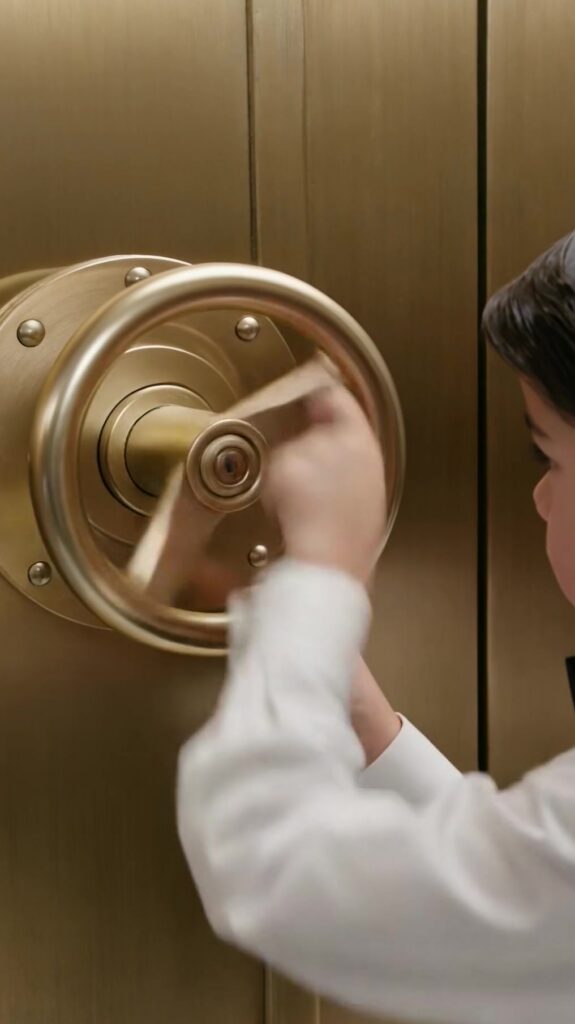
The vault sat at the back of Halverton & Co. like a mute judge, sunk into the wall behind the chandeliered showroom where men in tailored coats lifted crystal tumblers and spoke about security the way priests spoke about salvation. Its face was a disk of brushed steel, a wheel with spokes thick as a wrist, and around it the black granite had been polished until it reflected every smirk and raised eyebrow in the room.
For forty years it had been a story told with a proud laugh: Halverton’s vault had never failed. Not to drills. Not to fire. Not to brute force. Not to time. The rumor was that it had once been hauled out of a bank in a war zone, still sealed, still holding bonds and a wedding ring someone had hidden in the panic. The rumor was also that it had a temper, and that anyone who tried to bully it would find themselves humiliated.
On the night the story broke, the showroom was packed for another kind of ritual—an auction masquerading as a celebration. Smoke drifted from cigars, and the air smelled of money and expensive oak. Morgan Halverton stood near the vault with his sleeves rolled up like a man about to fix a stubborn engine. He was the sort of man who believed confidence could substitute for competence as long as there were witnesses.
“Gentlemen,” he announced, palm pressed flat to the steel, “this is the heart of the house. Some of you have questioned our methods. Tonight we put it to bed.”
He spun the wheel with theatrical force. The spokes blurred, then slowed. He leaned in, ear close to the metal, his jaw set. He turned the dial again, carefully this time, then tried the handle. He pulled. Turned. Forced it. Nothing moved.
A small laugh popped from the crowd, then another, then a few more, like coins dropped on a marble floor. Morgan’s smile stayed pasted on, but the tendons in his neck drew tight. He tried again—harder, less careful. The vault didn’t grant him even a shiver.
Something crept into the room then, thin as a draft: doubt. Not about the vault. About the man.
Morgan straightened, smoothing his shirt as if he’d meant for it to happen. “All right,” he said brightly, too brightly. “Let’s make it interesting. Ten thousand to anyone who can open it.”
The laughter died. Ten thousand was a line, not a joke. Eyes shifted toward the vault, then away, as if looking too closely would invite ridicule. The locksmith hired for the evening—an older woman with callused hands—stepped forward, examined the wheel, and shook her head once. “If it’s jammed,” she murmured, “it’s jammed.”
Silence laid itself over the crowd.
Then a boy moved from the far side of the room.
He was perhaps sixteen, thin in the way of someone who had learned to disappear in a hallway. His hair was dark and uneven, as if cut by impatient scissors. He wore a jacket that was almost too big for him and shoes that had seen better streets. No one had noticed him until he stepped into the light, but now the room seemed to tilt toward him, hungry for the next humiliation.
He stopped a few feet from Morgan and looked up with eyes that were calm, almost bored. “Are you sure?” he asked.
Morgan’s nostrils flared. “Sure enough to pay,” he said, and he gestured as if granting permission to a pet. “Go on, then. Make your attempt.”
The boy’s gaze flicked to the wheel, then past it, as if he could see through steel. He placed his fingertips lightly on one spoke. The room held its breath the way a body does before a fall.
Click.
The sound was small, but it went straight into the bones of the people listening. Clicks happened inside vaults, everyone knew that. Tumblers spoke. But this click was different—clean and certain, like the first note of a familiar song played after years of silence.
Click.
Morgan’s grin cracked. His eyes narrowed, not with skepticism now but recognition, the ugly sort that arrives when a hidden thing finds you.
The boy’s fingers moved with practiced patience. He wasn’t forcing anything. He was listening, answering in the same language the mechanism spoke. His wrist shifted by fractions. The wheel turned, stopped, turned again.
Morgan didn’t blink. Even his breathing seemed to pause, as if he feared the air might disturb the lock.
“Who taught you that?” he demanded, the words harsher than the room required.
The boy didn’t look up. “My father did,” he said, calm as a weather report.
Morgan’s face emptied of color. For a moment the crowd was nothing but a blurred border around him, and the vault behind him seemed to lean closer, as if it too wanted to listen.
“Step away,” Morgan said, suddenly low. It wasn’t a command meant for entertainment anymore. It was fear disguised as authority. “That’s enough.”
The boy kept his hand on the wheel. He turned it a hair’s breadth more, and another click sounded, final in a way that made the hair on the back of several necks lift.
“Or are you afraid of what’s waiting inside?” the boy asked.
A murmur ran through the room. Inside, the auction catalog promised legacy documents, a ceremonial key, a relic from the company’s founding—nothing that should frighten a man who had made his living selling safety. But Morgan’s eyes had gone glassy, fixed on a point somewhere past the steel, somewhere in a place that wasn’t the showroom.
“You shouldn’t be here,” Morgan whispered, and the whisper carried better than his earlier bragging. “Your father—”
The boy finally looked at him. “He told me to come when the vault refused you,” he said. “He said you’d make a spectacle of it. He said you’d offer money, because money is what you understand.”
Morgan’s hand twitched toward his pocket, toward the shape of a phone, toward an exit. His body knew it was trapped by pride and by the audience he’d invited.
The boy’s fingers tightened. There was a soft give, like a sigh from deep underground. The wheel stopped resisting. The handle turned under his palm as smoothly as if it had been waiting for him alone.
The vault door opened a crack, not swinging wide, just enough to let the breath of its interior escape.
Cold air rolled out, metallic and stale, carrying the faint scent of damp paper and something older—leather, perhaps, or blood dried long ago. The crowd leaned forward as one organism. Someone’s glass clinked against a ring.
Morgan lurched, one hand outstretched. “Don’t!” he barked, and the word ripped through the room. He shoved between the boy and the opening, trying to block it with his body as if he could stop what had already begun.
The boy didn’t flinch. “It’s not yours to keep sealed,” he said softly. “Not anymore.”
Morgan’s eyes were wet now, and rage fought panic behind them. “You don’t know what you’re doing,” he hissed. “You have no idea what’s inside.”
“I do,” the boy replied. “Because he told me.”
Morgan’s shoulders sagged the slightest bit, as if a long-held tension had finally snapped. “He’s dead,” he said, almost pleading. “Your father’s dead.”
“Then why,” the boy asked, “does this vault still answer him?”
He reached past Morgan, slid his fingers into the narrow gap, and pulled. The heavy door swung wider, protesting with a groan that sounded like the world remembering an old sin.
Inside were no gold bars, no jewels, no trophies of success. There were files wrapped in oilcloth. A ledger with a cracked spine. A sealed envelope stamped with a court mark. And at the very top, laid like an accusation, was a worn photograph of three men standing beside a vault door in another building, another era. One of the men was younger Morgan, his smile sharp. Another was the boy’s father, eyes shadowed, hand resting on the wheel the way the boy’s hand had rested just now. The third man’s face had been cut out cleanly with scissors.
The boy lifted the photograph and held it so the room could see the missing face. “He said you’d try to erase him,” he told Morgan. “He said you’d pretend the past was just a rumor. He said you’d count on the vault to stay quiet.”
Morgan made a sound like someone choking on a confession. “You can’t prove anything,” he said, but the sentence had no spine.
The boy reached into the vault and removed the envelope. He didn’t open it. He didn’t need to. The weight of it—the certainty—settled over the room like ash.
“Ten thousand,” Morgan croaked, trying to retrieve his old voice. “Take it and go.”
The boy looked at him with a patience that was almost cruel. “You offered that money for a trick,” he said. “This isn’t a trick. This is a door.”
He turned toward the crowd, toward the men who had come for a spectacle and found a reckoning instead. “My father built the lock you brag about,” he said. “He built it to keep something safe. Not to keep you safe.”
The vault had never failed, they would tell each other later, trembling over brandy and disbelief. That was still true, in a way. It had done exactly what it was made to do: it had waited until the right hands arrived. It had refused the unworthy. It had guarded its secret with the patience of steel.
Until that night, when it finally decided the secret was no longer meant to stay buried.
And as Morgan Halverton stood before the open mouth of his own legend, the boy stepped past him and walked out of the showroom with the envelope held close, leaving behind the smell of cold metal and the sound of a vault admitting, at last, what it had known all along.