At the top of the glass tower, the city looked like a spilled constellation—lights scattered, streets braided into veins of traffic, rain pressing its cold palm to every window. Inside the penthouse ballroom, nothing so humble as weather was allowed to exist. Crystal chandeliers held the night at bay. Strings whispered from a small stage. Waiters moved like practiced shadows, bearing trays of champagne and little glass spoons of caviar that tasted of salt and money.
Calder Rowe stood near the terrace doors, half turned toward the skyline, as if the view could distract him from the room’s relentless attention. The board members and donors drifted around him in careful circles, speaking as though their tongues were made of silk and their teeth of knives. Every so often a laugh rose, too bright, too sharp, the kind that signaled the room had decided to be pleased.
Beside Calder, Elowen Hart—his fiancée, the philanthropic darling of the city—held court with a serene smile. Her gown was a pale sheen of silver, fitting her as though it had been poured and cooled. Her hand occasionally brushed his sleeve, a reminder of what the night was for: the announcement, the merger, the future they’d promised each other in front of cameras and contracts.
A podium waited at the far end of the room like a loaded weapon. In minutes Calder would step up, accept applause, speak about legacy and vision, and his name would be printed again in tomorrow’s headlines. Tonight was engineered. Nothing accidental could get in.
Except it did.
The door to the service corridor opened with a small sigh. No one glanced up. No one broke stride. If a person entered without an invitation, the room’s collective instinct was to deny their existence until security removed the inconvenience. A girl, no older than ten, slipped through with the quietness of a dropped feather. Her dark hair was pulled back in a careless knot. She wore a plain gray dress and shoes wet from rain, leaving faint prints on the gleaming floor. Not a single head turned. The music kept playing. The conversation continued.
The room didn’t notice her entrance.
She walked forward anyway.
Through the drifts of gowns and tuxedos she moved as if she carried a map no one else could see. She didn’t hesitate at the clusters of expensive bodies; people unconsciously stepped aside without understanding why. It was not that they saw her—only that some primitive part of them recognized determination, the kind that does not ask permission. A waiter glanced down, startled to find his path disrupted, then looked away as though embarrassed by the intrusion of a child into his polished reality.
Only when the girl stopped did the air begin to shift.
She halted in the open space before Calder Rowe.
There was a ripple, a subtle constriction, as nearby conversations faltered. Eyes began to notice the small figure standing where no one dared—between the man of the hour and the rest of his curated world. Someone whispered, almost breathless, “Whose kid is that?” Another voice, sharper, hissed, “Someone get her out.”
Calder’s first reaction was irritation—a flash of it, quick and hot. Children did not belong here. The event had been designed to avoid surprise. He turned slightly, searching for security, for the nearest handler who could return the stray to wherever it had come from.
The girl didn’t flinch. She didn’t speak. She didn’t even look around at the faces now turning toward her like flowers following an unwelcome sun. She simply reached into her pocket with steady hands and took out something that caught the chandelier light and threw it back in a hard, pale glint.
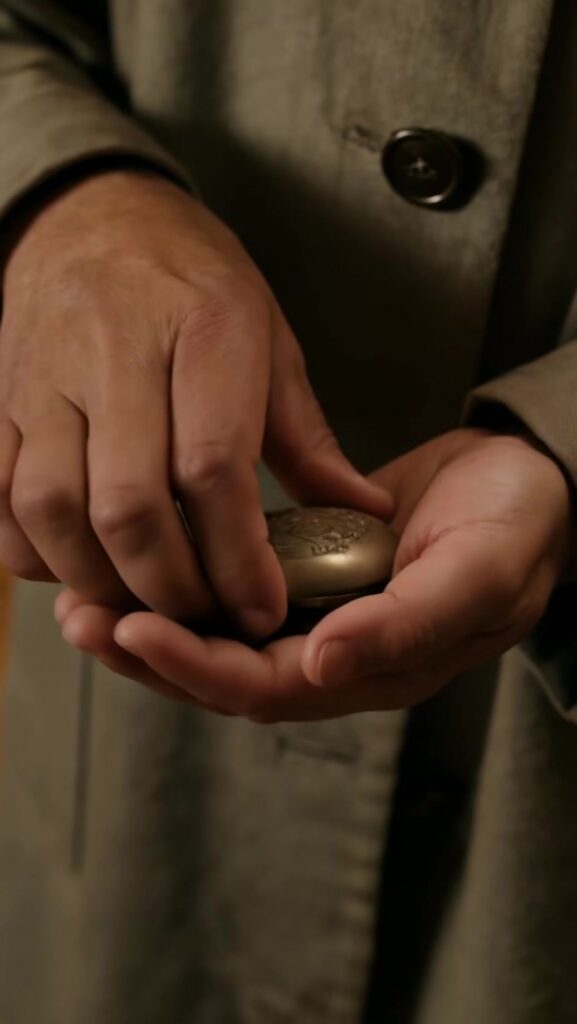
A silver locket.
She placed it on the marble-topped cocktail table between them with the care of someone setting down evidence. The sound it made was soft. Yet it landed like a gavel strike.
Calder glanced at it—only a glance, meant to measure the threat, to classify it as cheap trinket or sentimental bait—and then his lungs forgot what they were for. His throat tightened as if a fist had closed around it.
The locket was oval, tarnished at the edges, engraved with a small mark near the hinge: a star split by a thin line, imperfect and unmistakable. A mark Calder had not seen in fifteen years, not since the night he had buried the past under rain and sirens and a deal signed with shaking hands.
His own hand went to his chest before he decided to move it. Beneath his shirt, against his skin, hung another locket on a chain he never removed. A relic he pretended was meaningless, even to himself. His fingers found the familiar ridge of the split star.
Across the table, the girl watched him with eyes too calm for her age.
Calder swallowed, a sound that seemed too loud in the hush. “That’s… impossible,” he said. He meant it as denial, as shield. The word floated out and broke apart under the weight of the room’s silence.
“My mom told me you’d say that.”
Her voice was small but steady. It carried. It reached the people pretending they were not listening and hooked behind their ribs. Calder saw heads angle closer. He saw phones lowered. Elowen’s hand tightened on his arm, not in support but in warning.
Calder stared at the girl’s face as if it were a puzzle made of familiar pieces. The curve of her brow. The stubborn set of her mouth. He felt a sick, surreal vertigo—as though the skyline outside had tilted and the glass tower were sliding into the streets.
“What’s your name?” he asked, and hated how his voice shook.
“Mara.” She said it like a fact, not an introduction. “Mara Lorne.”
The surname hit him harder than the locket. Lorne. A name he had once spoken into a phone at three a.m., begging, bargaining. A name he had promised to protect, then failed.
Elowen made a sound—barely audible, more breath than noise. Calder turned his head. Her smile was still on her mouth, but it had changed. The corners no longer lifted. The warmth had drained from it like color from a photograph left in the sun.
“Calder,” she murmured, her voice sweet enough to fool strangers. “This is a misunderstanding. Tell her to go.”
But Calder couldn’t look away from the locket. Memory unspooled with cruel clarity: a cramped apartment above a laundromat, the smell of soap and burnt toast; a woman with ink-stained fingers and tired laughter; a promise made while the world was falling apart. He remembered pressing a matching locket into her palm, both of them laughing at the melodrama of it. Two halves of the same vow. Two split stars, meant to reunite one day.
“Where did you get that?” Calder asked Mara.
“It was my mom’s.” She kept her hands at her sides, brave and still. “She said if anything ever happened, I should find you. She said you’d recognize it, even if you pretended not to.”
The room breathed in a single, collective inhale. Calder’s mind raced to explain, to calculate. He had heard rumors, years ago, that Anya Lorne had disappeared. He had filed it away as one more consequence of the life he’d escaped. He had not allowed himself to look back, because looking back meant seeing the bodies left behind by ambition.
“Your mother…” Calder began, the words scraping. “Anya?”
Mara nodded once. “She’s gone.”
The sentence was blunt, like a door slammed without warning. Calder felt his knees threaten to fold. He gripped the edge of the table, knuckles whitening, and the locket shivered under the pressure like a living thing.
Elowen’s fingers dug into his arm. “Calder,” she said again, and now there was steel under the sugar. “This is not the time. Not here.”
Mara’s gaze slid to Elowen, and something in it—an old, learned caution—made Calder’s stomach turn. The girl looked at Elowen the way you look at a locked gate you’ve been warned about.
“She told me about you too,” Mara said softly. “She told me to be careful. She said you’d be standing next to someone who smiles like a knife.”
Elowen’s composure faltered. For the first time all night, her expression cracked. Not into anger—not yet—but into something colder: recognition. Fear, expertly hidden, yet there all the same.
Calder’s pulse roared. Pieces shifted in his mind—old phone calls, signed agreements, the sudden disappearance of certain files, the way Elowen had always been strangely interested in anything that touched Anya’s name. The way she had once asked, too casually, if he still kept “souvenirs” of his life before he became a Rowe.
Security finally began to move, belatedly sensing the change in the room’s temperature. A man in a black suit approached with polite menace, hand poised to usher Mara away.
Calder lifted his palm. “No.” The word came out with authority that startled even him. The security man froze mid-step, caught between protocol and power.
Calder reached under his shirt, drew out his own locket, and placed it beside Mara’s on the table. Two silver ovals. Two split stars. Identical scars on matching metal.
A murmur spread through the room, a wave of shocked fascination. People leaned in, unable to resist the gravitational pull of scandal. Somewhere, a camera flashed. Calder didn’t care. The future he’d been about to announce evaporated like breath on glass.
He looked at Mara as though trying to memorize her before the world could take her too. “Why did she send you now?” he asked.
Mara’s jaw tightened. “Because she couldn’t protect me anymore.” She took a breath. “And because she said you were the only one who could prove what really happened. She said you know who took her.”
Calder’s eyes flicked to Elowen. Her face was smooth again, but the smile was gone entirely, as if she had decided there was no longer any use for it. In its place sat a calmness that was far more dangerous.
“Calder,” Elowen said, voice low, intimate, meant only for him. “Don’t do this. Not with everyone watching.”
But everyone was already watching. The room had not noticed Mara’s entrance, but it would never forget the moment she made it stop. Calder felt the weight of every gaze like hands pressing him into the truth.
He looked back at Mara, at the wet hem of her dress, the stubborn courage holding her upright. A child who should have been invisible in a place like this, yet had made the powerful tremble.
Calder straightened, releasing the table. “She’s with me,” he said, loud enough to carry. The words tasted like fire and repentance. “No one touches her.”
Mara’s shoulders did not relax, but her eyes sharpened, as if she’d been waiting years for that sentence. Elowen’s gaze hardened, her mask slipping at last to reveal what lay beneath: calculation, and something like rage.
Outside, the rain intensified, drumming against the windows like an audience demanding a verdict. Calder knew, with sudden certainty, that the night was no longer about mergers or speeches. It was about a locket placed on a table, a promise dug up from the grave, and a little girl who had walked into the heart of power and dared it to remember.
When Calder took Mara’s hand, her fingers were cold from the rain. His were cold from fear. Together, they turned toward the waiting podium—toward the room that had finally noticed them—while Elowen Hart stood perfectly still, her smile vanished, and the city’s lights below blinked like witnesses.