The man thought it was a joke the moment the boy stepped onto the small stage set up in the community hall. A microphone that squealed when it breathed, folding chairs packed tight, and a banner that read FUNDRAISER NIGHT in tired, crooked letters. It had the flavor of harmless embarrassment—cupcakes, raffle tickets, and someone’s cousin playing acoustic covers.
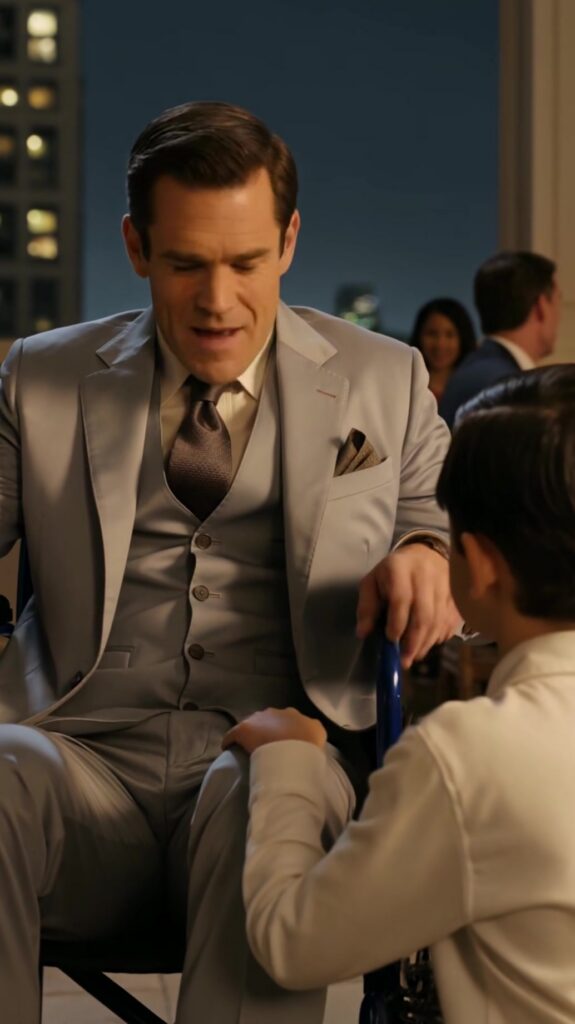
Graham Holt sat in the second row with his arms crossed, jacket still on though the room was warm. He hadn’t planned to be here. He’d come to drop off a check, let his photo be taken for the local paper, then slip away. That was the arrangement: his company gave, the town clapped, and Graham returned to his office where everything stayed predictable and under his control.
Then the boy took the mic.
He wasn’t a performer in the way the others had been—no sequins, no practiced grin. He looked maybe twelve, too thin in a button-up shirt that hung slightly wrong, as if borrowed. His hair had been combed with intention and then gave up halfway through the night. He held himself carefully, like someone carrying a glass of water filled to the rim.
The host introduced him as “Eli Harrow, with a little demonstration.” The word demonstration made Graham smirk. It was going to be a magic trick. A coin behind the ear. A volunteer from the crowd made to look foolish. Graham had already seen where it was headed.
Eli’s eyes searched the room, passing faces that smiled politely, and landed on Graham. Not the host. Not the mayor. Graham. The boy’s gaze didn’t bounce away. It stayed as if it had been aimed.
“Sir,” Eli said, voice clear, oddly steady. “Will you help me?”
A ripple of delighted anticipation moved through the crowd. Graham, caught in the light of attention, lifted his chin in a measured way. Refusing would look petty. Agreeing would cost him two minutes and a polite laugh. He stood and walked up, hearing the scrape of chairs and the soft applause that always accompanied obedience.
Eli didn’t offer his hand. He only watched Graham climb the steps and stand beside him.
“What’s the trick?” Graham murmured, leaning in, expecting a whisper of instructions.
“It’s not a trick,” Eli replied, not whispering at all.
The room quieted a little. Graham’s mouth tightened. He saw several phones lift, people ready to record whatever joke was about to bloom.
Eli faced him. Up close, Graham noticed the boy’s eyes were a strange gray—like rainwater over stone. “Count with me,” Eli said.
Graham let out a small laugh he couldn’t stop. It sounded hollow. “Count?”
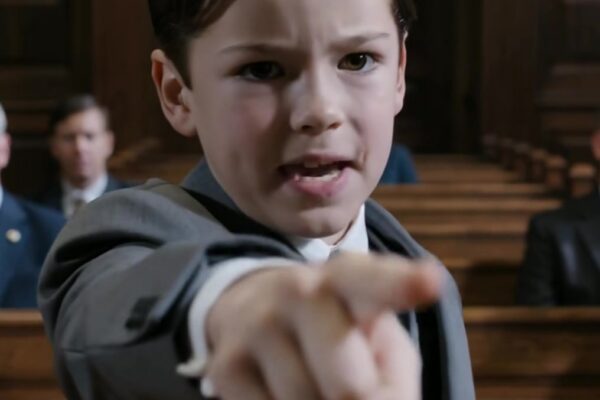
“Yes,” Eli said, and lifted one hand, palm forward, fingers spread in a solemn, schoolroom gesture. “Just count. Out loud.”
The host chuckled nervously into his own microphone and then lowered it, as if sensing he should not interrupt.
Graham looked at the audience. They were smiling, ready. He played his part. “Alright,” he said. “One.”
Nothing happened.
Laughter bubbled in the back. Someone coughed in that way people do when they’re about to laugh too hard.
Graham’s shoulders loosened. See? Harmless. “Two,” he continued, louder.
The change was so small at first he almost missed it. It wasn’t an explosion or a flash of light. It was a sensation—a tightening around his right ankle, like an invisible hand had wrapped itself there. Graham shifted his weight automatically. The floor felt suddenly uneven.
He looked down.
His right foot was turned slightly inward, as if trying to face away from him.
A bead of sweat slid from his temple. His smile faltered.
“Three,” Eli said, not prompting, simply continuing the rhythm with his eyes. He didn’t blink.
Graham swallowed. “Three.”
His calf seized. Not a cramp—the wrongness of it was immediate. It wasn’t pain yet; it was command. The muscle contracted like it had been ordered to, like it belonged to someone else now. Graham tried to straighten his leg, but it resisted, stiffening as if braced against him.
The laughter died in confused fragments. The phones lowered, then rose again for a different reason.
Graham’s breath came sharp. “What is this?” he hissed, keeping his voice down. “Stop it.”
Eli’s expression did not change. “Four,” he said, calmly.
Graham’s mouth went dry. His instinct was to step away, to retreat down the stairs, to do anything that would put distance between himself and the boy’s gray, unwavering gaze. He tried to lift his right foot.
It did not lift.
His foot stayed planted as if nailed to the stage. The ankle trembled. The knee gave a tiny, humiliating wobble. Graham felt his balance go, his body searching for a center it no longer recognized.
The crowd was silent now, the fundraiser hall transformed into a courtroom where no one knew who the judge was.
Graham looked at Eli again and found something there that chilled him—not anger, not triumph, but certainty. Like a doctor counting down before a procedure. Like someone reading numbers off a list written long ago.
“Count,” Eli repeated. “With me.”
Graham’s heart hammered. “Five,” he forced out.
The sensation climbed. His thigh locked. His hip tightened. It was as if his own body was becoming an argument against him. He tried to shift left, to unstick himself, and his left leg answered reluctantly, dragging his torso at an awkward angle. He looked like a puppet with one string cut.
“Sir,” Eli said softly, almost gently now, “don’t fight it.”
Graham’s pride flared, bright and useless. He clenched his jaw. He tried to move his right leg with pure will—commanding it like he commanded rooms, employees, contracts. He pictured it lifting. He pushed.
And right at that moment—
The stage seemed to tilt beneath him. Not literally; the hall remained level. But Graham’s mind pitched as a memory slammed into him with the suddenness of a door kicked open. A corridor of a hospital years ago. White walls. A child’s hand slipping in his. A small voice counting, terrified, whispering numbers to keep from crying.
“One,” the child had said, squeezing his fingers. “Two.”
Graham’s throat constricted. He saw it with horrifying clarity: not Eli’s face but another boy’s, paler, lying under fluorescent lights. The paperwork. The diagnosis. The moment Graham had decided there was a meeting he couldn’t miss, a deal he couldn’t delay. The way he had walked out thinking he’d return in an hour and then let an hour become a day become a lifetime of excuses.
“You left him,” Eli said, voice still calm, but now the words were a blade slid between ribs. “You left my brother.”
Graham’s eyes snapped to Eli’s. “What—”
“Count,” Eli said again. “So you remember.”
Graham’s right leg jerked violently, not under his control, and his body pitched forward. He caught himself on the microphone stand. It clanged, and the sound rang out like a bell. Gasps rose from the audience. Someone stood up as if to come help, then froze, unsure whether they were witnessing illness or performance or something that had no name.
Graham’s voice cracked. “I don’t know you.”
“No,” Eli said. “You didn’t want to.”
Graham’s mind raced through faces, timelines, old mistakes he had filed away. Years ago, in a charity hospital, a mother who had begged him in the hallway—begged for a ride, for money, for a signature on a form. He had said he couldn’t. He had walked past. He had told himself it wasn’t his responsibility. He had thought he’d forgotten. But forgetting, he realized, was only something the powerful got to pretend they could do.
Eli’s hand remained raised, palm out, like a stop sign. Like a blessing. Like a sentence.
“Six,” Eli said, and Graham, shaking, obeyed without knowing why. “Six,” Graham echoed, and his right leg finally released—but only enough for him to collapse to one knee. The relief was immediate and humiliating, and it came with pain now, a deep ache in muscles that had been forced into rebellion.
The boy crouched so their faces were level. Up close, Eli smelled faintly of soap and paper, as if he’d washed his hands too many times.
“This is what it felt like,” Eli whispered, and the microphone, still close, carried the words to the room. “Watching someone bigger than you decide you don’t matter. Your body wants to run, but it can’t. Your voice wants to shout, but it gets swallowed.”
Graham’s eyes stung. He didn’t know if it was from the bright stage lights or the way something inside him had been cracked open. “I—” he began, but there was no sentence that could cross the distance of years.
Eli straightened and looked out at the audience. “I didn’t come here for laughs,” he said. “I came because people keep calling what happened to us ‘unfortunate.’ Like it’s weather. Like no one makes choices.”
The hall was silent, the air heavy with the unshared understanding that they were all watching a reckoning, and none of them knew whether to clap or pray.
Eli turned back to Graham. “Seven,” he said, quieter now, almost kind.
Graham’s lips trembled. He could feel his leg again—his own leg, aching, present, painfully human. The spell, the trick, the whatever-it-was had done its work. He understood the simple terror of being unable to move. He understood, for one sharp moment, how a child had counted to survive abandonment.
“Seven,” Graham whispered.
Eli lowered his hand. The invisible pressure vanished. Graham’s muscles, freed, shook with aftershock. He stayed kneeling, not because he couldn’t stand, but because he couldn’t bear to rise as if nothing had happened.
“Now,” Eli said, voice barely audible, “we can start.”
The host, pale, stepped forward as if waking from a dream. The audience held its breath. Graham looked down at his hands, then up at the boy, and felt the strange, terrible certainty that the joke had never been on him.
It had been on the idea that he could walk away forever and still call himself untouched.
On the stage, under the fundraiser banner and the humming lights, Graham Holt finally understood that counting was not a game. It was a measure of time, of choices, of what you owe when you’ve taken someone’s hope and left them to number the seconds alone.
And somewhere deep within the silence, the number that came next waited like a door.