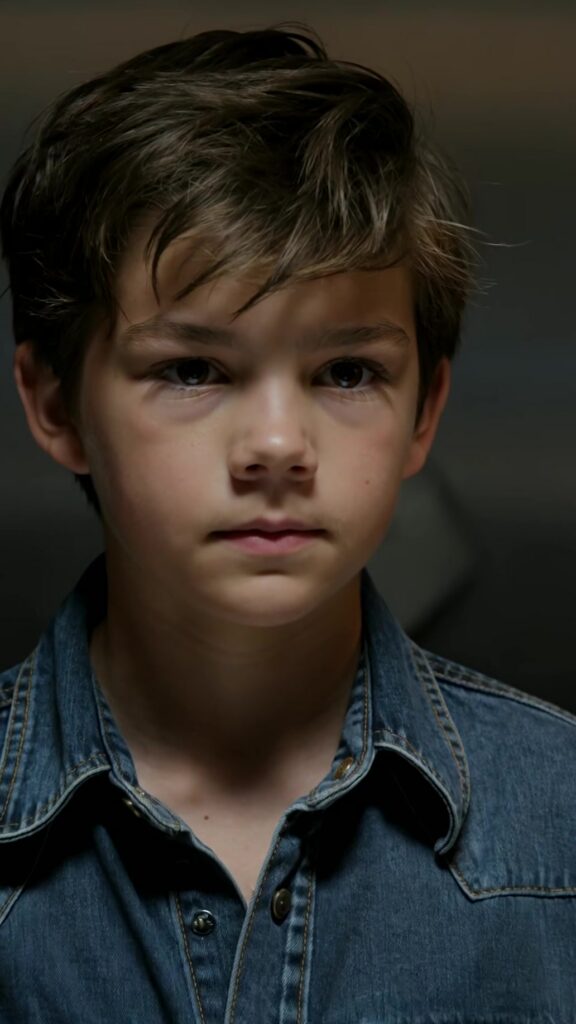
The vault door closed behind him with a sound that wasn’t merely loud. It was final. It had weight. It spoke in iron grammar: you entered, and the world behind you was no longer part of the sentence.
The corridor that led to Vault Seventeen was narrower than the lobby upstairs suggested, its walls lined with old conduit and newer cameras, every lens disguised as something harmless—an emergency light, a brass placard, a screw head that watched back. The air tasted of disinfectant and dust. Beneath the bank’s polished floors, time congealed.
The boy walked as if he had memorized the route in his sleep. He didn’t gape at the interlocking doors or the keypad panels that demanded codes and palm prints. He didn’t pause at the sign that warned AUTHORIZED PERSONNEL ONLY in letters meant to intimidate grown men. His sneakers made small, deliberate sounds on the concrete, and each sound felt like a dare.
At the end of the corridor, the manager waited. Not in a suit like he wore upstairs—down here he had rolled sleeves, a headset, and the tense posture of someone who believed he owned everything the lights touched. He had brought security, too: a guard with hands like spades and a holster that couldn’t hide its purpose.
“You can’t be here,” the manager said, as if the words alone could reverse what had already happened.
The boy climbed onto the stool at the counter, his chin just high enough to look the man in the face. From his pocket he produced a single key and placed it on the steel surface. It was small, old, and dull as a tooth. But it landed with a clarity that silenced the room.
“You’ve been keeping something that isn’t yours,” the boy said.
The manager’s mouth bent into a practiced smirk, the kind designed to turn fear into embarrassment. “Kid,” he said, letting the word fall like a coin into a well, “you don’t even know where you are.”
The boy’s gaze didn’t flicker. “My grandfather trusted you,” he said, quietly enough that it forced everyone to lean in. “And then he disappeared.”
Not died. Not passed. Disappeared—a word that implied agency, a hand over a mouth, a door closing. The guard shifted his weight, the leather of his belt creaking.
For a moment, the manager’s expression rearranged itself into something almost human. Almost. “Then you’re too late,” he replied, voice lowering. “Whatever you think you can do, it’s done.”
The boy slid the key forward an inch. “Open Vault Seventeen.”
Silence spread, quick and invasive, as if it could seep into the cameras and short them out. The manager stared at the key as though it had spoken. Vault Seventeen was a number that didn’t get mentioned. An old unit, a relic. A story told to new employees the way sailors tell stories about reefs: don’t sail there.
“Who told you that number?” the manager asked.
“The same person who’s still waiting down there,” the boy said.
The guard snorted, a sound that tried and failed to become laughter. The manager looked at him sharply, then back at the boy. “There is no one down there,” he said. But the sentence lacked conviction, as if he’d borrowed it from someone else.
The manager reached for the console. His fingers hovered over the keypad, hesitated, then began to move. He entered a code that was longer than anyone would use for something trivial. The screen accepted it with a bland green confirmation. A second prompt appeared: SECONDARY AUTHORIZATION REQUIRED.
He pressed his thumb to the scanner. The machine whirred, read his skin, and hesitated. The lights above seemed to dim by a fraction. Then the screen flickered.
Processed.
And then—froze.
“…that vault,” the manager murmured, and the word came out raw, “was sealed from the inside.”
The guard’s hand moved nearer to his holster. He didn’t draw. He didn’t need to. The message had drawn something else: an old fear, stored in bone.
“That’s impossible,” the guard said, though his voice sounded like he was arguing with the building itself.
The boy leaned forward, elbows on the counter, face still. “Nothing in this place is impossible,” he said, “if someone wants it hidden badly enough.”
The manager’s eyes narrowed. “You’ve been told a story,” he hissed. “And you’ve been used.” He took the key between two fingers, as if it might contaminate him. “This doesn’t mean anything.”
“It does,” the boy answered. “That key was in my grandfather’s ring. The one he never took off. The one you returned to my mother in a plain envelope with no apology.”
The manager’s smirk finally died. “I didn’t—” he began, but the boy cut him off.
“You did,” the boy said. “And you thought that would be the end.”
He slid off the stool, stepped around the counter with a confidence that made the guard’s brow furrow. The manager, caught between outrage and something like dread, didn’t stop him. The boy approached the vault door—taller than he was, thick as an oath—set into the wall like an eye that refused to blink.
He raised his hand. Not to touch the wheel. To listen.
The three of them stood, suspended, and in that suspended moment the bank was no longer a bank. It was a mausoleum with fluorescent lights.
From the other side of the vault door came a faint metallic click. Not loud. Not clear. But undeniable.
The boy exhaled. “He’s there,” he whispered.
The manager’s face drained. “No,” he said, too quickly. “No. That’s not possible.” But his eyes betrayed him. He knew the sound. He had heard it once before, years ago, through a wall he’d sworn would hold.
The console, still frozen, suddenly cleared. The screen refreshed as if the system had been waiting for a decision. ACCESS GRANTED blinked in clean, indifferent letters. The manager didn’t press anything this time. The mechanism engaged on its own, bolts retracting with a series of deep, measured thuds that sounded like a heart being unlatched.
The door opened.
Inside there was no cash. No stacks of bonds. No boxes of jewelry. The vault’s shelves were bare, scraped clean, as if every practical item had been removed with intent. Only one object sat at the center on the floor: a small metal box, the size of a lunch tin, its surface pitted and scratched. It looked like something that had been dragged across concrete in the dark.
The boy walked in. The vault door began to swing back, slow but inexorable, as if the room itself wanted privacy. The manager lunged forward and slapped his palm against the edge, holding it open by force.
“Don’t,” he barked, and the word was no longer managerial. It was terrified.
Too late.
The boy crouched and lifted the box. Its weight surprised him; he adjusted his grip and set it on a shelf. There was no lock—only a clasp, bent, as if someone had opened and closed it too many times with shaking hands. He snapped it free.
Inside lay a bundle wrapped in waxed paper and tied with twine. The boy untied it carefully, like a surgeon. The paper peeled back with a sound that made the manager flinch. Beneath it was an object too small to be a fortune, too plain to be a treasure.
A finger.
Not the whole hand. A single finger, preserved, the nail bruised black, the skin waxy and pale. Around it was a gold ring engraved with a set of initials and a date. The boy’s throat tightened, but he did not cry. He had practiced not crying. He had learned early that grief could be weaponized against you.
He looked at the engraving. It was his grandfather’s ring.
There was more in the box, beneath the waxed paper: a thin cassette tape in a cracked plastic case, an old-fashioned key tag stamped with “17,” and a folded strip of paper so worn it seemed as fragile as skin. The boy unfolded it. The handwriting was shaky but familiar from the notes his grandfather used to leave on the kitchen table.
If you are reading this, they let you in. That means the door did not hold, or they did not want it to.
The boy swallowed and continued.
Listen to the tape. Do not trust the man upstairs. Do not trust the man beside him. The vault is a mouth and they have fed it for years.
The manager made a sound that wasn’t a word. His knees seemed to forget their purpose. The guard, rigid by training, stared at the finger as if it had pointed directly at him.
The boy turned slowly, holding the open box out toward the manager. He did it with both hands, as though presenting an exhibit in court.
“You told my mother he was gone,” the boy said. His voice did not tremble. “You gave her a ring you thought proved it.” He lifted the ring now sitting on the preserved finger. “But you didn’t know he kept a second.”
On the boy’s chain, against his throat, the twin ring caught the vault light—a matching band he’d worn under his shirt the entire time, hidden from cameras, hidden from eyes that thought they knew what to look for.
The manager stared at it, and something inside him broke open. His lips parted, but no sound came. His chest rose in a desperate breath and refused to complete it, like lungs suddenly remembering every secret they’d been forced to hold.
“He wasn’t supposed to be found,” the manager managed at last, the words scraped from him. “We buried him. We—”
“You buried a story,” the boy corrected. “Not a body.”
He reached into the box and took the cassette tape. It felt absurdly ordinary in his hand. The kind of thing people forgot existed. But his grandfather had always loved things that could be hidden in plain sight.
The boy walked past them into the corridor. The guard tried to step in front of him, then hesitated, caught between orders and the sudden certainty that the orders were rotten. The manager followed, hands out, pleading without dignity.
“You don’t understand what you’re doing,” he said. “If you take that out—if anyone hears—”
The boy stopped at the threshold. The vault door, heavy and patient, hovered open behind him like a held breath. He looked back at the manager, eyes cold with a certainty that didn’t belong to children.
“I understand,” he said. “You thought the vault was the end of it.”
He lifted the key tag with “17” and let it swing once, a small pendulum marking time.
“It’s the beginning,” he said.
Then he stepped out, and the door finally swung shut, sealing the manager’s panic on the other side with the same final, heavy sound that had welcomed the boy in.