The cemetery was quiet except for the wind, the kind that slid between headstones as if it were looking for someone. It worried the tall grass along the iron fence and combed through the cedar branches until the whole place seemed to breathe in slow, patient shivers.
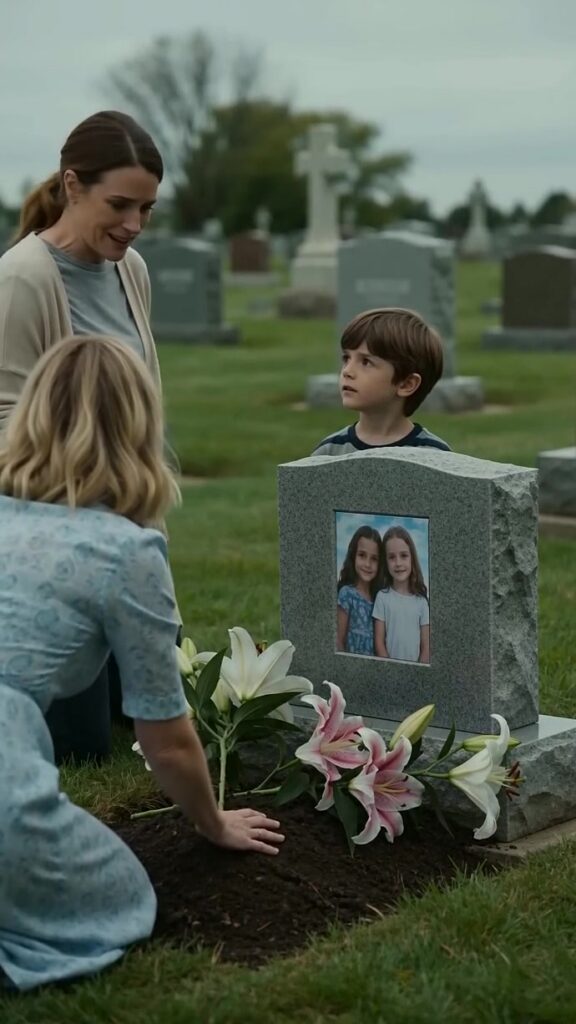
Mara knelt before the newest mound of earth as though she’d been lowered there by strings. Her light blue dress gathered dirt at the knees; she didn’t notice. She held a bundle of lilies—white at the center, pink blushing toward the edges—and her fingers trembled so hard the stems clicked together. She set them down with a care that felt almost superstitious, like roughness might make what had happened more real.
The headstone was still raw-gray, the edges too sharp, the engraving too clean. A portrait had been affixed to the front: two little girls with matching gaps in their smiles, hair tied with bright ribbon bows, cheeks pressed close as if the photographer had begged them not to wiggle. Mara’s throat tightened at the sight of those familiar faces, frozen in that moment of ordinary joy that now looked like a mistake the world had refused to correct.
“Hi, babies,” she whispered. The words scraped out of her as if her voice had become a dry brush. “I brought the flowers you like.”
She touched the stone with the flat of her fingers, gentle as a blessing, as if warmth could still travel through granite and photograph paper, as if the surface might respond with a pulse. For a moment she listened—ridiculous, desperate—expecting a sign. All she heard was wind and the faint rustle of petals shifting.
Footsteps sounded behind her: careful, uncertain. Mara didn’t turn. Grief, she had learned, made you territorial. She could feel people’s eyes from across the cemetery, the quick glances that always slid away. Most came to their own dead and left quickly, afraid of catching someone else’s sorrow like a sickness.
A woman in a beige cardigan had wandered too close with a small boy at her side. They weren’t carrying flowers. They had the look of passersby who had mistaken the cemetery path for a shortcut between streets. The woman’s discomfort was immediate—her shoulders rose, her hand tightened on the boy’s, and her gaze flicked to Mara and then away, as if she’d stepped into a room without knocking.
“Come on,” she murmured to the child, beginning to steer him back the way they’d come.
But the boy stopped. His feet planted as if the ground had decided for him. He stared at the portrait on the headstone with a concentration that didn’t belong to a child in a place like this. His brows drew together. His mouth fell slightly open.
Then he lifted his hand and pointed.
“Mom,” he said, voice clear in the cold air, “those girls are in my class.”
The wind seemed to falter, as if even it had paused to listen. Mara’s body reacted before her mind could brace. She turned so fast her balance shifted, her palm sliding along the stone for support. For a second her face was emptied of expression—no tears, no breath, just a blankness like a door slammed shut.
The standing woman forced an uneasy laugh that didn’t match her eyes. “I’m so sorry,” she said too quickly, the words tumbling over each other. “He—he must be mistaken. Children, you know. They see faces everywhere.”
But the boy didn’t look mistaken. He lowered his hand slowly without taking his gaze from the portrait, as though putting the pointing away was a rule he’d just been taught but didn’t understand.
Mara’s fingers clenched around the lilies she’d brought; petals crumpled, bruising pink against white. She stared at the child as if he’d reached into the ground and yanked at roots that should never be disturbed.
Hope arrived the way lightning does—violent, impossible, and for a moment brighter than fear. It was a dangerous thing. It had shattered her once already in the days after the accident, when she’d woken convinced she’d heard little feet in the hallway and then remembered the empty rooms. She’d sworn she wouldn’t let it in again.
Her knees shook as she stood. Dirt clung to her dress, dark half-moons. She took one careful step toward them, as if a wrong move might make the boy’s words vanish.
“Please,” she said, the syllable thin as glass. “Can I ask him what he meant?”
The woman hesitated. Her gaze dropped to the grave, to the portrait, to Mara’s flowers. She looked like someone watching a stranger lean too close to a precipice. “I don’t want to upset you,” she said softly. “He’s only five. He says all kinds of—”
“I need to hear it,” Mara interrupted, and hated the harshness in her own voice but couldn’t soften it. Her hands trembled, not from cold now but from the effort of staying upright. “Please.”
At last the woman loosened her grip on the boy’s shoulder, though she didn’t step away. “Leo,” she said gently, “what do you mean they’re in your class?”
Leo looked from his mother to Mara. He didn’t look frightened, only bewildered that the grownups were suddenly made of cracks. “They sit beside me,” he said, as if that should settle everything. “On the blue rug. When we do letters.”
Mara’s breath caught so sharply it hurt. The cemetery tilted for a moment, the stones and trees going slightly out of focus as her mind hunted for reason. It was impossible. Her girls—Elsie and Rowan—had been buried here six months ago. Mara had watched the caskets lowered. She had heard the first shovelful of dirt strike wood and felt something in her break with the sound.
And yet the boy spoke with the uncomplicated certainty of children who hadn’t learned to lie politely.
“Their names,” Mara managed, each word forced through a throat gone tight, “what are their names?”
Leo blinked, thinking. “One is Ellie,” he said, mispronouncing it the way Mara’s Elsie used to correct people. “And one is Ro.”
Mara’s knees threatened to fold again. She reached out and gripped the edge of the headstone for balance. Her fingertips left faint smudges on the polished photo cover.
“And one of them said—” Leo continued, as if finishing a story he’d started at breakfast. He glanced at his mother, then back at Mara. “One of them said not to tell the teacher. She said… you wouldn’t like it.”
The woman in the cardigan stiffened. “Leo,” she warned under her breath, suddenly uneasy. “That’s not appropriate.”
Mara barely heard her. Her mind rushed, tripping over memories: a school brochure Elsie had begged her to read, the way Rowan used to whisper secrets into Mara’s ear and then dissolve into giggles. The way children invented games with invisible friends.
“Why wouldn’t I like it?” Mara asked, her voice barely there.
Leo’s face pinched with effort, the way children look when trying to hold on to a detail adults keep snatching away. “Because they’re not… supposed to be there,” he said. “They said they’re hiding.”
The wind pushed harder now, rattling the cemetery gate. Somewhere deeper among the stones, a crow called once and went quiet. Mara stared at the portrait again. The girls smiled back, bright and permanent, as if they knew something she didn’t.
“Hiding from who?” she asked.
Leo shifted, uncomfortable. “From the loud man,” he said, and then, as if to clarify, “the one who smells like pennies. He comes in the hallway sometimes. He doesn’t have a face.”
The woman’s hand snapped back to Leo’s shoulder. “That’s enough,” she said firmly, alarmed now. She looked at Mara as though expecting her to collapse or scream. “I’m so sorry. He’s been having nightmares. We shouldn’t have—”
But Mara’s grief had found a new shape. It was no longer only a hollow ache; it was a blade turning slowly, searching for a place to cut. The phrase smelled like pennies opened something old in her memory—metallic and sharp. Blood. The emergency room. The way the doctor had said the word accident with too much certainty, as if saying it often enough made it true.
Mara swallowed, tasting soil and petals. “What school?” she asked, staring past the cardiganed woman to the child as though the answer were written on his small, steady face.
“Cedarbrook,” Leo said. “Miss Tessa’s class.”
Mara’s hands closed around the lilies again. Her knuckles whitened. Cedarbrook. Her girls’ school had been Cedarbrook—until the day after the funeral, when the principal had sent a sympathy card and Mara had shoved it into a drawer because the sight of the school logo made her sick.
She looked down at the grave. At the mound that everyone, including Mara, had agreed contained the end of everything. The wind lifted a corner of her dress and let it fall again like a sigh.
“Thank you,” Mara whispered, and she didn’t know if she was speaking to the boy, to the dead, or to whatever cruel mechanism of the world had chosen to hand her a thread.
Then she leaned forward, placed the bruised lilies on the soil, and pressed her palm to the headstone one more time—not tender now, but steady, as if making a vow.
“If you’re hiding,” she murmured, too low for the others to hear, “then I’m coming.”