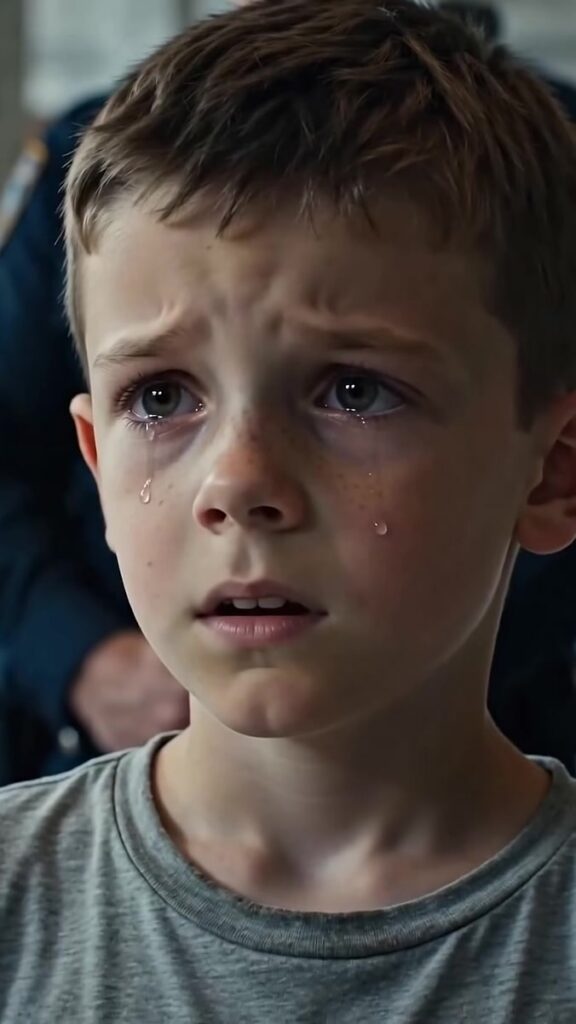
The bank was too grand for a child like him. It rose from the avenue like a courthouse for money—white stone, fluted columns, doors that swallowed sound. The revolving entrance turned with a hush, as if it didn’t want to disturb the air inside. When the boy stepped through, his sneakers squeaked once on the marble and then seemed to regret it.
Cold light poured from tall arched windows, bleaching the lobby until everything looked expensive and unforgiving. Men and women in dark suits moved with practiced restraint, their voices lowered to a confidential murmur. Even the potted plants looked disciplined, their leaves waxed and arranged like they had learned manners.
He stood near the center, too small to belong to the geometry of the place. His T-shirt had been gray for a long time; now it was the color of a rainy sidewalk. He clutched a brown envelope with both hands, knuckles whitening, as if the paper were a rope keeping him from falling into some deeper pit. His name was Milo, and his grandmother had taught him that holding on mattered when the ground changed.
Behind the envelope was the weight of the last week. The hospital room that smelled like plastic and faint perfume. The way Nana’s voice thinned until it felt like it might tear. The way she pressed the envelope into his palms with a force that startled him, as if she could hammer the message straight into his bones.
“Take this to Granite & Crown,” she had whispered. “Not the branch by the bus stop—the big one. The one with the lions.” Her hand had trembled, not with fear but with urgency. “Do not show anyone until you are at the counter. If they ask questions, you say only: It is mine.”
Milo had nodded even though he didn’t understand. He knew better than to ask for explanations from someone who was leaving. The next day, the apartment felt hollow. The spoon in the sink was too loud. The air refused to hold warmth. He found the envelope under his pillow where he had hidden it, and the corners were soft from his fingers worrying them in his sleep.
So he walked—past shops that smelled like bread, past the pharmacy where the lights were always too bright, past the place where teenagers laughed like nothing could ever end. He walked until the buildings grew sleek and the street became a corridor of glass and caution. When he reached the bank with the carved lions flanking the stairs, he stopped and stared. The lions looked like they had never been hungry a day in their lives.
Inside, a security guard glanced at him and then away, as though a child in a worn shirt was a minor inconvenience the building could pretend didn’t exist. Milo crossed the marble carefully, stepping around invisible lines. At the far end was the counter—polished, high, and shining with the reflection of people who belonged.
He waited until the suited man behind it looked up. The teller’s hair was cut sharply, his tie too perfect to have been tied by human hands. Milo swallowed, feeling the envelope press against his ribs like a second heartbeat.
“Sir,” he said, voice small in the cathedral of money. “I just… I want to check my account.”
The teller’s gaze traveled from Milo’s face to his shirt and down to his shoes. Something hardened behind his eyes, like a door clicking shut.
“This is a private institution,” the man said. “You need to leave. Now. Before I call security.”
The words didn’t shout, but they hit Milo with the dull force of something heavy. His shoulders twitched. He didn’t move. He couldn’t. Nana’s instructions were a hand at his back, pushing him forward even while his stomach tried to fold itself into a knot.
A police officer stood near a column to Milo’s left, the kind assigned to places where problems were expected to wear cheap clothes. The officer shifted his weight, paying attention now.
Milo drew in a breath that felt too cold. He slid his fingers into the envelope and pulled out the black card Nana had told him not to show until he was here. It wasn’t shiny like the cards he had seen adults wave around. It was matte, dark as a closed door, with no logo—only a small crest pressed into the corner that caught the light when he tilted it.
“Please,” Milo said, throat burning. “My grandmother left this for me.”
The teller snatched the card as if he were plucking a lie out of the air. The disgust came fast, practiced. “Where did you steal this?” he said, too loudly for a place that lived on whispers.
People in line turned their heads. A woman holding a leather handbag stopped scrolling on her phone. A man in a navy suit paused as if he had forgotten why he was there. Milo felt heat rise behind his eyes, the betrayal of tears he had promised himself he wouldn’t show.
“It’s mine,” he managed. The words were thin, but he put all his weight into them.
The teller tossed the card beside his keyboard, like it was something dirty. “Sure it is.” His fingers began to fly over the keys, not hurried exactly—more like entertained. Milo stood very still, clutching the envelope to his chest, trying to make himself smaller than the counter.
The police officer took one step closer, drawn by the tension the way people are drawn to a sudden change in weather. The woman in line leaned slightly to see the screen, though of course she couldn’t. She only watched the teller’s face.
At first, the teller’s smirk stayed put, comfortable as a well-worn mask. Then it slipped, the way a smile does when it meets something it can’t digest. His fingers slowed. Then stopped entirely.
He leaned toward the monitor, squinting. He typed again—two quick taps—then froze harder, as if his hands had been unplugged from his body. The color drained from his cheeks, leaving his skin strangely translucent under the bank’s cold lighting.
“What is it?” the police officer asked, voice low, professional. He wasn’t asking out of curiosity anymore. He was asking because the room had tilted.
The teller didn’t answer. He stared at the screen as if it were staring back. His mouth opened slightly, then closed, as though he had forgotten how speech worked. His eyes flicked to the black card on the counter and then to Milo—really looked at him for the first time, not as an interruption but as a threat to the order of things.
Milo’s hands were shaking now, though he tried to force them still. The envelope crinkled softly under his grip. “Can I see my balance?” he asked. The question was tiny, polite, impossible.
The lobby seemed to stop breathing. Even the revolving door at the entrance made no sound, as if whoever passed through it had sensed they were entering a moment they shouldn’t interrupt. The teller’s throat bobbed. His fingers hovered above the keyboard but did not touch it.
He swallowed, and the sound of it was loud in the hush. When he spoke, his voice had lost its polished impatience. It had become raw, edged with something that didn’t belong to men behind counters.
“This account is…” he began, and the word that followed wouldn’t come. His eyes flicked again to Milo’s face, as though searching for proof that the boy was real.
The officer leaned closer, frowning now. The woman in line lowered her phone completely, forgotten in her hand. Milo held Nana’s envelope against his heart and felt it hammering like it wanted to break free.
The teller’s hand started to tremble. When he finally finished the sentence, it came out in a whisper that sounded like confession.
“This account is under Crown Protocol.”
The title meant nothing to Milo, but it changed the air in the bank the way thunder changes a summer afternoon. The teller’s eyes widened—not with contempt, not with embarrassment, but with fear. Then, with stiff, careful movements, he slid the black card back toward Milo as if it were a live wire, and reached beneath the counter for a phone that wasn’t part of the public system.
“Sir,” the teller said, and the word sir landed on Milo like a coat too heavy for his shoulders. “Please… wait right here. Do not leave. I need to notify—”
He stopped, looked at Milo again, and lowered his voice even further, as if the walls themselves were listening. “I need to notify the Executor.”
Milo didn’t understand the bank’s secret language. He only knew Nana had always been smarter than anyone gave her credit for. He knew she had looked at him in that hospital bed like she was trying to see him grown, like she was trying to warn him about the world he was stepping into.
Now the grand bank had finally noticed him, and it wasn’t just watching. It was reacting. The lions outside hadn’t moved, but Milo could feel their stone weight anyway—guardians of something vast and old. He stared at the black card, then at the teller’s pale face.
For the first time since Nana’s last breath, Milo felt it: not just grief, but the sharp edge of what she had left him. Whatever sat behind that number on the screen wasn’t merely money. It was a door. And the bank, in all its quiet power, was suddenly afraid of what might walk through.
Milo lifted his chin the way Nana had taught him—small, stubborn, refusing to disappear. “Okay,” he said, voice steadying in the silence. “I’ll wait.”