Rain hit the glass like it had a grudge, rattling the tiny convenience store’s windows hard enough that the neon OPEN sign flickered in sympathy. Inside, the refrigerator lights gave off a sickly white glow and buzzed like a swarm trapped in plastic. The whole place smelled like wet asphalt, old coffee, and that weird sweet scent of overripe bananas.
Mara stood near the counter, soaked straight through, hair plastered to her cheeks. She had a baby balanced on her left hip—her brother, Nico—and a carton of milk pinned against her chest like it was something she could use as a shield. Nico’s little hands were balled into fists, his face scrunched, his cry more tired than loud.
The old cashier watched her the way people watch bad weather: not with empathy, exactly, but with the detached patience of someone who’s seen it all. He wore a faded blue vest and had a deep crease between his eyebrows that looked permanent.
“Please,” Mara said, voice small under the buzzing lights. She shifted Nico higher and felt her arms shake. “My brother hasn’t eaten since yesterday. I just need this.”
The cashier’s gaze slid from Mara’s wet sneakers to the milk. He didn’t reach for it. He didn’t nod. He didn’t frown. It was almost worse than yelling.
Mara swallowed. She could feel the dampness of her own clothes turning cold, could feel the store’s air conditioning getting bold now that she was dripping all over the linoleum. “I can pay later,” she added, because begging always made you offer the future even when you didn’t own it.
Nico made a hiccuping sound and pushed his face into her shoulder. Mara kissed the top of his head, tasting rain and cheap shampoo and fear.
The bell over the door rang.
It was a clean, bright sound that didn’t match the storm. Mara flinched anyway, because every sudden sound lately felt like a hand on the back of her neck.
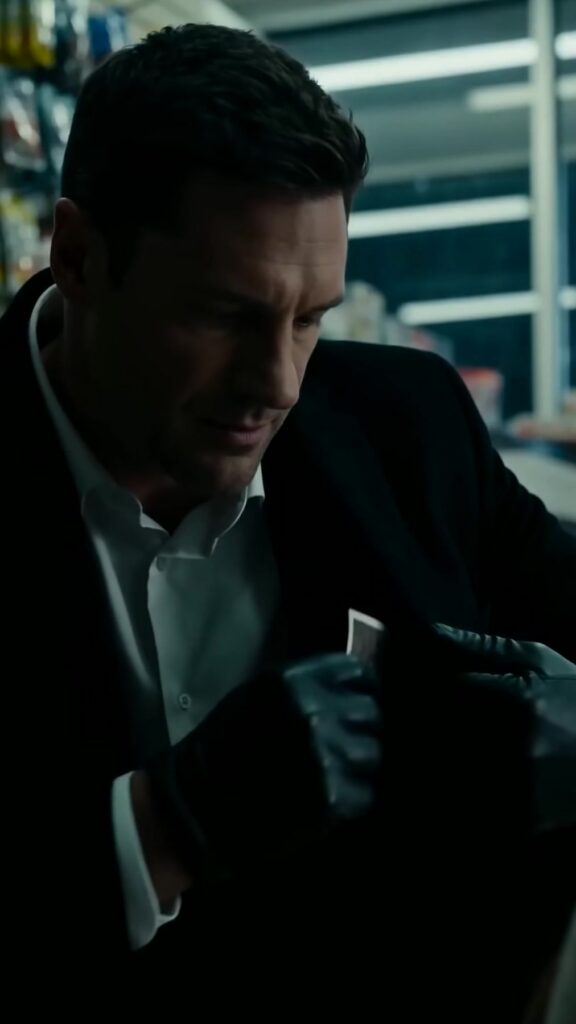
A tall man stepped inside, rainwater sliding off his coat in dark streams. He was dressed like someone on a billboard—dark suit, crisp collar, shoes that didn’t look like they’d ever met a puddle before tonight. But his eyes were the opposite of polished. Exhausted. Sharp. Like he’d been awake too long, or like he’d seen something that didn’t unsee easily.
He paused, letting the door close behind him. The bell stopped. The storm became muffled again, like a radio turned down.
Mara’s instincts screamed. She adjusted her stance, putting her body between him and the counter, between him and Nico, even though she had nowhere to go. The aisle behind her was narrow and crowded with chips and discount toys.
The man walked forward slowly, not rushing, not apologizing for the way the water from his coat left a trail. He stopped at the counter beside Mara, close enough that she could smell clean cologne fighting the smell of rain.
“What if I offered more than milk?” he asked, voice low, like he didn’t want the store to hear.
Mara tightened her grip on Nico. Her jaw clenched so hard her teeth hurt. “Stay away from us.”
The cashier finally moved, straightening a little like he’d remembered his body could do that. His hand hovered near the register, uncertain whether it was about to be robbed or recruited.
The man didn’t smile. He didn’t even look offended. He just reached into his jacket.
Mara’s blood went cold so fast it felt like her heart stumbled. She pictured a gun, a badge, a knife, any of the things the world handed men who walked like they owned the floor.
Nico’s cry stuttered, then started again, a thin thread of sound.
But the man’s hand came out holding something flat and worn, not shiny. A photograph. The edges were frayed like it had lived in a pocket too long. There were crease lines from being folded and unfolded and folded again.
He turned it toward Mara with careful fingers, like it could break if he moved too fast.
Mara’s breath stopped. The carton of milk slipped a little against her chest.
In the picture, a young woman laughed into the sun, head tilted, hair pinned up messily, eyes squinting with joy. Mara recognized the smile instantly because she’d spent most of her life trying to remember it accurately. The woman looked alive in a way memories never quite managed.
Her mother.
The milk carton fell from Mara’s hands and hit the floor with a dull thud. It burst at a corner and started to leak, white spreading across the tile like some kind of surrender flag.
“How do you have that?” Mara whispered. Her voice sounded wrong, like someone else’s.
The man’s gaze didn’t leave her face. It wasn’t hungry. It wasn’t smug. It was careful, almost… tiredly relieved.
“I’ve been searching for you,” he said. “For years.”
Nico’s crying stopped abruptly, as if the silence had been commanded. He stared at the man with wet lashes and a serious, suspicious baby expression that made Mara want to laugh and cry at the same time.
“No,” Mara breathed. Her fingers dug into Nico’s little back. “That’s impossible.”
The man’s eyes flicked to Nico—just a glance, but it carried weight, like he was counting something. “Both of you,” he said softly.
The cashier took a step back, bumping into the rack of lottery tickets. His face had gone pale under the harsh fluorescent lights. He didn’t look like a man bored by bad weather anymore. He looked like a man who’d realized the storm was inside the building.
Mara tried to make her brain work. Her mother had vanished when Mara was nine. Not died—vanished. One day she was there, humming while she washed dishes, promising pancakes on Saturday. The next day, the apartment was half empty and the landlord said it wasn’t his problem. The police made tired notes and shrugged. Social services scattered Mara through relatives like she was mail.
And now a man in a suit had a picture of her mother like it was a key.
“Who are you?” Mara asked. Her throat tightened around the words.
The man hesitated, like names were expensive. “My name is Gabriel,” he said finally. “Your mother called me Gabe, but she was the only person who ever got away with that.”
“I don’t know you,” Mara snapped, though she didn’t fully believe herself. There was something familiar in his face, not in features but in expression—like he and her mother had once shared a secret and it had aged them both.
Gabriel nodded once. “You weren’t supposed to. That was the point.”
Mara’s pulse hammered in her ears, matching the rain. “Where is she?”
Gabriel’s jaw tightened. The exhaustion in his eyes deepened into something darker. “Not here,” he said. “And not safe. She knew this day would come.”
Mara felt a chill crawl up her spine. “What day?”
Gabriel leaned closer, lowering his voice until it was nearly swallowed by the refrigerator buzz. “Your mother knew they would come for you one day.”
Mara’s knees threatened to buckle. She clutched Nico harder and he made a small protesting squeak. Her mind flashed through the last few weeks: the strange man across the street pretending to check his phone every time she left the shelter, the gray sedan that seemed to be parked wherever she went, the way the volunteer at the front desk had suddenly started asking too many questions about Nico’s birth certificate.
“I’m not important,” Mara said, though she already knew how useless that sounded. “I’m just— I’m nobody.”
Gabriel’s eyes softened, just for a second. “That’s what she worked so hard to give you,” he said. “Normal. Invisible.”
Before Mara could ask what she was supposed to be instead, a harsh wash of light flooded the store windows. Headlights, bright and white, cutting through rain like knives.
The cashier made a startled noise and ducked instinctively, like he’d been shot at before.
Outside, engines snarled. Tires squealed against wet pavement. Three black SUVs slid into the parking lot and stopped with the kind of precision that didn’t belong to drunk teenagers or delivery drivers.
Mara’s stomach dropped. Her skin prickled as if someone had opened a freezer door in the room.
Gabriel didn’t look surprised. He looked resigned, like he’d been counting minutes since he walked in. He reached into his coat again, but this time he didn’t pull out anything shiny. He pulled out a small, battered keycard and a folded scrap of paper.
“Listen,” he said quickly, voice still calm but now edged with urgency. “There’s a service hallway behind the cooler. It leads to the alley. This store used to be a bakery—there’s an old basement door that still opens if you kick it hard enough. You’ll go down, follow the pipes, and come out two buildings over.”
Mara stared at him. “Why would I trust you?”
Gabriel held her mother’s photograph between two fingers. “Because she trusted me,” he said. “And because the people in those SUVs don’t want to help you. They want what your mother took.”
“What did she take?” Mara whispered.
Gabriel’s gaze flicked to Nico again. “A future,” he said. “And a name.”
Something heavy thumped against the front door. Not a knock. A test.
The cashier muttered, “Oh no, oh no,” like a prayer that didn’t have a god.
Gabriel stepped toward the door, shoulders squaring. He looked less like a man caught in the rain and more like a wall deciding to stand up. He pressed the keycard into Mara’s free hand. “Take him. Go.”
Mara’s fingers closed around the card automatically. “What about you?”
Gabriel exhaled, and for the first time his eyes showed something like regret. “I’m the distraction,” he said. “It’s what I’m good at.”
Another thud. The glass rattled. A voice outside barked something Mara couldn’t make out through the rain.
Gabriel leaned close one last time and spoke so only she could hear. “Your mother left you more than a photograph,” he said. “She left you instructions. They’re in the place you think is empty. The place you never go because it hurts.”
Mara’s mind flashed to a storage unit in her aunt’s name that she’d never been allowed to open. To a shoebox in the back of a closet that nobody talked about.
“They found us,” Gabriel whispered, eyes lifting toward the front windows as silhouettes moved through the headlights.
Mara looked down at Nico. His wide eyes blinked slowly, trusting her in the way only babies can, like she was the whole world and the whole world was enough.
Then Mara made her choice.
She grabbed the photograph from Gabriel’s fingers—not to steal it, but because she needed proof she wasn’t hallucinating—and ran toward the back, slipping on spilled milk, catching herself on a shelf of canned soup. The cashier stared at her like he wanted to help but didn’t know how to become brave in time.
Behind her, the front door’s bell rang again, wild this time, as it was yanked open.
Mara didn’t look back. She pushed through the plastic strip curtain near the cooler, the cold air hitting her like a slap. Nico startled and grabbed at her collar.
She found the narrow service hallway, just like Gabriel said. It smelled like bleach and old bread ghosts. At the end was a metal door with chipped paint and a rusted handle. She kicked it once—nothing. Twice—the latch gave with a screech.
As she stumbled down into darkness with Nico held tight and her mother’s smiling face pressed against her chest, Mara realized something that made her chest ache in a brand-new way.
Her mother hadn’t disappeared.
She’d been running. And somehow, without ever saying goodbye, she’d been trying to teach Mara how.
Upstairs, above the buzzing refrigerator lights and the angry rain, voices rose and footsteps thundered across tile. Mara kept moving anyway, deeper into the building’s bones, following the pipes like a map, the keycard sweating in her palm.
She didn’t know where she’d end up. She didn’t know what a “stolen future” meant, or why anyone would hunt a baby for it.
But she knew this: the world had just cracked open, and whatever was inside it had her mother’s smile at the center.
And Mara was done being invisible.