The restaurant looked untouchable from the outside—like it had been poured from molten gold and cooled into a building. A velvet rope guarded the entrance even though there was no line, because a line suggested waiting, and waiting suggested regular people.
I was regular people. I was also sweaty, broke, and holding a delivery bag that smelled like fries from the place across the street because it was the only bag I owned.
“Don’t do it, Milo,” I told myself on the sidewalk. “Don’t go in. Don’t become a story on someone’s phone.”
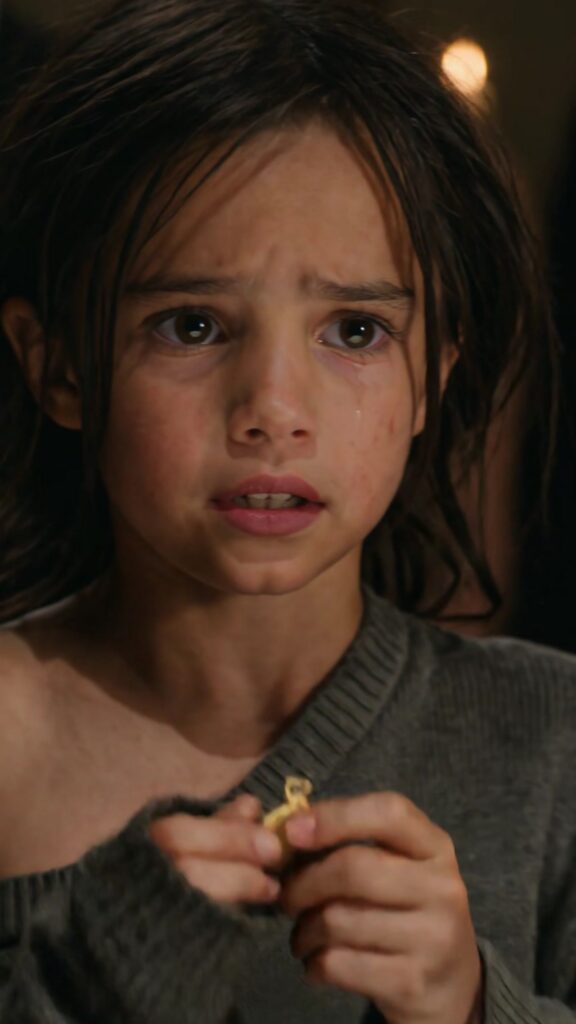
But the kid tugging my sleeve didn’t care about my survival instincts. She stood beside me like she’d spawned out of a storm drain: too thin, sweater too big, socks that didn’t match, hair in a tangled knot like she’d fought a vacuum cleaner and lost. In her fist was a gold locket, the kind people in that building wore like it was nothing.
“You promised,” she said, voice small but with a blade hidden inside it.
I had promised. An hour earlier I’d found her behind the dumpster of my apartment building, trying to warm her hands on the vent of the laundromat. She’d asked me if I knew where the fanciest place in town was. Not a big question, except for the fact that she said it like she was going to war.
I’d tried the usual: calling someone, asking her name, offering to buy her food. She’d taken the sandwich but not the pity. “I’m not lost,” she’d said. “I’m late.”
Late for what? She didn’t answer. She just opened her palm and showed me the locket.
Inside was a photograph so old the corners were soft. A young woman in a hospital bed, smiling with that bright exhaustion new moms have, holding a baby wrapped in a striped blanket. The baby’s face was turned away. The young woman’s face was the part you couldn’t ignore—because it looked like the woman on the restaurant’s website. The one they called Mrs. Vale, patron of the arts, donor, board member, queen.
“That’s her,” the kid said. “She thinks nobody can touch her.”
And now here we were.
I kept my eyes on the doorman, a broad guy in a black suit with an earpiece and the calm, bored expression of someone who’s practiced refusing people for a living. I leaned down to the kid. “Okay. We can try. But you don’t sprint, and you don’t scream. You stay right next to me.”
She nodded once, already looking past me. Her eyes weren’t wandering—she was aiming.
We walked up. The doorman’s gaze swept over me, then over her, and his face did that tiny flinch people do when something doesn’t fit the picture they’ve built in their head.
“Private,” he said, before I could open my mouth.
I held up my delivery bag like it was a badge. “I’ve got a—uh—special order. Table twelve.” I said it with enough confidence to almost believe myself.
He didn’t. His eyes narrowed. “We don’t accept outside—”
The kid slid around my leg like a cat. Before I could grab her, she ducked under the velvet rope and walked straight in, as if the rope was a suggestion made for other people.
“Hey!” the doorman barked, but he was a step too late. I panicked and did the only thing I could think of: I followed her. If I was going to get tackled, I wanted to be tackled with the kid still in my line of sight.
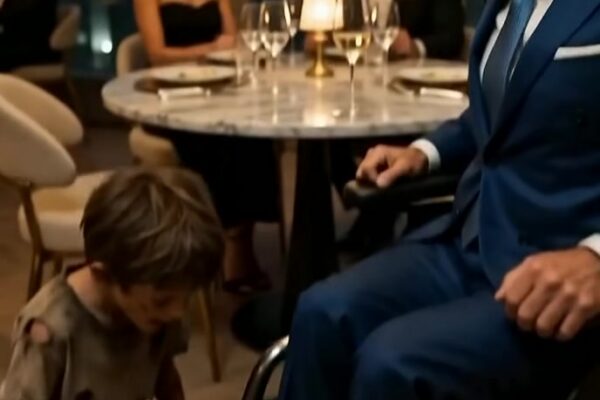
The air inside was chilled and scented like money. Candlelight danced on crystal glasses. A piano played in the corner like someone was trying to soothe the room into staying perfect. Every surface gleamed. Even the silence felt expensive.
We made it six steps before it happened.
Scrape.
A chair dragged across marble, sharp as a shout. Heads turned like a synchronized trick. Conversations paused mid-laugh, mid-sip, mid-secret.
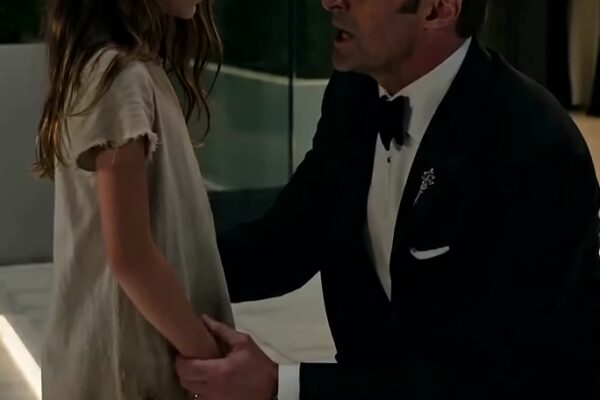
The kid stood in the center aisle, small enough that she should’ve disappeared between the tables, but somehow she was the only thing anyone could see. Her shoulders shook, not from fear exactly. More like she was carrying a thought too heavy for her body.
The piano player’s hands hovered over the keys, unsure whether to keep going or stop. He chose stop.
From a table near the middle, a woman in silk and diamonds lifted her gaze. She was exactly the kind of person who belonged here—not because she’d earned it, but because she’d been built for it. Perfect posture, perfect makeup, perfect calm.
Until she saw the locket.
Something in her face changed in a quick, private flicker. She masked it fast, but not fast enough for me to miss it. I’d worked enough catering gigs in my life to recognize the look: the moment someone realizes their carefully managed world has a crack.
“You can’t be in here,” the woman said. Her voice didn’t rise. It didn’t have to. It was cold the way a locked door is cold.
The kid swallowed. She lifted the locket like it weighed a hundred pounds. “I just need one minute.”
The doorman had pushed inside behind us, and now two other staff members appeared, hovering like they were waiting for a cue. Everyone else watched with the strange hunger of people who pay for entertainment and have just been handed something better than dessert.
The kid’s fingers shook as she opened the locket.
Click.
She turned it outward so the room could see. It wasn’t just a photo; it was evidence. It was a receipt.
The woman’s breath caught. Her eyes locked on the image as if it had reached out and grabbed her.
“Where did you get that?” she asked, and the polish in her voice fractured slightly, like ice under a heel.
“My mom hid it for me,” the kid said. Her chin lifted. She wasn’t begging. She was presenting a case. “She said the woman in that picture sold me and never looked back.”
The woman’s wine glass slipped from her fingers.
It fell and shattered, red spreading across the marble in a stain that looked too dramatic to be real.
A collective inhale rippled through the room. Someone muttered, “Oh my God,” like they’d just seen a magician pull out the wrong rabbit.
Mrs. Vale—because it had to be her—stood slowly. For the first time, she looked her age, whatever it was. Not old, but tired in a way money couldn’t fully erase.
“Who is your mother?” she asked, and there was something almost desperate threaded under the anger.
The kid’s eyes brightened with tears, but she didn’t wipe them. “Her name is Lena Reyes.”
That name did something to the woman. It hit her like a scent from another life. Her hand went to her throat, where a diamond necklace sat like a collar.
“Lena,” she whispered, and it wasn’t for us. It was for herself. The room felt like it leaned forward an inch.
One of the staff finally moved. A manager in a dark suit approached with practiced urgency. “Ma’am, should I have them removed?” he murmured, trying to offer the woman a way to restore the illusion.
The woman didn’t answer right away. Her gaze stayed on the kid—on the locket—on that photo like it was a door she’d welded shut years ago and now someone was tapping from the other side.
The kid took one step closer. “I’m not here for money,” she said quickly, as if she’d anticipated the accusation. “I’m here because my mom is in the hospital. She’s been sick for a long time, and she wouldn’t tell me why she cried every time she saw your name on TV. She tried to keep me from coming. She said you had power and lawyers and you’d make us disappear.”
I felt my stomach twist. I hadn’t known any of that. I’d thought she was chasing a fantasy. This was something else.
“But she gave me this,” the kid continued, holding up the locket with both hands now. “And she said if I ever wanted to know the truth, I should show it to you. That you’d know what it meant.”
Mrs. Vale’s eyes darted to the locket’s chain, as if noticing it for the first time. The clasp was distinctive—an unusual hinge. Her expression shifted from shock to recognition, then to something that looked dangerously like fear.
“That locket,” she said softly. “That was mine.”
A murmur rose around the room. Somebody’s fork clinked against a plate. The pianist stared at his hands like he wished he could sink through the bench.
The kid’s voice cracked. “So it’s true.”
Mrs. Vale closed her eyes for a moment. When she opened them, the coldness had drained away, leaving something raw and unprepared. “It’s… complicated,” she said, and it was the weakest thing she could’ve said, because complicated is what people call their choices when they don’t want to name them.
“No,” the kid said, and her determination flared. “It’s not complicated to a kid. Either you wanted me or you didn’t.”
The woman flinched as if slapped. She looked around, suddenly aware of the room watching, and that awareness made her spine straighten. Wealth snapped back into place like armor.
But her hands were trembling.
“What’s your name?” she asked.
The kid hesitated. It was the first time she’d looked uncertain since walking past the velvet rope. “Marin,” she said. “Marin Reyes.”
Mrs. Vale repeated it like she was tasting it. “Marin.” Her gaze slid to me then, as if I had any authority here. “Who are you?”
My throat went dry. “Just… someone she asked for help,” I said. “I’m Milo.”
She looked back at Marin, and for a second, she didn’t look powerful at all. She looked like a person cornered by time.
“Where is your mother?” she asked.
Marin’s shoulders sagged with relief and pain at once. “Saint Daria’s. Room 409.”
The manager leaned in again, whispering urgently, “Ma’am—”
Mrs. Vale cut him off with a single glance. “Clear my car,” she said. “Now.” Then, to Marin, quieter: “You’re coming with me.”
Marin didn’t move. She tightened her grip on the locket like it was the only real thing in the room. “No,” she said. “You’re coming with me.”
That stopped Mrs. Vale, as if she’d expected obedience, not a boundary. And then, to my shock, her mouth twitched—not into a smile exactly, but into something that acknowledged the kid in front of her wasn’t a problem to be erased. She was a person with an edge.
“Okay,” Mrs. Vale said, the word sounding unfamiliar in her mouth. “I’m coming with you.”
The doorman and staff parted like they’d been trained for disasters. Conversations didn’t resume. Nobody touched their food. Everyone watched the untouchable restaurant get punctured by a little girl with a locket and a truth.
As we walked out, I glanced back at the room—at the shattered wine glass, the stain on the marble, the candles still flickering like nothing had changed.
But everything had.
Outside, the night air felt warmer. The city sounded normal again—cars, distant laughter, a siren far away. Mrs. Vale paused at the curb as her sleek black car pulled up, and for a heartbeat she looked at Marin like she was seeing a ghost and a mirror at the same time.
Marin slid the locket back under her sweater. “You thought you were untouchable,” she said, not cruelly, just factually. “But my mom touched your life first.”
Mrs. Vale swallowed. “And I left fingerprints everywhere,” she whispered.
I didn’t know what would happen at Saint Daria’s. I didn’t know if this would end in apologies or courtrooms or something worse.
I just knew the restaurant hadn’t been untouchable. It had only been protected—until Marin decided protection wasn’t the same as truth.
And truth, it turned out, didn’t need a reservation.