The street felt colder than it should have, and it wasn’t because the wind had teeth. The sun was out. People had iced coffees. Someone’s dog wore a tiny sweater like it had a publicist.
It was colder because nobody looked down.
They walked fast, eyes straight ahead, their faces set in that city expression that said, I am busy being a person with a destination. The world existed from chest height upward: storefront signs, traffic lights, phone screens, the occasional dramatic pigeon. Anything below that was basically scenery—gum stains, puddles, a glove someone dropped weeks ago and never came back for.
And tucked against a cracked gray wall, half-hidden by a broken sandwich-board sign that advertised a comedy show from last month, sat a boy.
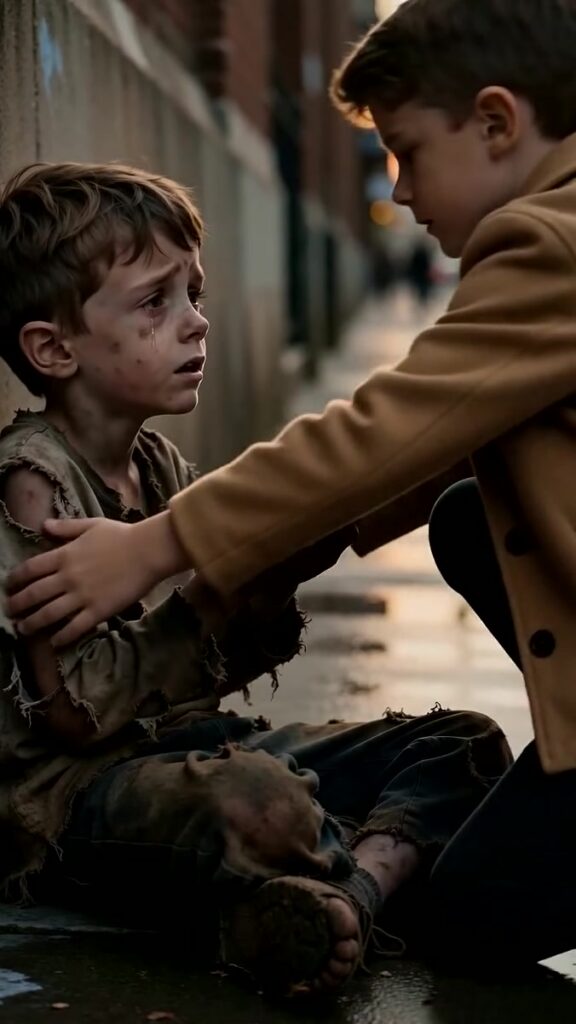
He couldn’t have been older than eight. His jacket looked like it had lost a fight with a fence. One sleeve was held together by a safety pin and optimism. The shoes were split at the sides so you could see his socks, thin and damp. He had his knees pulled tight to his chest, arms wrapped around them like he could squeeze warmth out of himself if he tried hard enough.
His face had that drained look of kids who are supposed to be chubby but aren’t. Hunger had sharpened his cheeks, made his lips pale and a little cracked. He stared at the sidewalk, not quite asleep, not quite awake—just conserving.
People passed him like he was a piece of trash they didn’t want to deal with. Someone stepped around him without slowing down. A man in a navy suit almost tripped on the comedy sign and swore at the sign like it was at fault for existing. A woman glanced down for half a second and then looked away faster, like her eyes had brushed something dangerous.
The boy didn’t ask for anything. That was almost the worst part. He wasn’t loud. He wasn’t pleading. He was just there, quiet enough to be ignored.
Then, a shadow stopped.
It belonged to another kid—about the same age, maybe a little taller. He had a clean camel-colored coat that looked expensive enough to have its own insurance policy. His hair was neatly combed, and his cheeks were pink in that healthy, well-fed way. He carried a paper bag that smelled like a bakery: warm bread, butter, something sweet.
He didn’t just glance. He looked. Really looked, like he was trying to solve a puzzle without a picture on the box.
“Hey,” he said, soft.
The boy against the wall didn’t respond at first. His eyes flicked up, cautious, then back down again. Like eye contact was a trap.
The standing boy opened the bag and pulled out a small loaf, still steaming faintly. He hesitated—like there were rules he was trying to remember—then he broke it in half. The sound was quiet but crisp, like a promise snapping open.
He held one piece out.
The hungry boy stared at the bread as if it might evaporate if he believed in it too hard. His fingers twitched but didn’t move.
“It’s okay,” the other kid said. “You can have it. I have… more stuff at home.” He said it the way kids say things they don’t understand yet. Home as a place you could count on. Food as something that simply happened.
Slowly, like moving through cold water, the boy on the ground reached out. His hands shook. His nails were rimmed with dirt. He took the bread, careful, like it was glass.
For a second he just held it. Then he took a bite.
It wasn’t dramatic. No movie music. Just a kid chewing like his life depended on it, because it did, a little. His eyes welled immediately, tears that made clean tracks down grimy cheeks.
“Thank you,” he whispered, voice thin and cracked. “I was so hungry.”
The clean-coat boy’s face did something strange, like he was trying not to cry but also trying not to look like he was trying not to cry. He crouched down, knees bending in a way that would definitely ruin his coat if his mom saw.
Then he did something even more illegal in the unwritten rulebook of the city: he hugged him.
No hesitation. No flinch. Just small arms wrapping around a smaller body, two kids pressed together on freezing pavement like warmth could be shared like bread.
The hungry boy froze. For a heartbeat he stayed stiff, as if waiting for the trick part. Then, quietly, he melted into it. His hands clutched the back of the other boy’s coat with a desperate kind of relief, like he’d been holding his breath for weeks and finally exhaled.
The sidewalk kept moving around them. People kept stepping around. But for a moment, the street softened. Like the cold backed off, surprised.
It didn’t last.
A door banged open behind them so hard the metal handle slapped the frame. The sound snapped heads around. A woman in a cream trench coat rushed out of a boutique, her heels striking sharp on the concrete. She looked like she belonged on a billboard selling something expensive and unbothered, except her face was pure panic.
“No!” she shouted. “Get away from him. Now!”
The clean-coat boy jolted but didn’t let go immediately. He looked up, confused, brows knitting together.
“Mommy,” he said, like he couldn’t understand why she was yelling. “He’s cold and hungry.”
The woman took another step forward, then stopped as if she’d hit an invisible wall. Her expression shifted—not softer, not kinder, just… cracked. Her eyes dropped from her son to the boy in the dirt, and something in her went still.
Because up close, the dirty child wasn’t just a dirty child.
There was a birthmark near his left eyebrow, half-covered by grime. A crescent shape. There was the way his ears stuck out slightly, the same way hers did if she pulled her hair back. There was the exact curve of his mouth, the one she used to kiss goodnight.
Her hand rose to her lips slowly, fingers trembling. The street noise seemed to fade, like the city itself leaned in to listen.
The hungry boy looked up at her. His eyes were huge. Not just scared. Recognizing.
His voice came out small, as if it had to crawl up his throat.
“Mom?”
For a second, the woman didn’t move. Like if she stayed still, the moment might rewind and correct itself. Like the universe would realize it had made a mistake and return her to the version of the day where nothing ever got this real.
“No,” she breathed, but the word didn’t sound like refusal. It sounded like grief.
The clean-coat boy turned his head quickly between them. “Mom? You know him?”
The woman’s eyes filled. She took one step, then another, slower now, like approaching a wild animal. Her voice came out uneven. “Eli?” she said, and it wasn’t a name so much as a question she’d been asking for years.
The boy against the wall swallowed hard. He nodded once, barely. The bread in his hand was still there, half-eaten, like proof that kindness had happened even if nobody else wanted to witness it.
“They said you didn’t want me anymore,” he whispered. “They said… I was too much.”
Her knees buckled a little, and she caught herself on the edge of the comedy sign. The irony hit nobody. She was shaking, mascara threatening to run in a way that would ruin her entire carefully constructed life.
“I never—” she started, then stopped because her throat closed. She looked down at her son—her clean-coat son—then back at the other one, and the space between those two boys suddenly felt like the coldest thing on the street.
Behind them, people had slowed. Phones hovered in hands, hungry for a story. But the woman didn’t look at any of them.
She crouched, the same way her son had, trench coat pooling on the dirty sidewalk like she didn’t care what it cost anymore.
“Eli,” she said again, softer now. “Where have you been?”
The boy’s chin quivered. “I tried to find you,” he said. “I did. I…” He squeezed his eyes shut for a second, like he couldn’t hold the memories and the present at the same time. “I’m tired.”
The woman reached out, and her hand hovered for a heartbeat, permission unspoken. Then she touched his cheek with two fingers, gentle as a first snowfall.
He leaned into it like he’d been waiting forever.
The street still felt cold, but now it was a different kind of cold—the kind that happens right before something breaks open and changes. And somewhere in that shifting air, two brothers sat pressed together, one mother kneeling in front of them, trying to remember how to be the person she thought she was.
Across the window of the boutique, the old comedy poster in the sandwich-board sign fluttered and finally tore loose, skittering down the sidewalk like a warning: some things aren’t funny once you really look down.
And this time, people were looking.