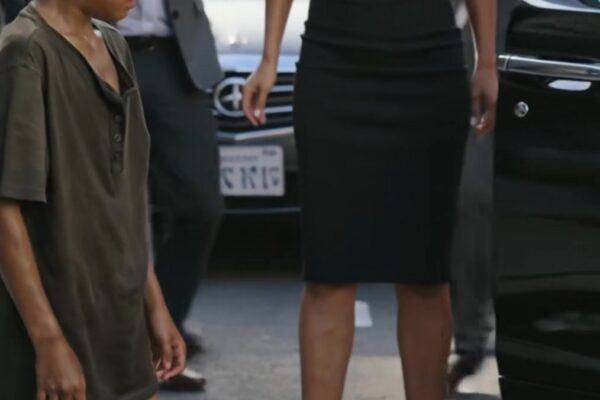
The lobby felt like a museum that served espresso.
Everything in it was curated to make you forget time existed: marble floors polished so perfectly they reflected the chandelier like a second ceiling, soft gold lighting that made everybody look a little healthier and a little wealthier, even the guests who were neither. People walked as if they’d signed an agreement not to rush. Suitcases rolled with near-silent wheels. Voices stayed low, the way they do around expensive art.
Mila moved through it with a tray in her hands and a storm in her ribs.
The tray wasn’t heavy—two tiny cups of coffee, a glass of water, a dish with one impossibly neat lemon twist—but her fingers kept threatening to betray her. She could feel her pulse in her thumbs. It didn’t make sense. She’d carried heavier things during brunch rush at the diner she’d worked at before, dodging toddlers and slamming doors and cooks who yelled like it was their job. Here, everything was quiet, calm, controlled. She should’ve felt safer.
Instead, she felt like the lobby itself could tell she didn’t belong.
She adjusted her grip and reminded herself to breathe. Don’t think about the envelope. Don’t think about the weight of that paper in your pocket like a stone. Just deliver the coffee. Smile. Say, “Enjoy your morning.” Leave.
But the envelope pressed against her uniform like it had a heartbeat of its own.
She’d meant to leave it in her locker. That was the plan: get to work, put it away, pretend it didn’t exist until she was off shift and brave enough to open it again. But she’d been late, the employee entrance had been crowded, and she’d felt that familiar tightness—like if she stopped moving she’d fall apart. So she’d shoved it deeper into her pocket and told herself it would be fine.
It was never fine.
At the center of the lobby, near the concierge desk, a man stood with the kind of presence that made the air feel rented. Tailored charcoal suit, watch that probably had its own insurance policy, hair cut with surgical confidence. He wasn’t talking loudly, but people angled toward him anyway, like attention was magnetic.
Mila didn’t know his name. She’d heard staff call him “Mr. Crane” in the back hallways, the way they said “fire alarm” or “health inspector.” Everyone went a little straighter when he was in the building. He stayed here a lot. Sometimes he booked a suite for a week and used it like a private office. Sometimes he showed up for a single night and left before sunrise, as if sleep was something he’d outgrown.
Mila had served him once. He’d tipped too much and hadn’t looked at her face.
She didn’t plan on being near him today. She intended to skirt the edge of the lobby and disappear into the elevator corridor.
But the hotel was all angles and reflective surfaces, and a guest with a wide-brim hat stopped abruptly to take a selfie with the chandelier. Mila pivoted to avoid her, tray tilting slightly, shoes skidding just enough on the marble to make her heart spike.
She corrected, stepped sideways—straight into Mr. Crane.
The impact was small, more of a brush than a collision, but in the lobby’s hush it landed like a slap. Coffee trembled in its cups. Mr. Crane’s shoulder barely moved.
“I’m so sorry,” Mila blurted, voice too loud in the quiet. “I didn’t—”
She felt the envelope slip.
It slid from her pocket in slow, humiliating grace, as if it wanted an audience. The sealed flap flashed white against the gold lighting. Then it hit the marble with a sound that wasn’t actually loud but somehow filled the space anyway—paper on stone, a soft click that made people turn their heads.
Silence tightened around it. Even the fountain in the corner seemed to pause mid-bubble.
Mila froze. She’d never seen an envelope look so dangerous.
Mr. Crane’s gaze dropped to the floor. His body went rigid, like someone had pulled a wire through his spine. His face, which had been politely blank a second ago, drained of something—color, ease, whatever made him look unshakeable.
His eyes locked onto the envelope.
“Where did you get this…?” he murmured.
It was barely audible, but it carried. That’s what money did in a room like this: even a whisper sounded like a command.
Mila’s knees went soft. She bent quickly, reaching for it with reflexive panic. “It’s— I— I dropped it, I’m sorry—”
Before her fingers touched paper, his hand shot out.
Not violently. Efficiently. Like a man used to taking what he wanted without anyone questioning it.
He snatched the envelope off the marble and held it in front of him as if it were a live wire. His grip tightened, knuckles whitening.
Mila straightened too fast, tray wobbling again. She steadied it against her hip, the coffee miraculously intact, and stared at him as her chest pinched.
She’d rehearsed this moment in her mind so many times. In none of those versions had it happened in the lobby, under chandeliers, with strangers watching like they’d paid for a show.
Mr. Crane’s thumb traced the seal. It wasn’t addressed. There was no name, no logo, no reason it should matter to anyone. Except his pupils had gone sharp, and something flickered in his expression—fear, recognition, both tangled together.
“This—” he said, but the word failed him. He swallowed hard and glanced around as if the lobby itself might be listening, which was absurd, except the lobby was listening. People were watching now. A couple in vacation clothes paused mid-step. A woman in pearls lowered her phone. The concierge’s smile faltered.
Mila wanted to disappear. She wanted to yank the envelope back and sprint through the service corridor and never come back. But her feet felt anchored.
Mr. Crane broke the seal with one clean motion.
He slid out the contents, and the air seemed to thin.
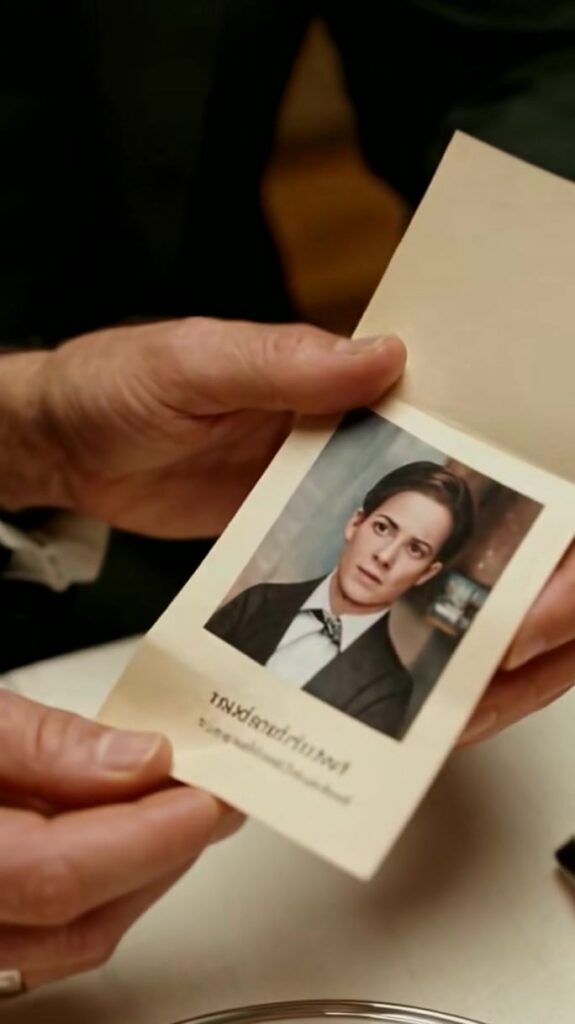
A photograph—old, slightly blurred, the edges softened with handling—fell into his palm. Next to it, a hospital tag, yellowed with age. The kind wrapped around a wrist. The kind you keep only if you’re trying to remember something you’ve been told to forget.
Mila saw it upside down: a tiny newborn’s face, eyes closed, skin wrinkled like a thought not fully formed. A smudge of ink. A date that had once mattered. The hospital’s name faded but still readable in fragments.
Mr. Crane stared at the tag as if it were accusing him.
His hand began to shake.
That was what made everything real. Wealthy men didn’t shake. Not in lobbies like this. Not under chandeliers.
He lifted his eyes to Mila. They weren’t the cold, distracted eyes she remembered. They were suddenly human, raw around the edges.
“This shouldn’t exist,” he said, and his voice cracked on the last word like it surprised him.
Mila felt her throat close. Heat rushed behind her eyes. She hated that she might cry here, on this floor, in front of people who wore calm like perfume. She hated that the envelope had dragged her out into the open.
But she couldn’t stop the tears from rising.
“I didn’t mean to drop it,” she whispered, as if that was the worst part.
Mr. Crane didn’t look away. His stare held her like a hand on her shoulder.
Mila’s mind flashed to last night: the older woman who’d come to her tiny apartment, hair pinned back, coat too thin for the season. The woman’s hands had trembled when she passed Mila the envelope. She’d smelled like rain and old perfume and fear.
“Don’t open it here,” the woman had said. “Don’t show it to anyone. Not until you’re right in front of him. If he sees it early, he’ll bury it again.”
“Why me?” Mila had asked, and her own voice had sounded small in her kitchen.
The woman had looked at her like she was looking at a ghost she’d made herself. “Because you’re the only proof I couldn’t burn.”
Now, in the lobby, Mila found her voice again, thin but steady enough to cut through the hush.
“I was told you would never see it,” she said quietly.
The words landed heavier than the envelope ever could.
Mr. Crane’s jaw tightened. His gaze dropped to the photo, then back to Mila’s face, searching, comparing, calculating. His breathing became visible in the shallow rise of his chest. For the first time, he looked like a man who had spent years building walls and had just realized someone left a door unlocked.
“Who gave you this?” he asked.
Mila opened her mouth, then hesitated. Saying the woman’s name felt like striking a match near gasoline. She didn’t even know if it was safe to speak in this lobby, with the concierge ten feet away and security cameras tucked into corners like discreet black eyes.
Mr. Crane noticed her glance. His gaze flicked up to the nearest camera, then back to her. Something in him hardened with decision.
He folded the photo and hospital tag back into the envelope with trembling precision. Then he looked past her tray, past her uniform, as if seeing the outline of her life beneath it.
“Come with me,” he said. Not a request. Not an order. A necessity.
Mila’s stomach dropped. “I’m working,” she managed, ridiculous under the circumstances.
He didn’t smile. “You won’t be for the next ten minutes.”
He turned slightly toward the concierge desk. “I need the Solarium room,” he said, voice back to controlled, expensive calm. “Now.”
The concierge blinked, then nodded too quickly. “Of course, sir.”
Mila stood there, tray still in hand, feeling the lobby watching her like she’d become a crack in the marble. Untouchable was gone. Controlled was gone. The golden light suddenly felt like a spotlight.
Mr. Crane took one step closer to her, lowering his voice so only she could hear. “If this is what I think it is,” he said, each word careful, “then someone lied to me for a very long time.”
Mila’s tears finally slipped free, hot on her cheeks. She didn’t wipe them away. She couldn’t afford pride right now.
“Someone lied to me too,” she whispered.
He held her gaze, and for a second the entire lobby seemed to tilt, like the building itself leaned in to listen.
“Then we’re going to find out who,” he said.
Mila swallowed, and with a hand that still wouldn’t stop trembling, she adjusted the tray and followed him across the gleaming marble—past the turned heads, past the quiet luxury—toward a door she’d never been allowed to open before.
Behind them, the lobby’s calm slowly pretended to return, but the silence they left behind felt different now.
Like something had finally dropped that was never supposed to hit the floor.