He stepped out of the restaurant holding a small white takeout box, the kind that always leaked a little steam and smelled like somebody’s comfort food. Behind him, the glass door swung shut with a lazy hiss, and warm golden light poured onto the sidewalk like honey. Inside, people laughed and clinked glasses. Outside, the city was strangely polite—no sirens, no shouting, just the distant hum of traffic and the soft slap of his shoes against the concrete.
He’d only meant to grab dinner and go home. That was the plan. Simple. Quiet. One more normal night after a long week of doing nothing heroic at all—answering emails, dodging meetings, pretending he wasn’t lonely in a way that had become routine.
Then he saw her.
A little girl stood near the restaurant entrance, half in the spill of light, half in the shadow. She didn’t move the way kids usually moved—no fidgeting, no bouncing on the balls of her feet. She looked like she’d been paused. Too thin. Too still. An oversized gray dress hung off her shoulders as if it belonged to someone else, someone taller, someone who had once been warm.
She wasn’t holding a cup out. She wasn’t sniffling. She wasn’t performing misery the way the world sometimes demanded in exchange for kindness. She was just waiting, eyes fixed on the people coming and going, like she was listening for a sound only she could hear.
Ben hesitated. His first instinct was the one he hated: keep walking. Don’t get involved. You don’t know the story. You can’t fix it. It’s late. You’re tired. The city had taught him to be careful with his heart, like it was a wallet.
But the little white box was warm against his palm, and the smell—fried rice, ginger, something sweet—made his stomach twist in an unpleasant way. He thought of the way he’d complained about the delivery app being five minutes late. He thought of his fridge at home, full of nothing but condiments and old intentions.
He turned back.
“Hey,” he said gently, as if loudness might shatter her. “Are you hungry?”
The girl’s eyes lifted to his face. They were a weird, clear kind of dark, like deep water reflecting streetlights. She didn’t nod. She didn’t shake her head. She just looked at the box.
Ben crouched slightly, keeping a respectful distance. “This is for you,” he said, holding it out with both hands, like an offering.
She took it carefully. Not snatching, not grabbing—taking it the way you’d hold something fragile you didn’t trust the world to let you keep. Her fingers were pale and the nails were bitten short. For a second, he noticed a faint smudge on her wrist that could’ve been dirt or a bruise. He couldn’t tell. It made his throat tighten anyway.
“Thank you,” she whispered. The words came out small, like they’d been saved up for a moment that mattered.
Ben tried a smile. “Where’s your—” He almost said parents, then stopped himself. Where’s your family. Where do you live. Are you okay. Every question felt like a doorway into a room he didn’t know how to handle.
“What’s your name?” he settled on.
She blinked once. “Mara.”
“I’m Ben. Do you… do you have somewhere you can go?”
Mara’s gaze flicked past him, toward the street. Not the bright part—the darker stretch where the storefronts thinned and the streetlights got lazy. Her grip on the takeout box tightened. She looked like she was making a decision.
“You shouldn’t,” she said, barely audible.
“Shouldn’t what?” Ben asked.
But she was already turning.
And then—without warning—she ran.
Not a kid’s playful sprint, not the kind where you look back and laugh. She ran like she’d been chased before and knew exactly how fast fear could move. The takeout box stayed level in her hands, tucked tight against her chest. She vanished off the curb, across the street between two slow cars, and into the mouth of an alley that looked like it led nowhere good.
“Hey—wait!” Ben called out, his voice echoing off brick. His feet moved before his brain caught up. He jogged after her, then broke into a run, the plastic bag from the restaurant swinging uselessly at his side. Somewhere behind him, someone laughed inside the restaurant as if the world hadn’t changed.
The alley smelled like wet cardboard and old rain. A puddle reflected a crooked slice of sky. Ben’s breath turned sharp in his lungs. “Mara!” he called, louder now, feeling ridiculous and terrified at the same time.
He caught a glimpse of her gray dress ahead, disappearing around a corner. He followed, heart thudding. The city didn’t feel calm anymore. The quiet was the kind that waited for a bad decision.
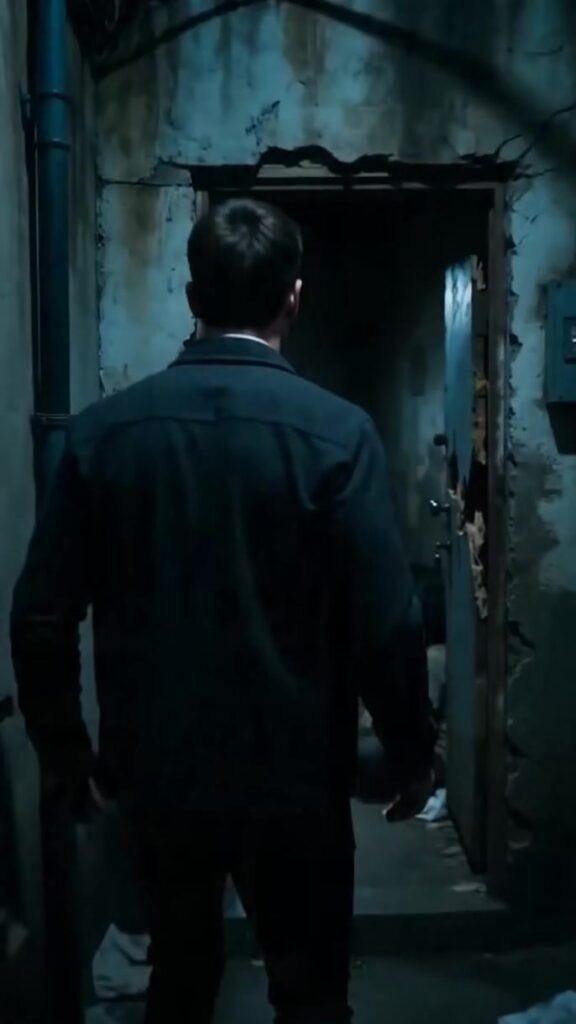
He turned the corner and nearly slipped. The alley widened into a back lot with dumpsters and a chain-link fence. Beyond the fence, train tracks cut through the darkness like a scar. Mara stood near the fence, not climbing, not trying to escape—just waiting again, the same stillness as before, only now it looked strained. Like she was holding her breath.
Ben slowed, hands up, trying to look harmless. “Okay,” he panted. “Okay. I’m not— I’m not mad. I just… you can’t run into the street like that.”
Mara stared at him. The takeout box was still closed. She hadn’t even opened it. That was the weirdest part. If she was hungry, why hadn’t she torn into it the second she got away?
“You followed,” she said.
“Yeah,” Ben admitted. “Because you’re a kid and it’s late and I’m worried about you.”
Mara’s mouth twitched, not quite a smile, more like she’d heard that line before and didn’t trust it. She lowered her eyes to the box. “It’s not for me,” she said quietly.
Ben frowned. “What do you mean?”
She glanced toward the fence, then toward a dark gap beneath an overgrown section where weeds and trash made a little tunnel. “If I don’t bring it,” she said, “he gets mad.”
Ben’s skin prickled. The word he—he—hung in the air like a cold drop of water. “Who gets mad?”
Mara hugged the box tighter, like it was a shield. “He lives under there,” she whispered. “He says I’m lucky he lets me stay. He says I owe him.”
Ben’s brain did that awful thing where it tried to make the situation smaller. Maybe it’s a weird older brother. Maybe it’s a homeless guy who’s not dangerous. Maybe she’s exaggerating. Anything but the picture forming in his mind.
“Mara,” he said slowly, choosing each word like stepping stones, “you don’t owe anybody your safety. You hear me?”
Her eyes widened. “Shh.”
From somewhere beyond the fence, something shifted. A scrape, like metal against rock. Then a voice, low and rough, carried through the weeds. “Mara?” it called, sing-song, like it was teasing. “You got it?”
Ben’s pulse spiked so hard he felt it in his teeth. His instincts screamed to grab Mara and run, but he didn’t know where to run to. The street was back the way they came. The lot was boxed in by fences and trash. His phone was in his pocket, suddenly feeling as useless as a pebble.
Mara looked up at him, eyes shining with a complicated kind of fear—part terror, part resignation, part something else that looked almost like relief.
“You shouldn’t have followed,” she whispered again, but this time it sounded less like a warning and more like a confession.
Ben took a step closer, placing himself between her and the fence. His voice came out quieter than he intended. “I’m here now,” he said. “We’re not going under there. Not tonight.”
The weeds rustled again. The voice chuckled. “Who’s that with you, Mara?”
Ben swallowed. His mind raced through options: call the police, run, scream, bargain, fight. None of them felt like the right size for what was happening. He reached back without looking and found Mara’s small hand. She flinched at first, then held on like she’d been waiting for permission.
“We’re leaving,” Ben said, projecting his voice toward the fence. He tried to sound like a man who knew what he was doing. Like someone who had backup. Like someone who wasn’t terrified. “She’s not bringing you anything.”
Silence stretched. Even the city seemed to pause.
Then, slow as a nightmare, a hand appeared through the weeds, gripping the chain-link. Fingers dirty, knuckles scraped. The fence rattled softly.
Mara squeezed Ben’s hand so hard it hurt.
Ben tightened his grip back. In the distance, a train horn moaned like a warning. He didn’t know how this would end, but he knew one thing with absolute clarity: the calm night had been a lie, and the little white takeout box was never just dinner.
It was a message. A test. And now, apparently, an invitation to a fight Ben hadn’t planned on having.