The first time I heard the words “Don’t touch that necklace,” it didn’t come out of a dramatic soap opera villain or an overprotective mom. It came from a kid so small he still had that wobbly, newly-upright stance, like gravity was a suggestion and not a law.
I was sitting at a corner table in Lark & Linen, the kind of café where the chairs look like they’ve never been sat in and the pastries have last names. My laptop was open, my drink was cooling into bitterness, and I was pretending to work while actually eavesdropping—because that’s what people do when a single cappuccino costs twelve dollars and the only entertainment is watching rich strangers perform being relaxed.
Everything in that place had a hush to it. The espresso machine wasn’t loud; it was “assertive.” The music wasn’t playing; it was “curated.” Even the laughter sounded like it had been trained.
Then this kid wandered in, like he’d gotten dropped into the wrong movie.
He looked maybe three, but hard to tell—he was small, all elbows and oversized sleeves, with clothes that had seen better planets. His hair stuck up in patches, like he’d slept in a dryer. He wasn’t crying. He wasn’t asking anyone for anything. He just walked straight past the display case of macarons, straight past the host stand, and right toward a woman near the middle of the café.
She was the kind of woman you could spot from a distance because she looked expensive on purpose. Not trendy-expensive. Old-expensive. Beige coat that probably cost more than my rent. Hair smooth and shiny and pinned like it belonged in a portrait. She had one of those calm faces that only stay calm because they rarely have to deal with consequences.
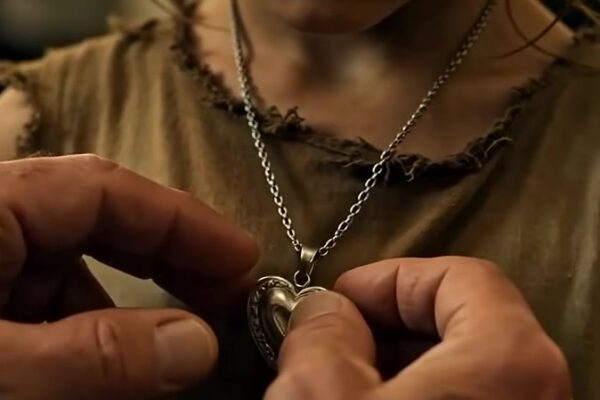
Her necklace was the kind of gold that didn’t yell. It glowed. Thin chain. Small pendant. Simple, but clearly not cheap. It rested at her collarbone like it had always been there.
The kid stopped in front of her chair and lifted his hand. Slow. Careful. Like he’d practiced the motion.
His fingers hovered an inch from the pendant.
And he said, very quietly, “Don’t touch that necklace.”
It wasn’t loud. It wasn’t even sharp. But it cut through the café like someone had popped a balloon in a library. The conversations faltered. A spoon clinked against a saucer and sounded like a cymbal. I realized I’d frozen with my cup halfway to my mouth.
The woman’s eyes snapped down to him. Her smile sprang up fast, the way some people’s smiles do when they’re offended and trying to cover it with charm.
She grabbed the pendant with two fingers as if to prove she could. “Excuse me?” she said, voice coated in a laugh. “Sweetie, step back. That’s not yours.”
The kid didn’t step back. He didn’t blink. He looked straight at the pendant like it was a compass needle.
“This is my mom’s,” he said, still calm, like he was stating the weather.
Somebody near the window whispered, “Did he just—?” and that was the moment phones started rising. Not everyone, but enough. Little rectangles of attention aimed at the kid, then at the woman, like the café had turned into a courtroom and everyone wanted evidence.
The woman’s smile didn’t disappear, not right away. It flickered. Like a lightbulb that knows it’s about to die.
“Where are your parents?” she asked, louder now. Her tone changed from friendly to managerial.
The kid ignored her question like it wasn’t relevant. He leaned a little closer, not in a threatening way—more like a secret was heavy and he needed her to carry some of it.
“She said if I find you,” he whispered, “I should stop you.”
That whisper did something to the room. It didn’t just silence it; it made the air feel wrong. Like the temperature had shifted but nobody could find the vent.
The woman’s fingers tightened around the pendant. Her shoulders stiffened. When she spoke again, the laugh was gone entirely. “Who told you that?”
The kid didn’t answer. He slid his hand into the pocket of his oversized pants, the fabric bunching around his wrist. Everyone leaned forward without meaning to. Even the barista had stopped steaming milk.
He pulled his fist out, closed tight, knuckles pale. He looked up at the woman, eyes clear, and said softly, “She cries every night about you.”
I watched the woman’s throat move as she swallowed. For the first time, her face didn’t look carefully built. It looked human. And scared.
“Show me,” she breathed.
The kid opened his hand.
Inside was a broken piece of gold chain, with a tiny clasp and a jagged end where it had snapped. It caught the café light and threw it back like a spark.
It was the same gold. The same thickness. The same little curve where it had once sat against skin. Even from my table, I could see it was a match. Not a similar necklace. The same necklace—just the other half of it.
A few people actually gasped out loud, like it was a magic trick. Someone murmured, “No way.” Another person’s phone shook so hard the recording must’ve looked like an earthquake.
The woman stumbled backward, her chair scraping the floor. “No,” she whispered. “That’s impossible.”
The kid’s voice stayed steady. “You were supposed to keep both pieces together.”
The woman’s lips parted like she was about to deny it, but the words didn’t come. Her eyes darted around the café—at the phones, at the strangers, at the exit—like she suddenly remembered she was visible.
“…Because I—” she started, and then cut herself off, breathing fast. The beige coat didn’t look so perfect anymore; it looked like armor that had stopped working.
Then she did something that made my stomach flip.
She grabbed the kid’s arm. Hard. Too hard for how small he was. Her nails dug into his sleeve.
He didn’t cry. That might’ve been the strangest part. He just looked up at her like this was the part he’d expected.
The woman leaned down, mouth close to his ear, whispering like she didn’t care who was filming as long as they couldn’t hear. But the café was so silent you could catch pieces of it anyway.
“Where did you see her last?” she hissed.
That’s when I stood up, chair legs screeching loud enough to snap everyone’s attention. I hadn’t planned to. My body did it before my brain could argue. Maybe it was the way she held him. Maybe it was the way nobody else moved because they were too busy recording. Maybe it was because I’d been a kid once, and I knew what it felt like when adults decided you were an object instead of a person.
“Hey,” I said, voice shaking with anger I didn’t know I had. “Let go of him.”
The woman’s head snapped toward me. Her eyes were sharp now, cold and measuring. Like she was deciding what kind of problem I’d be.
“This isn’t your business,” she said.
“It becomes my business when you’re hurting a child,” I replied. I could hear my own pulse in my ears. Around us, phones stayed raised. Nobody stopped filming. But at least they were looking.
The kid spoke again, still calm. Still weirdly composed. “If you pull, it’ll break again.”
The woman’s grip loosened an inch, as if the words hit a nerve. Her hand flew to her necklace protectively.
“You don’t know what you’re talking about,” she said, but it didn’t sound convincing. It sounded like she was trying to convince herself.
The kid turned his head slightly toward me, as if I’d been added to the script. “She told me to find the café with the green chairs,” he said. “And the lady with the gold.”
The woman’s eyes widened at that, just for a second. Then her expression shut down again, smooth as a locked screen.
“Who is ‘she’?” I asked, keeping my voice gentle, keeping my distance so I wouldn’t scare him.
The kid stared at the woman instead of me. “My mom,” he said. “She said you used to wear it together. And you promised.”
Promises. The word hung there, heavy and old.
The woman glanced toward the door. I noticed then that she had a bag already on her shoulder, like she’d been ready to leave fast. Like she always left fast.
“You shouldn’t have come here,” she muttered, not to me, not to the café—just to the kid, like he was a ghost that had followed her in.
“I didn’t come alone,” the kid said, and finally, finally, he blinked. Slow. Deliberate. “She said you’d try to run.”
Somewhere behind me, a man in a suit whispered, “Call the police.” Someone else whispered back, “Already did.” I didn’t know if it was true, but I hoped so with everything in me.
The woman’s gaze dropped to the broken chain in the kid’s palm. Her breathing went shallow. “Where is she?” she asked again, but this time the question sounded less like a threat and more like panic.
The kid tilted his hand so the broken gold caught the light. “She’s waiting,” he said.
“Where?” the woman demanded.
The kid looked up at her, and for the first time his calm expression cracked into something like sadness. “Where you left her,” he said. “In the place with no windows.”
The woman’s face drained so fast it was like someone had pulled a plug. Her lips opened, but nothing came out. Her fingers trembled on the pendant at her throat.
And in that thick, awful quiet, I realized something that made my skin prickle: the necklace wasn’t just jewelry. It was a breadcrumb. A proof. A key. A reminder that two lives had been tied together once, and someone had snapped the chain and walked away.
The kid closed his fist around the broken piece and took a small step back, out of her reach. “Don’t touch it,” he repeated, still soft. Still steady. “Not until you put it back.”
Outside, faint but growing louder, sirens began to weave through the city noise, heading straight for our too-clean, too-quiet café.
The woman stood frozen, gold clutched in her hand, as if she’d just remembered that some promises have teeth.
And the smallest person in the room was the only one who looked like he’d known exactly how this was going to go.