It started like a movie scene that someone forgot to yell “cut” on.
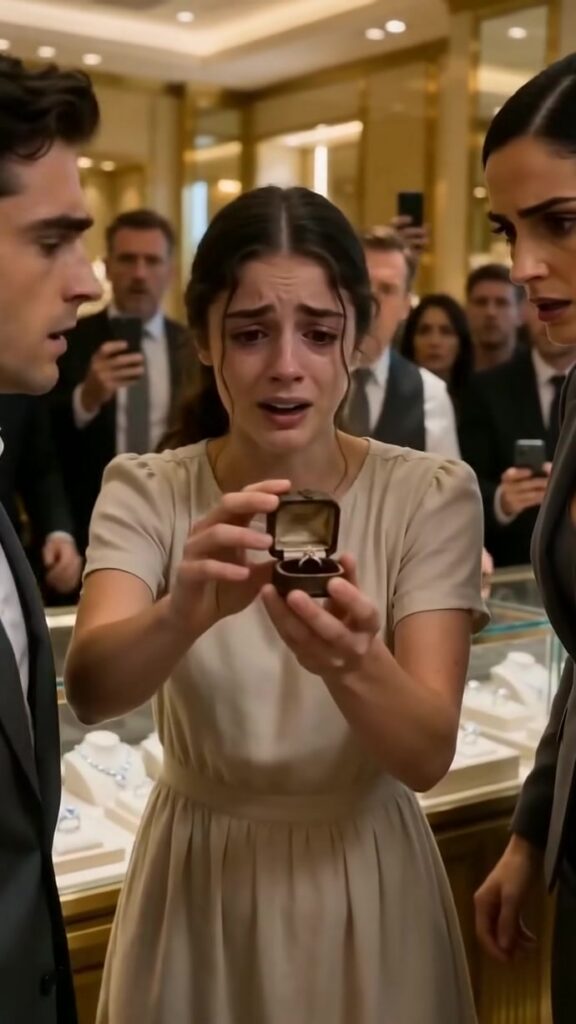
One second I was standing under the soft chandelier light of Lark & Lune Jewelers, trying not to touch anything because everything looked like it cost more than my car. The next second, two security guards had hands on my arms and I was being hauled forward across the marble floor while people in cashmere and quiet perfume turned to stare.
“Ma’am, you need to come with us,” the taller guard said, like he was announcing a train delay.
“I’m not stealing,” I blurted, because that’s what people say when they’re being dragged in a jewelry store. “I didn’t even—”
“She’s here to extort me,” a man’s voice cut through the room.
Every head swiveled toward the counter. Behind the glass stood Miles Harrow—polished, charismatic, a face you’d believe on billboards. He was in a navy suit that looked designed for people who never spilled coffee. At his side, his fiancée Nora Vale clutched his arm like it was a life raft. Nora’s engagement ring, which I’d seen in magazines because Nora’s social media was basically a lifestyle catalog, shot cold light across the room.
Miles didn’t have to raise his voice. He didn’t need to. The store bent around him like he was gravity.
“This woman has been harassing me for weeks,” he continued, eyes locked on me. “Demanding money. Threatening to ruin my family if I don’t pay.”
A whisper went around: blackmail. The kind of word that makes strangers feel morally involved.
My throat tightened. I tried to pull my arms free, but the guards tightened their grip just enough to tell me they could do worse without even looking like it.
“I’m not blackmailing anyone,” I said. “I’m here because—”
“Because you want more,” Miles said smoothly, like he’d rehearsed it. He nodded toward my hands, which were curled around the only thing I’d carried into this place: an old ring box, cracked at the hinge, wrapped in a rubber band like it was trying to hold itself together.
It looked ridiculous against the gleaming velvet trays inside the store. It looked like something you’d find in the bottom of a junk drawer. It looked like the opposite of blackmail.
“She waved that thing around,” Miles told the manager, a woman with a sleek bun and an expression that had never been surprised in her life. “Said she’d open it in front of everyone if I didn’t cooperate.”
Nora finally spoke, her voice thin and brittle. “Miles, I told you we should’ve called someone sooner.” She looked at me like I was something sticky on a shoe. “Why are you doing this? Do you have any idea what kind of day this is?”
It was an appointment day. A ring-sizing day. A “finalize the custom setting” day. Lark & Lune had closed off half the showroom for them. There were champagne flutes on a side table. There was a bouquet of white roses that smelled like money.
My cheeks burned, half from humiliation and half from the feeling that I might throw up if I didn’t speak quickly.
“I don’t want money,” I said. “I want him to tell the truth.”
Miles smiled, just a little, like he was indulging a child. “Truth? About what? That I won’t let a stranger threaten me?”
“I’m not a stranger,” I said, and the words came out sharper than I expected. “You just don’t like being reminded.”
The manager gave the guards a look that said, end it. The taller one started pulling me toward a side corridor, toward whatever quiet back room people disappeared into when you wanted the problem handled privately.
“Wait,” I said, the panic rising. “Just—let me open it.”
Miles chuckled, and somehow that sound made my skin crawl. “See? The performance.”
“Open it,” I insisted. I wasn’t asking anymore. “If I’m lying, throw me out. Call the cops. I’ll go. But open it.”
Maybe it was the way the box trembled in my hands. Maybe it was the way everyone loves a spectacle as long as they aren’t the one being dragged. Maybe it was the manager’s calculation that a scene in the showroom was better than a lawsuit later.
She lifted a hand. “Let her.”
The guards released me, but they stayed close enough that I could feel their presence like a wall.
Silence fell in layers. The chandelier light hummed. Somewhere, a bracelet display clicked as someone shifted their weight.
I held the ring box like it was a small animal. The rubber band snapped away. The hinge squealed when I opened it, a sound so sad it barely belonged in a room this expensive.
Inside wasn’t just a ring.
There was a ring, yes—thin gold, worn down at the edges, with a small cloudy stone that caught light like a tear. But tucked beneath it, folded too many times, was a strip of paper sealed in plastic. And beneath that, a tiny metal tag, the kind hospitals use, stamped with numbers.
I lifted the ring first. My fingers knew it like muscle memory. “This ring,” I said, and my voice wobbled despite everything I tried to do to steady it, “was buried with my mother.”
A few people sucked in breath. Nora’s eyebrows drew together in confusion, then annoyance, like grief was an inconvenience she hadn’t ordered.
Miles stopped smiling.
“That’s impossible,” he said quickly. “What is this, some kind of—”
“She died when I was fifteen,” I continued, because if I paused I’d lose my nerve. “Car crash. Closed casket. That’s what they told me. We didn’t get a viewing. We didn’t get to say goodbye.”
I reached into the box and pulled out the plastic-sealed paper. The fold lines were soft with age. I held it up so the manager could see, so the couple behind Nora could see, so anyone could see.
“This is a burial receipt,” I said. “Not from a funeral home. From a private facility outside Briar County. The kind you don’t find unless you look for it.”
Miles’s jaw tightened. His eyes darted toward the exit like he was mapping distance.
“And this,” I said, lifting the metal tag, “is the inventory number from the same facility.”
Nora let go of his arm. The contact broke like a spell. “Miles,” she whispered, and it was the first time I heard real fear in her voice.
The manager leaned closer, her professional mask slipping just enough to reveal interest. “Where did you get that?” she asked.
“From a pawn shop,” I said. “A month ago. I was looking for a cheap replacement for a lost earring. I saw the box behind the counter. The owner said it came from an estate clear-out. He thought it looked ‘vintage.’”
My throat burned. “I opened it and recognized the ring. My mother wore it every day. She used to twist it when she was thinking. She’d tap the stone on the kitchen counter when she was impatient. I know it.”
I looked straight at Miles. “So I asked questions.”
His eyes narrowed, but he didn’t speak.
“The pawn shop owner told me the man who sold it wore a nice watch and smiled too much,” I said. “He paid cash for the transaction fee. He said he’d ‘found it in storage.’ He signed the paperwork under a name that didn’t match his driver’s license. But the license number was recorded.”
I swallowed. “It traced back to a company car.”
Miles’s hand flexed, once, at his side. A tiny crack in the perfect image.
“Harrow Development,” I said. “Your company.”
A murmur rolled through the room. People leaned in like the truth was a jewelry tray being slid across glass.
Nora’s lips parted. “No,” she said, like she could refuse reality if she said it quietly enough. “Miles doesn’t—he wouldn’t—”
“I thought maybe it was a mistake,” I said, softer now, because something in me felt tired down to the bones. “So I kept digging. I found the facility. I found a former employee who talked after I showed him the tag.”
I took a breath, and when I spoke again it felt like lifting something heavy onto a table.
“My mother didn’t die in a car crash,” I said. “She was a bookkeeper at Harrow Development. She flagged payments that didn’t make sense. She tried to report it.”
Miles’s voice snapped out, sharp as broken crystal. “Stop.”
“She disappeared,” I said, not stopping. “And her ring—her ring that was supposed to be in the ground with her—ended up in a pawn shop because someone got careless.”
The room had changed. It wasn’t just watching anymore. It was weighing. Measuring. Recalculating who Miles was.
Nora backed away from him in tiny steps, her face pale. “Tell me that isn’t true,” she said, and the way she said it sounded less like a demand and more like begging.
Miles laughed, but it didn’t land. It was the wrong laugh for the moment. “You think you can walk in here with a dusty box and—what?—convince people I’m some kind of villain?”
I met his eyes. “I don’t have to convince them,” I said. “I brought proof.”
From my coat pocket, I pulled out my phone. My hands steadied in a way they hadn’t all day. “The facility’s records were wiped,” I said. “But people forget about backups. And people talk when they’re scared enough.”
I pressed play.
The audio that filled the room wasn’t dramatic. It wasn’t cinematic. It was worse. It was ordinary.
A man’s voice—older, exhausted—saying, “We did what he paid us to do. Harrow’s guy brought the body in. Said it was an accident. Said if we asked questions, our families would have accidents too.”
The recording crackled. Another voice, hesitant: “You sure it was Harrow?”
“I saw him. Miles. He came once. Looked at the paperwork like it was a menu.”
Someone in the showroom whispered, “Oh my God.”
Nora made a sound like she’d been punched. She turned to the manager like the store could protect her. “Is this—can he—”
Miles’s face went blank, the kind of blank that wasn’t calm but contained. “That’s fabricated,” he said, and for the first time his smoothness was gone. “You have no idea what you’re doing.”
“I know exactly what I’m doing,” I said. I held up the ring again. “I’ve been carrying this box for a month, trying to decide if I was brave enough to do it in public where you couldn’t buy silence.”
The manager stepped back, eyes hardening. “Sir,” she said to Miles, and the word sir suddenly sounded like a threat, “I’m going to have to ask you to leave.”
“Excuse me?” Miles snapped. “You can’t be serious. Do you know who I am?”
“I know what I just heard,” she said. She looked at the guards. “Call the police. Now.”
The taller guard hesitated, caught between old instincts—protect the man in the suit—and new information—protect the room from him. Then he reached for his radio.
Miles’s gaze flicked from face to face, searching for loyalty. He found none. Not in the couple who’d been admiring necklaces. Not in the salesperson who’d been hovering with a velvet tray. Not even in Nora, who stood frozen with her hands pressed to her mouth, her engagement ring glinting like a cruel joke.
He took one step toward me, and the guards moved between us without thinking.
“You ruined my life,” he hissed, low enough that only I could hear.
I shook my head. “No,” I said. “You did. I’m just returning something you stole.”
Outside, sirens began to rise, distant but coming fast, like the city itself had been waiting for permission to notice.
I closed the ring box gently, as if it might break again. The room stayed silent, but it wasn’t the same silence as before. This one was heavier. It had a direction.
All those people who had watched me get dragged across a luxury jewelry store—who had believed the easy story about a desperate woman and an innocent man—were looking at Miles now like he was the one who didn’t belong.
And for the first time in years, I felt like my mother wasn’t just a missing person in a file somewhere.
She was present.
In a cracked old box. In a ring that had traveled back from the ground. In a truth that, once opened, couldn’t be shut again.
Because inside that box wasn’t just jewelry.
It was the beginning of the end.