The heat that day wasn’t just sitting on the city—it was leaning on it. It pressed down on shoulders, made the asphalt look like it was breathing, and turned every exhaust pipe into a tiny dragon. Horns argued with each other. Vendors shouted like they were trying to out-yell the sun. Motorbikes slipped through gaps that didn’t feel real. And right in the middle of it, like a smudge everyone’s eyes decided to skip, was a boy with no shoes.
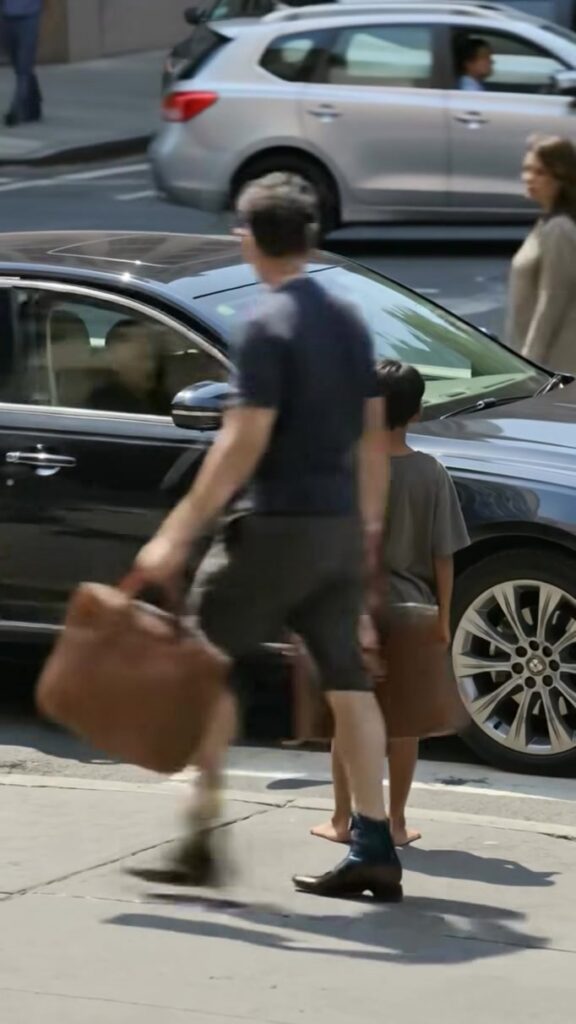
He couldn’t have been more than nine, maybe ten if life had stretched him out early. His hair was the color of dust, mostly because dust had basically moved in and stopped paying rent. His shirt used to be white. Now it was a map of stains and patches, the kind of fabric that had been washed without water and dried without hope. His feet were blackened from walking bare on streets that ate skin like it was a snack.
He had a job, technically. Not a real one—no boss, no pay stub, no lunch break—but it was still work. He drifted between trash piles and overfilled bins, hunting for anything that could become money: a crumpled bottle, a piece of wire, a can that wasn’t completely crushed. He carried a sack that looked like it had lived several lives and didn’t like to talk about them.
People moved around him in the way water moves around a rock. Not cruel on purpose, not always. Just… trained. Everyone had somewhere to be. Everyone had a problem bigger than a barefoot kid in the gutter. He was background noise. The city’s little secret that everybody knew and nobody wanted to look directly at.
He’d learned to be quiet because quiet kept you safer. Quiet meant you didn’t get noticed by the wrong kind of person. Quiet meant you could keep your finds without someone deciding they belonged to them now. But inside, he was loud. The boy kept a whole storm in his chest, and it rattled when he breathed.
Near a broken curb, beside a wall plastered with old flyers that promised cheap loans and miracle cures, sat his bucket. It was plastic, once bright, now sun-faded and scratched up like it had fought a cat and lost. The bucket was filled with water that used to be clean, probably, a long time ago. Now it looked like tea made from street dirt. He used it to rinse his hands sometimes, to splash his face when the heat got too sharp, to make the grime feel less like a second skin.
He crouched and pulled a half-melted soda bottle from a pile of trash. That was good. Bottles were good. He shook it out, checked for ants, shoved it into his sack. He didn’t look up often, but he felt the street the way you feel a mood in a room. And suddenly, the mood shifted.
Traffic had been aggressive, impatient, always pushing. But now something was rolling in like it owned the air. A car—black, glossy, the kind that reflected sunlight like it was proud of itself. It didn’t rush. It glided. It moved slowly, almost lazily, as if it could afford to take its time because nothing could touch it.
People noticed. Of course they did. Heads turned. A vendor stopped fanning his skewers. A man on a motorbike actually took his hand off the horn. It wasn’t just a car; it was a statement. Money on wheels. A private world behind tinted windows.
The boy watched it the way hungry people watch food behind glass. Not with admiration. Not even with desire. More like… a staring contest between two different universes.
He’d seen cars like that before, but they never came this close. Usually they lived on the wide roads near the towers, not on this messy street where the paint peeled and the gutters had opinions. It was wrong, like seeing a swan in a sewer.
The car rolled closer. And for a second, because the street narrowed and the crowd shifted, it was right there. So close he could see his own reflection on the door: a small, dirty boy bent in half, eyes too serious for his face.
Something in him snapped—not loud, just final. Like a thin string that had been pulled too long.
It wasn’t only the car. It was everything the car represented. Every time someone told him to move because he was in the way. Every time a shopkeeper chased him off like he was a stray dog. Every time he watched kids in clean uniforms eat snacks outside a school while he counted bottle caps in his palm. Every time someone looked through him instead of at him.
His hand went to the bucket before his brain finished thinking. He grabbed it by the rim. It was heavier than he expected, sloshing with warm, murky water. His arms shook for a heartbeat. He could still stop. He could still put it down and pretend he’d just been moving it.
But then the car’s window—dark glass—caught the sunlight and flashed like a wink. A little too polished. A little too perfect. Like it was laughing.
He swung.
The water left the bucket in one angry arc, a dirty comet. It struck the side of the black car with a wet slap and exploded across the door, the window, the mirror. Brown streaks crawled down the paint. Drops sprayed onto the street. For a moment, the car looked like it had been dragged through a puddle of the city’s worst truth.
Silence fell so suddenly it felt like somebody had turned off the world.
No horns. No shouting. Even the sun seemed to pause, as if it didn’t want to miss what happened next.
The boy stood there, bucket still in his hands, chest heaving. His eyes were wide, but he didn’t look sorry. If anything, he looked surprised he’d actually done it. Like he’d finally punched a wall he’d been staring at for years.
People froze. Then the phones came up, one after another, like a flock of curious birds. A teenager leaned out from behind a fruit cart, already recording. A woman pulled her child closer as if trouble had a smell. Two men exchanged a quick look that said, This is going to be bad for him.
The car stopped completely. The engine purred, quiet and expensive.
The boy’s brain finally caught up with his hand. Fear arrived late but strong. It crawled up his spine, cold against the sweat on his back. He imagined guards. He imagined shouting. He imagined a hand closing around his arm and squeezing until bones complained. He imagined being made an example.
He tightened his grip on the empty bucket anyway. Not because it could protect him. Mostly because letting go felt like surrender.
Inside the car, something moved. A shadow shifted behind the tinted glass. The boy couldn’t see faces, but he could feel attention. Like a spotlight. Like the whole car was looking at him.
Then came the sound: a click, sharp and clear in the hush.
The door handle popped.
The door swung outward with a clean, confident motion, pushing through the hot air like it owned that too. The black paint, now streaked and dripping, caught the light in messy rivers.
The boy took one step back without meaning to. His heel hit a rock. He almost stumbled, then caught himself. He lifted his chin like it was a shield.
Everyone held their breath.
From the opening door, a polished shoe touched the ground—so shiny it looked like it had never met dust. Then a second shoe. Then a figure began to rise from the seat, slow, deliberate, as if making sure every eye stayed right where it was.
The boy’s heart hammered so hard he thought it might burst out of his ribs and run away on its own.
And as the person stepped out, the street stayed silent, waiting to find out whether the next thing would be a slap… or something nobody expected.
The door slammed shut behind them with a sound that felt like the end of a sentence.
To be continued.