Every October, Claire and Thomas went back to the same grave like it was a calendar appointment they couldn’t cancel. Same section of the cemetery, same tired path, same tree that dropped leaves like it was trying to blanket everything they didn’t want to look at. They told people it was “for closure,” but closure was a word that sounded nice in other people’s mouths. For them, it was just the only place their bodies knew how to go.
This year, the rain had stopped ten minutes before they arrived, leaving the world shiny and damp. Claire was already down on her knees, palms pressed to her face, shoulders hitching. Thomas knelt beside her with the stiffness of a man holding himself together with screws. The gray headstone stared back, and behind the glass inset, a black-and-white photo showed Ben and Noah grinning like the universe had never invented fire.
Thomas hadn’t cried at the funeral. He’d done his crying alone in the shower, where grief could blend with hot water and go down the drain without witnesses. But the cemetery did something to him every year, like it reached up through the soles of his shoes and squeezed his heart. He stared at the photo until his eyes started to sting.
That was when a small voice floated in from the other side of the stone, light as a leaf and somehow heavier than all of them.
“They’re not here,” it said. “They’re with me.”
Claire’s sob caught mid-breath. Thomas’s head turned so slowly it looked painful.
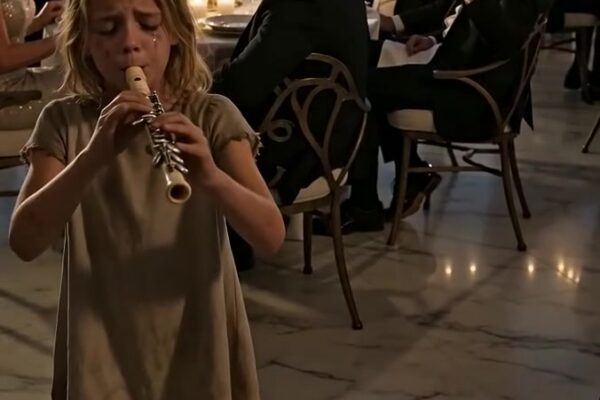
A girl stood on the far side of the grave. Bare feet on wet grass. Blond hair tangled into a mess of wind and knots. A thin smock that looked like it used to belong to someone else. Her face was smudged like she’d been playing in dirt, but her eyes were steady in a way that didn’t belong to a kid.
Thomas’s mouth opened and closed once before words showed up. “What did you say?”
The girl pointed at the photo behind the glass, like she knew them personally. “Ben tries to be quiet when he cries,” she said. “Noah keeps asking for his mom, like he thinks if he says it enough you’ll hear him.”
Claire made a noise that didn’t qualify as language. Her hand slid down from her face, fingers trembling. Nobody knew that. Not the police, not the fire investigator, not the therapist who’d offered breathing exercises like that would bring kids back.
“Who are you?” Claire managed, voice thin.
The girl’s gaze stayed on the picture. “I’m Mara,” she said. “They told me to look for you when the trees started dropping leaves again.”
Thomas felt his pulse rise into his throat. “This is… you can’t—” He stopped because he didn’t know what to call it. A lie? A miracle? A cruel prank from a child who clearly didn’t have the tools for cruelty?
Mara reached into the pocket of her smock and pulled out a bundle wrapped in dirty cloth. Claire’s hand flew to Thomas’s sleeve like she had to anchor herself to something solid.
Mara unfolded the cloth carefully, like she’d practiced. Inside was a small brass button shaped like a train engine, dulled with age but unmistakable.
Thomas’s face went blank. “Noah’s,” he said, not as a guess. He remembered sewing that stupid button back on twice because Noah liked to spin it between his fingers.
Claire leaned forward so fast her knees squeaked in the wet grass. “Where did you get that?”
“He pushed it through a crack,” Mara said, holding it out but not letting it go yet. “He said it was for proof.”
Thomas’s breath came out sharp. “A crack where?”
Mara swallowed. For the first time she looked her age, scared and small. “At Saint Martha’s,” she whispered. “The home on the East side. They keep the boys downstairs when visitors come. Like… like storage.”
Claire’s grip tightened on Thomas’s sleeve until it hurt. Saint Martha’s. The place whose director had stood in their living room three years ago, hands folded, voice smooth, telling them the state had confirmed the worst, telling them not to see the bodies because of the condition, telling them it was kinder.
Thomas stood up so abruptly his knee protested. “That place burned,” he said, mostly to himself. “It was on the news.”
Mara shook her head. “The top part burned,” she said. “The downstairs is fine. They moved kids around. They moved them a lot.”
Claire’s heart was trying to claw out of her chest. “Why would they do that?” she asked, and the question came out like she already knew the answer would be ugly.
“Because people pay,” Mara said simply. “Not for me. I’m… not worth much.” She said it like she’d read it on a price tag.
Thomas’s hands curled into fists. The cemetery air felt suddenly too thin. “We’re calling the police,” he said, reaching for his phone.
Mara flinched like he’d raised his voice at her. “No,” she whispered. “Not here. Not yet. She listens.”
“Who?” Claire asked.
Mara’s eyes flicked past them toward the cemetery gate. Claire turned, and her stomach dropped like an elevator snapping its cable.
A black car had rolled up to the curb outside the iron fence. It looked expensive in a way that didn’t belong near chipped headstones. A woman stepped out, tall and pale, wearing a long dark coat that didn’t care about the wet. At her throat, a silver cross gleamed like a warning.
Mara’s voice went papery. “That’s her. Sister Larkin.”
Thomas’s mind scrambled for rules. Cemeteries were public. People visited. But the timing was a punchline from hell. The woman’s gaze swept the grounds and landed on them with the casual certainty of someone who expected obedience. She smiled like a person practicing manners.
Claire felt something inside her harden, the way sugar turns to glass if you heat it long enough. Grief had made her soft for years. This was different. This was sharp.
“Get behind us,” Claire said to Mara, surprising herself with how steady she sounded.
Thomas stepped forward, phone in hand, not calling yet—just holding it like a shield. Sister Larkin walked through the gate without hurrying, her shoes making no sound on the wet path.
“What a touching tradition,” she said when she was close enough. Her eyes slid to the headstone, to the photograph. “So loyal. So faithful.”
Thomas’s voice was tight. “You work at Saint Martha’s.”
“I supervise,” she corrected, as if that mattered. Her gaze drifted to Mara. “And this one wandered off again.”
Mara grabbed Claire’s coat from behind like it was the only safe thing in the world.
Sister Larkin held out a hand toward the girl. “Come, Mara. You’re confusing these people.”
Claire took a step closer, putting herself between the woman and the child. “She’s not confused,” Claire said. “She brought us something.”
Thomas lifted the brass button, pinched carefully between two fingers. “Explain this,” he said. “Explain why she has a button that belonged to our son.”
For a second, the woman’s smile faltered. Not fear—just annoyance, like a plan had developed an unexpected wrinkle.
Then her expression smoothed out again. “Grief makes people see patterns,” she said softly. “If you’d like, we can speak privately.”
Thomas’s thumb hovered over his screen. “Or we can speak with the police,” he said.
Sister Larkin’s eyes sharpened. “Police are very busy,” she said. “And you’d be amazed what can happen when desperate parents decide to cause trouble.”
Claire’s stomach went cold. The threat was wrapped in a polite tone, like a knife hidden in a bouquet.
Mara whispered, barely audible. “She’ll move them tonight.”
Thomas looked at Claire, and the decision passed between them without needing words. If they called right now, Sister Larkin would walk away, make a call, and whatever was in that basement would vanish. If they waited, they might have a chance to see it with their own eyes.
Claire slid her phone into her pocket and, without looking away from Sister Larkin, pressed the side button three times—her emergency shortcut. It wouldn’t call loudly. It would quietly share her location with her sister and start recording audio. A pathetic little modern spell, but it was something.
“Fine,” Claire said, forcing calm into her voice. “Let’s talk.”
Sister Larkin’s smile returned, satisfied. “Good,” she murmured, and turned back toward her car as if she already owned the next hour of their lives.
Thomas leaned down slightly, his words for Mara only. “Can you lead us there?” he asked.
Mara nodded once, quick and terrified. “Yes,” she whispered. “But you have to promise something.”
Claire’s throat tightened. “Anything.”
Mara looked up at her, eyes bright but steady. “When you see them,” she said, “don’t scream right away. They get punished when adults make noise.”
Claire tasted blood where she’d bitten the inside of her cheek. She nodded anyway, because promises were all she had left to give.
As they followed Sister Larkin out of the cemetery, wet leaves stuck to their shoes like the ground was begging them to stay in the world they understood. Claire didn’t. She walked faster, holding Mara’s hand so tightly it felt like a lifeline, thinking of the photo in the headstone and the way her sons had smiled like nothing bad could ever find them.
Somewhere ahead, a car door closed with a soft, final sound. And in Claire’s chest, grief shifted shape—not smaller, not gone, just sharper, aimed like a tool. If her boys were alive, she wasn’t going back to that grave next October.