By day twelve, the paste under Leo’s fingernails had turned into a second skin.
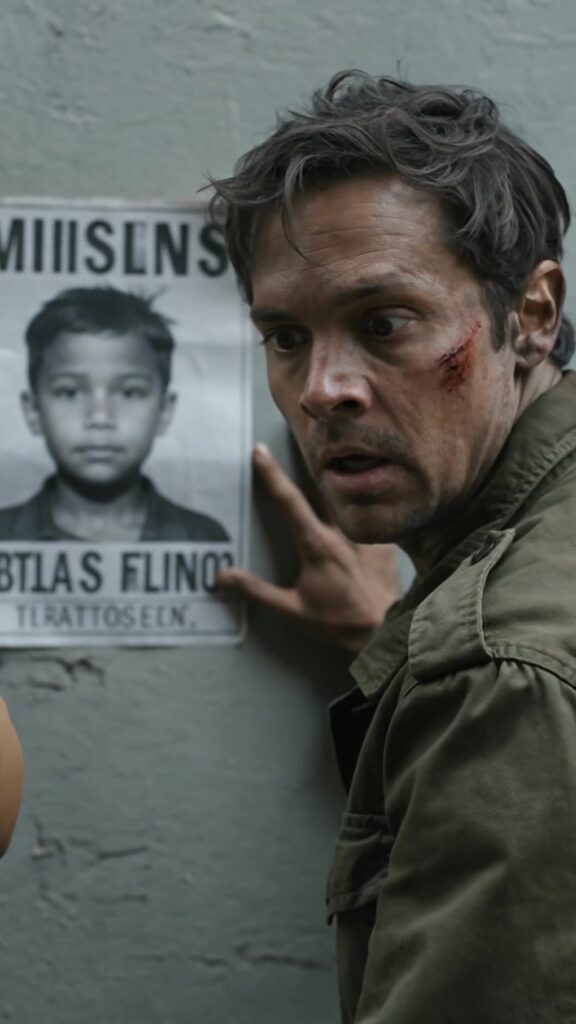
He’d been mixing flour and water in a chipped mug like he was making pancakes for a kid who wasn’t there. Then he’d smear it on the back of another poster—another smiling photo he’d picked because it didn’t show the missing tooth, didn’t show the crooked ears, didn’t show how small Milo looked when he tried to stand tall. The photo made strangers say, “He’s adorable,” and then walk away. Leo needed them to stop walking away.
Half the city wore Milo’s face now. Lamp posts. Laundromat windows. The cracked wall of the butcher shop. The side of a bus stop shelter that smelled like cold cigarettes and yesterday’s rain. MISSING, the headline screamed in thick black letters, like volume could make the universe listen.
For twelve nights, he’d done everything but sleep. He’d stood at the police desk until the fluorescent lights gave him a headache and the officer started answering questions like they were a chore. He’d walked through the train station at dawn, looking under benches and in corners where people curled up with their bags like they were holding on to their last possessions and their last secrets. He’d gone through shelters, holding up the photo so many times his mouth learned the sentence by itself: “Have you seen my son?”
He’d checked abandoned buildings too, places with broken stairwells and graffiti that looked like angry prayers. He’d searched streets so grimy the puddles reflected the sky like it didn’t want to be seen.
Each time someone shook their head, his hope didn’t shatter in one dramatic moment. It just thinned. Like paper left out in the rain.
That afternoon he was in a narrow alley behind a row of closed shops, pressing a fresh poster onto damp brick. The paste made a squelching sound when he smoothed it, like the wall was swallowing the paper. His hand trembled, partly from exhaustion, partly because every time he put Milo’s face up somewhere new, it felt like admitting he still didn’t know where Milo actually was.
“Sir?”
The voice was small, almost swallowed by the alley’s echo. Leo turned with the poster brush still in his hand.
A girl stood a few feet away. Barefoot. Her toes were dark from the street, and her faded blue dress looked like it had been washed a thousand times and still couldn’t get clean. Her hair was tied back with a strip of cloth, and she watched him with the steady look of someone used to adults not believing her.
“Sir,” she repeated, nodding at the poster like it was a sign on a map. “That boy… he lives in my house.”
Leo’s heart didn’t leap. It hit a wall.
He gripped the brush harder, as if it could anchor him. “What did you say?” His voice came out wrong—too quiet, too sharp at the edges.
The girl pointed at Milo’s picture, calm as a weather report. “He cries at night. He calls for his dad.”
Leo’s lungs forgot what to do.
That wasn’t a thing people guessed. Milo didn’t call for his mom when he had nightmares. He didn’t call for help. He called, always, “Dad,” like Leo’s name was a flashlight that could scare off monsters.
Leo took a step forward, slow, like he was approaching a skittish animal. “Where do you live?”
“Come,” she said, already turning. Like she’d been waiting for someone to ask the correct question.
He yanked the poster down off the wall without thinking. The paper tore at one corner, and he hated himself for that, like it was a bad omen, like he’d just ripped his son a little bit. Then he followed the barefoot girl out of the alley.
She moved fast, weaving between puddles, ducking under a sagging clothesline, turning down side streets that didn’t show up on the maps Leo had stared at until his eyes burned. The neighborhood changed as they went, slipping from storefronts and traffic into an area where buildings leaned toward each other like tired old men.
They passed a stray dog curled under a rusted staircase. The dog lifted its head, judged them, and decided they weren’t worth the trouble.
Leo’s shoes slapped hard against the wet concrete. His mind ran ahead of his body, inventing possibilities: a misunderstanding, a different kid, a cruel joke. And yet his chest kept tightening like it knew the truth before he could accept it.
At the far end of a narrow lane, the girl stopped at a doorway so dark it looked like a hole punched into the building. The place was half-crumbling, the paint flaking off in big tired curls. The windows were either boarded or broken, and the air around it smelled like damp plaster and old cooking oil.
“Here,” she whispered.
Leo looked down at her, and for the first time her face flickered with something like fear. She wasn’t fearless. She was just used to being ignored, which is a different kind of brave.
“He’s upstairs,” she said. “But you gotta be quiet. The lady… she comes back before dark.”
Leo felt ice crawl up his spine. “What lady?”
The girl hesitated, then held up her own hand and made a circle around her finger with the other. “She has a big red ring. Like candy, but not candy.”
Everything in Leo’s world narrowed into a sharp point.
They’d had one blurry security camera clip from the supermarket parking lot—the day Milo vanished. In the grainy footage, you could barely make out the woman’s face, but there had been a bright spot on her hand, catching sunlight like a warning. A large red ring.
Leo’s hands started shaking, not from tiredness now. From a rage so clean it almost felt calm.
He stepped into the building, and the smell hit him: mold, dust, and something chemical—medicine or disinfectant. The hallway was dim, the kind of dim that made you feel like you were trespassing even if you belonged there.
The girl pointed to the stairs and stayed back. “I can’t go up,” she murmured, like the staircase itself had teeth.
Leo nodded, not trusting his voice. He climbed. Each step creaked, loud in the silence, and he tried to place his weight carefully, like quiet could change what waited at the top.
On the second floor, a narrow corridor ran along doors that looked locked from the outside. The air was warmer here, stale, as if it had been breathed too many times and not allowed to escape.
He paused, listening. A faint sound—something between a sniffle and a hiccup. Then a whisper, soft and disbelieving, sliding through the floorboards and into Leo’s bones.
“Dad?”
Leo’s knees almost gave out. His throat tightened so hard it hurt.
He stepped toward the nearest door and saw the new padlock, shiny against old wood. His eyes swept the hallway and landed on a small table pushed against the wall—cheap, wobbly. On it sat a plastic cup with a few coins, an ashtray full of lipstick-stained cigarette butts, and—like some cruel signature—an empty ring box.
His mind flashed to his own kitchen table, Milo spinning his cereal spoon, asking a million questions. It felt like a different universe.
Behind him, downstairs, the girl’s voice floated up, thin as a thread. “She keeps the key in her shoe,” she called, then swallowed the rest of the sentence like she was afraid the building could hear her. “The left one. Under the bed.”
Leo closed his eyes for a heartbeat, letting the information settle into place like a puzzle piece clicking. This barefoot kid—this stranger—had been watching, learning, surviving. And she’d decided, for reasons he couldn’t yet understand, to take a risk on him.
He moved to the end of the corridor where a door stood half open to a tiny room. Inside was a mattress on the floor, a chair with a broken leg propped up by a stack of magazines, and a pair of women’s shoes by the bed—cheap black flats, scuffed at the toes.
Leo’s hands were so unsteady he had to press his palms against his jeans to steady them. He knelt, reached under the bed, and felt dust and a cold metal edge. A key, taped into the shoe’s insole like it belonged to the darkness.
His pulse hammered in his ears. He stood, key clenched, and walked back toward the locked door.
On the other side, Milo let out another small sound—hopeful, terrified, trying not to be heard. “Dad?”
Leo put the key into the lock. It resisted for a second, then turned with a click so loud it felt like thunder.
He didn’t open the door yet. He rested his forehead against the wood and tried to breathe like a person instead of an emergency.
“Milo,” he whispered, voice cracking like dry earth. “It’s me.”
From behind the door came a shuffling, a gasp, and then the smallest voice in the world turning into the biggest sound Leo had ever heard.
“Dad.”
Leo’s hand closed around the knob. Downstairs, the barefoot girl’s feet padded away fast, like she knew her part in this story was done for now. Somewhere outside, the day was tilting toward evening, and a woman with a red ring might already be on her way back.
But for the first time in twelve nights, Leo knew exactly where to look.
He opened the door.