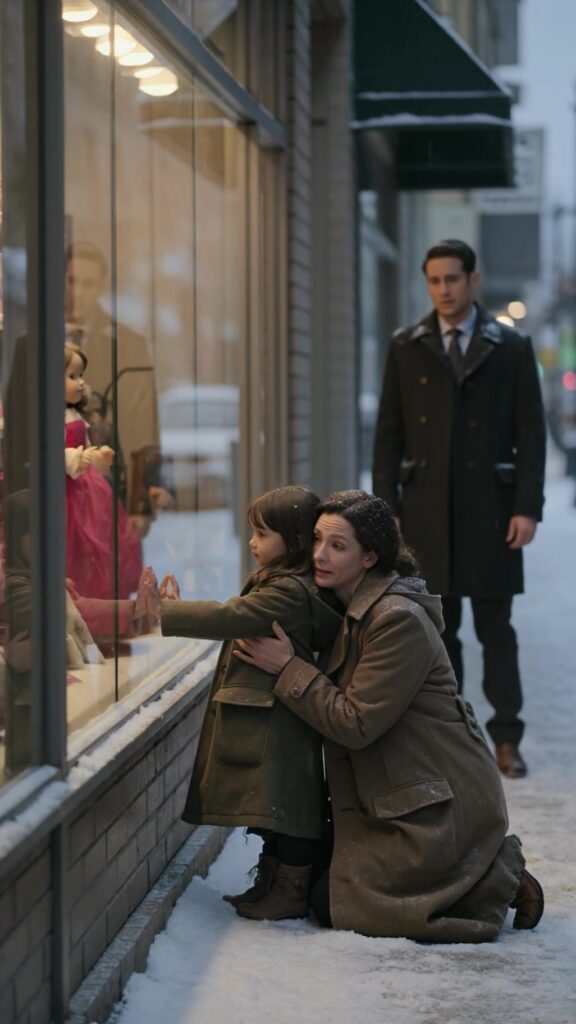
Snow had that polite, hush-hush way of falling that made the city feel like it was trying not to wake anyone. It dusted the curb, the parked cars, the shoulders of people hurrying with their heads down. And right in the middle of all that moving gray, a kid stood perfectly still in front of Goldfarb’s Toys, hands splayed against the glass like she could warm her fingers on the glow inside.
She couldn’t have been more than six. Seven, maybe. Her coat was too thin for December, her hat had a loose pom-pom that kept flopping into her eyes, and her boots were the kind that looked like they’d survived an older cousin first. But she stared at one specific doll—pink dress, shiny hair, little plastic smile—as if it was a celebrity who might wave back if she waited long enough.
“It’s the prettiest one,” she murmured. Not whining. Not begging. Just stating a fact the way you’d say snow is cold.
Her mom—young, but with the worn-out posture of someone who’d been tired for years—crouched beside her. The woman’s cheeks were raw from the wind, and her gloved hands kept doing that nervous thing where you rub your palms together like you can generate hope by friction.
“Birthday’s coming,” the mom said softly. “I know. But we… we can’t do that one this year.” She tried to make it sound casual, like they were skipping a movie, not a dream.
The girl didn’t cry. That was the part that landed like a stone. She just nodded once, like she’d been practicing disappointment for a long time. Then she put her face a little closer to the glass, fogging it with a tiny breath, and whispered, “Okay.”
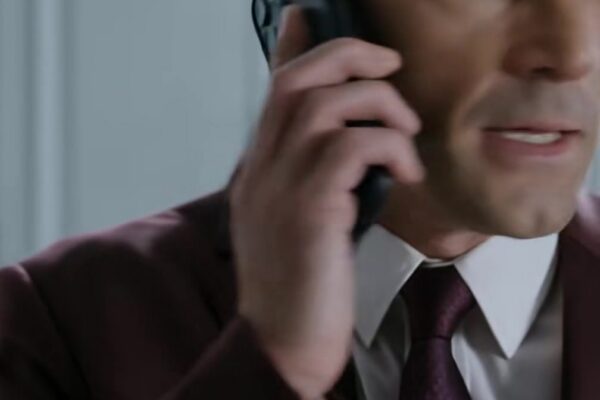
Across the sidewalk, a man in a dark coat slowed down without meaning to. He’d been walking fast on purpose—the whole point was to keep moving, keep his thoughts behind him, keep his chest from doing that tight, stupid thing it always did in winter. But he heard the word “birthday,” and then he saw the reflection.
In the toy store window, the girl’s face overlapped with the bright display lights. It wasn’t a clear mirror image, more like a ghost drawing itself in the glass. Yet it hit him so hard he stopped mid-step. The eyes. The way her mouth pressed into a brave line. The faint dimple near her cheek when she tried to be fine. It wasn’t “she looks like someone.” It was “that expression belongs to someone I buried.”
He’d spent ten years doing the kind of running that never shows up on fitness trackers. He’d moved apartments. Switched jobs. Changed his number twice. If a street reminded him of the hospital, he took a different route. If a song reminded him of her laugh, he turned the radio off. He told himself he was surviving, when really he was avoiding his own heart like it was a crime scene.
And now, a kid he’d never met wore the same sadness his wife used to wear when she didn’t want anyone to worry.
He approached carefully, hands visible, voice gentle. “Hey,” he said, like he was asking for directions. “Sorry to intrude. I— I overheard. It’s her birthday?”
The mom’s head snapped up, protective at once. She pulled the girl a half-step behind her without even looking. “Yes,” she said, clipped.
He nodded toward the doll. “I can buy it. No strings. Just… it’s a rough season. Let me do one decent thing tonight.” He even smiled, because he knew how creepy it sounded if you didn’t.
The mom didn’t relax the way people usually did when a stranger offered help. She stiffened more. Her eyes darted to his face, not just to check his intentions, but like she was checking a memory. The girl peered around her mom’s coat, curious in that fearless way kids have when adults are the ones acting weird.
“No,” the mom said quickly. Too quickly.
He blinked. “Okay. I didn’t mean to—”
“You don’t understand,” she cut in, and her voice wobbled like she’d just stepped on ice.
“Then explain,” he said, and he hated how desperate he sounded. The tightness in his chest wasn’t just grief now. It was a sharp, bright thread of something else. Recognition didn’t come from nowhere. Faces didn’t do that for no reason.
The mom’s gaze flicked down to the girl, then back to him. She swallowed. “We shouldn’t be here,” she muttered, more to herself than to him. She grabbed the girl’s hand as if she might bolt. “I told myself it’d be fine. I told myself you wouldn’t—”
“Wouldn’t what?” he asked, stepping closer before he could stop himself. The street noise faded. Even the toy store music felt like it moved farther away.
The mom’s eyes shone, not with the watery shine of gratitude, but with fear—fear mixed with guilt so old it had roots. “You were never supposed to see her,” she whispered. “Alive.”
His whole body went cold, like the snow had slipped under his coat and found his bones. “What did you just say?” he managed.
The girl looked up at her mom. “Mom?” she said, small and confused. “What’s happening?”
The mom’s jaw trembled. “I didn’t steal her,” she blurted, like she’d been waiting a decade to say it to someone who could actually ruin her life. “I didn’t— I didn’t plan anything. I was a nurse’s aide back then. I was in the maternity ward, the night… the night your wife died.”
The man’s ears rang. Ten years ago, fluorescent lights. Machines. His wife’s hand, going limp. A doctor telling him the baby didn’t make it, that it was tragic, that sometimes these things happen. He remembered signing papers with a pen that kept slipping because his hands wouldn’t stop shaking.
“We were broke,” the mom said, voice cracking. “My husband had left. I had an eviction notice and a job that barely covered groceries. And that baby— your baby— she wasn’t gone. She was tiny and blue and struggling, but she was breathing. One of the nurses panicked about paperwork, about liability, about… I don’t even know. Someone said, ‘He’s in shock. He won’t question it.’ And I—” She pressed her free hand to her mouth, horrified at herself even now. “I took her. I told myself I was saving her. I told myself it was mercy. And then days turned into years, and how do you walk into a police station with a kid who calls you Mom?”
The girl’s grip on her mom’s hand tightened. “You’re my mom,” she insisted, and her voice wasn’t pleading. It was a statement of reality.
He stared at the child—at the curve of her brow, the familiar set of her eyes—and something inside him, something he’d locked up with the hospital memory, broke open. Not just pain. Not just rage. A sudden, dizzying sense of air returning to a room that had been sealed for too long.
“What’s her name?” he asked, hoarse.
The mom’s shoulders sagged, like the truth finally had weight. “Lila,” she said. “I named her Lila.” Then, quieter: “I didn’t know what your wife wanted to name her. I’m sorry.”
Lila looked between them. “Do I… know you?” she asked, suspicious now. Not scared. Just careful, like she’d learned to read adult faces for weather.
He crouched slightly so he wasn’t looming. His knees complained; he’d been living like a man twice his age for a decade. “I don’t know if you know me,” he said. “But I think… I think I’m supposed to.” His throat worked. “I’m Owen.” He didn’t say the word father. It felt too big to throw at a kid in the snow.
Lila studied him with the seriousness of someone evaluating whether you can be trusted with a secret. Then she asked, very practically, “Are you gonna yell at my mom?”
He glanced at the woman who’d stolen his life and also, somehow, kept it breathing. He felt anger, sure. It was there, sharp as winter. But underneath it was a decade of grief that suddenly had a different shape. You couldn’t rage at a miracle without feeling your own heart wake up and argue back.
“I’m gonna be honest,” he said, voice low. “I don’t know what I’m gonna do yet.”
The mom flinched, as if bracing for handcuffs. “I’ll turn myself in,” she whispered. “I will. I swear. Just… don’t take her from me like she’s a coat you forgot at a party.”
Lila pressed closer to her mom, then looked up at Owen again. “My birthday is on Tuesday,” she announced, like that was the most important fact. “I wanted the doll. But I can be okay without it.” She paused, then added, softer, “Are you okay without… whatever you wanted?”
That question—so simple, so unfair—hit him harder than the confession. Because the thing he’d wanted for ten years was impossible. Or so he thought.
He breathed out, watching the air fog between them. “No,” he admitted. “I’m not okay without it. I’ve been pretending I am.”
The mom’s eyes filled, and she nodded like she understood what pretending cost. Lila tilted her head, thinking. Then she did something so ordinary it almost broke him: she held out her mittened hand to him, palm up, offering him the tiniest bridge in the world.
Owen stared at it. Ten years of running, and a kid by a toy store window was asking him to stop with one small gesture.
He took her hand. Her mitten was damp and cold, but her grip was warm with decision.
“Okay,” Lila said, satisfied. “So. Can we go inside and just look? Looking is free.”
Owen let out a laugh that came out strange, like a sound he’d forgotten he could make. The mom made a shaky noise that might’ve been a sob, might’ve been relief. Snow kept falling, soft and steady, like the city was trying to give them a clean page.
They went into the toy store together—not as strangers, not as a solved problem, but as three people finally facing the same truth. Owen didn’t buy the doll right away. He didn’t do anything dramatic. He just stood between the shelves and the warm lights and let his heart, for the first time in a decade, do what it had been trying to do all along.
It reached for them. Messy. Terrified. Alive.