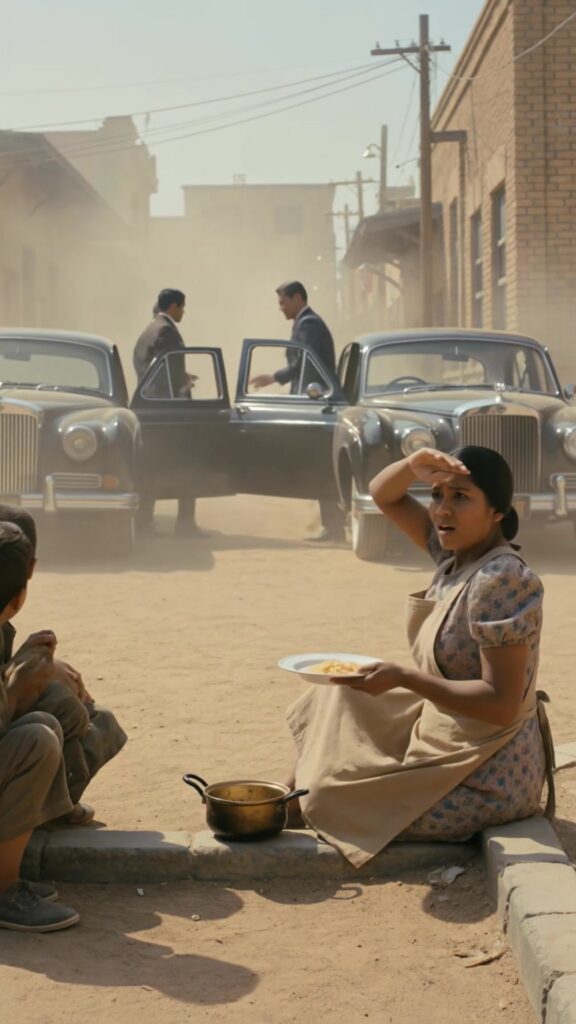
Maribel’s street had a way of grinding the color off everything. The houses looked like they’d been sanded down by years of wind. The pavement held more dust than memories. Even the sun seemed tired, hanging low and pale like it had clocked in out of habit.
She was tired too, if she was being honest. Her knees complained when she stood too long over the barrel stove. Her apron had stains that had survived so many washes they’d basically earned tenant rights. And her hands—her hands had the rough, shiny look of someone who’d grabbed too many hot things in a life with not enough potholders.
Still, every afternoon she dragged out her dented pot, set up her wobbly table near the curb, and served whatever she could stretch into a meal. Thin lentil stew when lentils were cheap. Rice with bits of chicken when she got lucky. Bread ends soaked in broth when she didn’t.
And every afternoon, the boys appeared like clockwork—three of them, all elbows and hungry eyes, posted on the curb like they belonged to it.
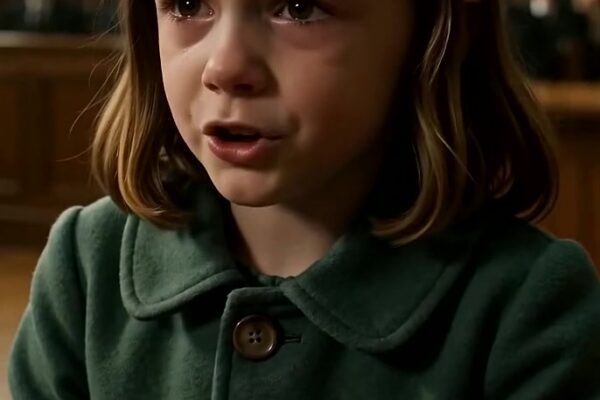
Maribel noticed everything about them. The oldest, Nico, held his chin up as if pride could fill the hollow under his ribs. The middle one, Jun, tried to make jokes with his mouth while his eyes stayed serious. And the smallest, Tomas, didn’t pretend at all. He just looked at food the way people look at oxygen.
They ate fast, but not careless. Not like kids at a birthday party. Like kids who’d been trained by bad luck. Nico always waited until the other two took bites first. Jun always tucked away a chunk of bread in his pocket “for later,” except later never seemed to come. And Tomas—Tomas had started to shake in the last few weeks, like his body had begun arguing with itself.
That day, when Maribel poured him a scoop of stew, his hand trembled so hard the spoon clinked against the bowl. He tried to lift it, missed his mouth, and stared at the drip on his shirt like it had personally betrayed him.
“Hey,” Maribel said, gentle but firm, like she was talking to a shy cat. “No fighting with the spoon. It’s just a spoon.”
Tomas tried again. Same result. His cheeks went pink with shame.
Maribel didn’t make a big show of it. She didn’t want pity to be another thing he had to swallow. She just set her own spoon—her best one, the one with the handle bent from an old accident—into his hand.
“This one knows the way,” she said. “It’s been to my mouth a thousand times. It’ll get you there.”
The boys snorted a laugh. Tomas managed a weak grin, but his fingers still didn’t listen. After two more tries, Maribel exhaled and slid her plate toward him too.
“Take it,” she said when he looked up, startled. “I’m not hungry.”
That was a lie. Her stomach pinched like it always did. But she’d gotten good at living with that pinch. She hadn’t gotten good at watching children lose.
The three boys ate like tomorrow was a rumor. Maribel watched them with a quiet ache that felt older than her body. Then, cutting through the usual street sounds—barking dog, distant radio, someone cursing at a broken fan—came an engine.
Too smooth. Too confident.
Then a second engine joined it, and suddenly the dust in the road lifted like it had been slapped.
Two black vintage luxury cars rolled in, glossy as wet ink, and stopped hard behind her table. The street went weirdly still. Even the dog quit barking, like it knew better.
Nico froze mid-bite. Jun’s hand went to his pocket like he was protecting the bread. Tomas stared, spoon hovering, trembling again.
Maribel straightened slowly, still holding the serving ladle. Her first thought was stupid and practical: My table is going to tip over. Her second thought was darker: This is trouble.
All four car doors opened at once. Three men stepped out—dark suits, clean shoes, the kind of calm you only see on people who can afford it. They didn’t scan the street like tourists. They walked like they were following a map only they could see.
Straight to Maribel.
She tightened her grip on the ladle. It wasn’t a weapon, but it was something. “Who are you?” she asked, voice steady because sometimes you just decide to be steady.
The man in the center didn’t answer right away. He opened his palm instead.
Resting there was a spoon—cheap, worn, and slightly twisted at the handle. Maribel’s breath snagged. She knew that bend. She’d cursed that bend for years, every time it didn’t sit right in the drawer.
The man looked up, and for a second the suit disappeared and all she saw were his eyes—dark, familiar, carrying the old shape of fear and stubbornness.
“You gave me this,” he said, softly, like saying it too loud might break the moment. “When I was too weak to eat.”
Maribel’s mouth opened, but her voice got lost somewhere between her chest and her throat. “Tomas?” she managed finally, and it came out like a question and a prayer at the same time.
The man nodded once. His jaw worked, like he was holding back too much. “We never forgot you,” he said. “Not any of it.”
Behind him, the other two men—one taller with a scar near his eyebrow, one shorter with the same crooked smile Jun used to wear—stayed quiet. But their faces said enough.
“Nico,” Maribel whispered, looking at the scar. “Jun…”
Jun’s grown-up version gave a small wave that looked ridiculous next to his expensive watch. “Hey, Mari,” he said, like he’d just popped out for groceries and not vanished for fifteen years.
Maribel’s knees threatened to quit. She reached for the edge of her table, and Tomas gently moved closer, ready to catch her without making it obvious.
The taller man—Nico—turned back to the cars and nodded. The trunks opened.
Maribel flinched. Her mind threw up every ugly possibility. But inside were stacked crates of food, boxes of medicine, neatly rolled blankets, and one locked leather case with brass corners.
Maribel stared, confused, heart pounding like it had something to prove. “What is this?” she asked.
“A start,” Tomas said. He took a breath, and the old shaking was gone from his hands, replaced by something else—control, maybe, or practice. “But before we give you anything… we need to tell you about the night we disappeared.”
Maribel’s fingers curled around the ladle until her knuckles went pale. She’d replayed that night so many times it had become a bruise. The boys had eaten, thanked her, and walked off like always. And then—gone. No bodies. No note. No whisper except rumors that swarmed like flies: stolen, sold, dead, run away.
“I looked for you,” she said, and her voice cracked at the edges despite her best effort. “I went to the station. I went to churches. I asked the women who know things. Nobody told me anything.”
Tomas nodded, eyes wet now. “Because nobody knew. Not even us, at first.” He glanced at Nico and Jun like he needed their permission to say the next part out loud.
Jun blew out a breath. “We were taken,” he said, plain as dirt. “Not by some random thug. By a guy who ran a ‘charity’ that was really just a trap. He’d pick up kids who looked like nobody would miss them.”
Maribel made a sound—half anger, half grief—that surprised her. “I missed you,” she snapped, and then softer, “I missed you every day.”
Nico’s scar twitched as if it remembered being new. “We know,” he said. “That’s why we’re here.”
Tomas continued, voice steadier now. “They moved us out of the city that same night. A truck. No windows. We thought we were dead already.” He swallowed. “But Jun… Jun did what he always did. He talked. He made jokes. He kept the driver looking at him instead of looking at the rope on Nico’s wrists.”
Jun shrugged like it was nothing, but his eyes shined. “It was a terrible joke, too,” he said. “I said his driving could kill people without the truck even stopping.”
Maribel let out a broken laugh that turned into a sob. She pressed her free hand over her mouth, embarrassed, but Tomas reached out and covered her wrist with his palm—warm, steady.
“We got out,” Tomas said. “Not clean. Not easy. But we got out. And after that, we made a promise. We weren’t going to survive just to survive. We were going to come back for the people who fed us when we were invisible.”
He gestured toward the crates. “We’ve got a small foundation now. Food pantry, clinic days, school supplies. Legal help. We’re not saints. We’re just… paying a debt.”
Maribel looked at the boys—men—standing in front of her, and she saw the old curb again, the way they’d sat with their knees pulled up, pretending not to be cold. She saw Tomas shaking. She saw herself sliding over a spoon like it was nothing, because in that moment it had been the only thing she could do.
“And the case?” she asked, voice raw.
Nico stepped forward and tapped the leather gently. “That’s for you,” he said. “But you have to let us finish the story first.”
Tomas met Maribel’s gaze. “The man who took us,” he said, “is still alive. And he’s back in this neighborhood.”
The street seemed to shrink around them. Dust swirled again, but this time it felt like a warning.
Maribel lifted her ladle like a flag she hadn’t meant to raise. “Then tell me,” she said, surprisingly calm. “Tell me everything. And then we’ll feed whoever needs feeding—after we make sure he never takes another child.”
Jun’s crooked smile returned, small but real. “Yeah,” he said. “That’s the Maribel we remember.”
And for the first time in years, the hunger in her chest loosened—not because it was gone, but because it finally had company.