The first thing Nico noticed wasn’t the chandelier or the smell of expensive perfume. It was the shine of the marble floor—so clean it looked like it didn’t believe in dirt. Like dirt was some rumor poor people made up.
He’d been dirty enough lately to qualify as proof. His hoodie was the color of old dishwater. His sneakers had a split grin at the toe. He’d slept behind a bakery the night before, which sounded romantic until you remembered rats also liked bakeries.
Still, the lobby of the Beaumont Hotel had a piano, and Nico had a plan that only worked if he pretended he belonged there.
He walked in with his shoulders squared like a kid in a school play, trying to pass for confidence. The doorman’s eyes snagged on him and didn’t let go. A couple in evening clothes paused mid-laugh as if someone had switched off the music.
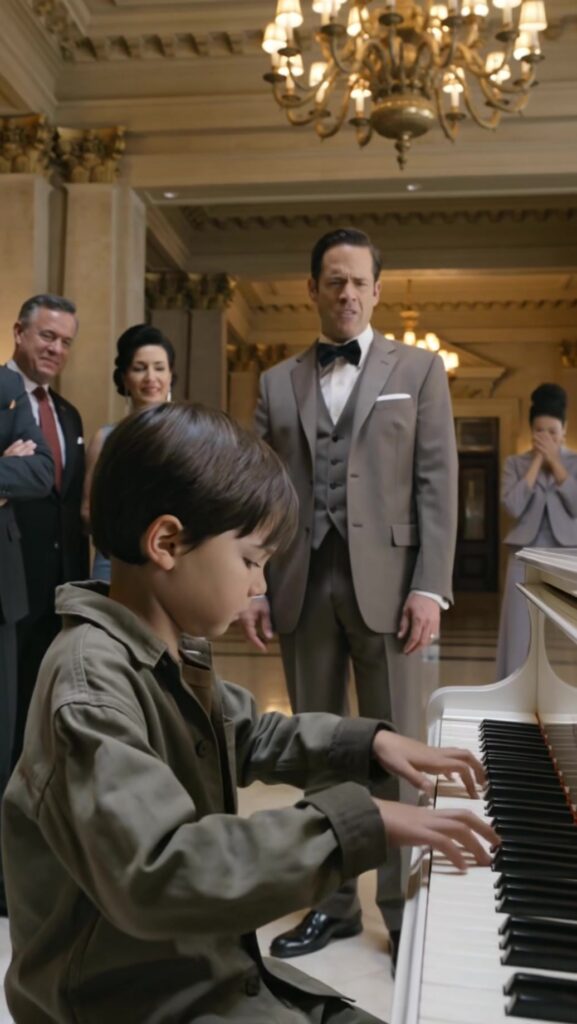
The grand piano sat under a chandelier that looked like a frozen fireworks burst. Nico’s gaze locked on the keys. Ivory and ebony. Clean lines. Order. The kind of order you could press down and make something honest come out.
“Hey,” someone called, not friendly. “You lost?”
Nico kept walking anyway. He was barely tall enough to look over the piano lid without craning his neck. He could feel the weight of eyes on the back of his head like hands pushing him toward the door.
Then the laugh came—the kind that wasn’t about a joke. It was about a person.
A man stood near the bar area with a cluster of guests orbiting him like he had his own gravity. His suit was soft-looking, expensive in the way that didn’t need logos. He held a drink up like it was a microphone.
“All right,” he said, amused, voice smooth as polished wood. “Let’s make it interesting. Play one song, kid. If you impress me… maybe you won’t be sleeping on the street tonight.”
A few people chuckled. Not loud, just enough to make sure Nico understood the room was on the man’s side.
Nico saw a bellboy pause with a luggage cart. Saw a woman near the staircase stare hard at a painting like she’d suddenly become deeply interested in brushstrokes. Saw the concierge pretend to check something on his tablet with furious focus.
Nico didn’t speak. If he spoke, his voice might shake, and shaking was how you lost before you started.
He climbed onto the bench. It was taller than he expected, and he had to scoot forward, feet not quite reaching the floor. The bench leather was cold through his jeans.
Up close, the piano was a black lake. The keys were the only shoreline.
Someone’s phone camera tilted toward him. A red recording light blinked. Nico ignored it.
He put his hands over the keys and hovered, not touching. That pause was the last place laughter could live.
Then he pressed down.
The first notes came out small. Not timid—careful. Like he was walking across thin ice with something precious in his arms. The melody moved in a spiral, repeating and changing, repeating and changing, until it didn’t feel like a song so much as a memory trying to hold itself together.
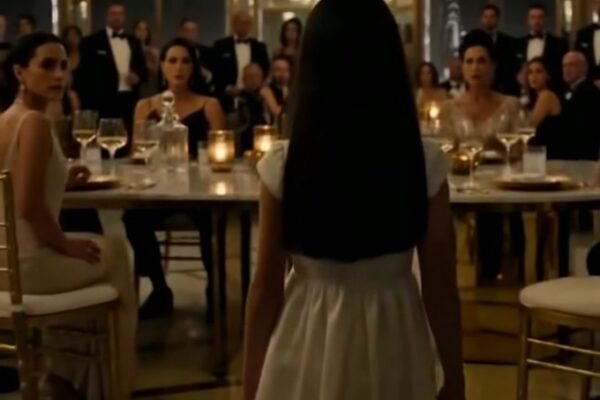
The lobby started to quiet in layers. First the giggles died. Then conversations thinned out. Forks stopped clinking. A spoon froze in mid-stir over coffee.
Nico didn’t look up. He watched his hands and listened for the way the piano answered back. The Beaumont’s instrument was tuned perfectly, but it had that deeper thing—a voice. It held the notes like it had been waiting for someone to ask the right question.
The melody grew. It opened, wider than the lobby, wider than the chandelier. People turned their bodies without realizing they were doing it, like sunflowers tracking a sun they didn’t want to admit they needed.
The rich man’s smirk vanished. His eyebrows pulled together like someone had handed him a bill with his name on it.
He took one slow step toward the piano. Then another.
Nico heard it anyway, the change in the room, the way attention moved. He had learned to read rooms without looking—how danger made air heavier, how embarrassment sharpened it.
The man’s face went pale in a way that didn’t match the warm gold lighting. His glass trembled slightly in his hand.
“No,” the man said, soft at first, like he was trying not to say it. Then louder, cracking, ugly with disbelief. “That song—” He swallowed. “That song was never written down.”
Nico’s fingers didn’t hesitate. The melody kept unfolding like a letter being read aloud.
Because he wasn’t playing it for applause. He was playing it because it was the only map he had.
When Nico was little—really little, small enough to fit inside his mother’s coat—she used to hum it while she washed dishes in a sink too small for the plates. He remembered her voice more than her face. He remembered how the tune made the room feel safe even when the electricity was off. He remembered her warning, whispered one night when men yelled in the hallway: “If you ever get lost, follow the song. It will lead you to the truth.”
Then she was gone. Not a clean disappearance. A ripping. A before and after.
Nico finished the last turn of the melody and let it fall into a single note that rang out and faded like a held breath released.
Silence rushed in, thick and startled.
He lifted his eyes. The rich man was only a few feet away now. Close enough that Nico could see the faint red lines around his eyes, like sleep had been losing the fight for a long time.
Nico spoke quietly. He didn’t need volume. The room had already leaned in.
“Then ask your wife why my mother was buried with your family ring.”
The sentence landed wrong in the air, like a vase hitting the floor but not breaking right away. People didn’t understand it, but they could feel it was dangerous.
The rich man’s glass slipped. It didn’t fall gracefully. It dropped, hit marble, and exploded into jagged pieces that caught the chandelier light and scattered it across the lobby like stars.
Nobody moved. Even the bellboy seemed locked in place, hands still gripping the cart handle.
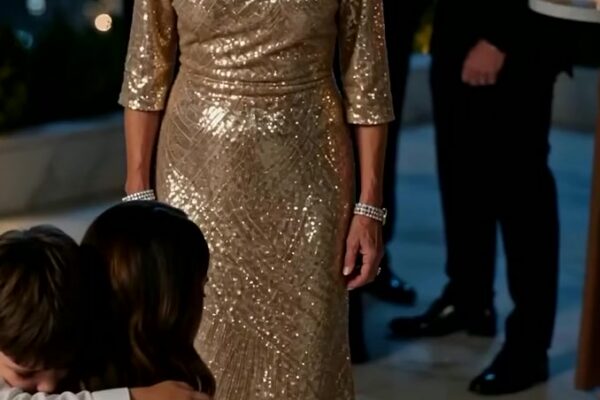
The rich man’s wife stood near the staircase. Nico hadn’t looked at her until now, but he’d known exactly where she was. He’d seen her in photographs online—charity galas, ribbon cuttings, smiling beside her husband like a matched set.
In person, her smile wasn’t there. Her hand gripped the edge of a side table so hard her knuckles were the color of paper. Her eyes were fixed on Nico, and something in her expression wasn’t surprise. It was recognition mixed with panic, like she was seeing a ghost that had learned to knock.
The rich man turned toward her, slow, as if his neck had to push through water. His gaze flicked from Nico to his wife and back again, trying to solve a puzzle that suddenly had blood on it.
“What is he talking about?” he asked, but the question wasn’t for Nico. It was for the woman he’d trusted to keep the world tidy.
She took one step backward. The heel of her shoe scraped the marble, a small sound that somehow sliced through the silence.
Her voice came out thin. “He was never supposed to find you.”
Nico slid off the bench. His legs felt too light, like they belonged to someone else. He looked down at the keys one last time, then up at the man who had tried to buy entertainment with spare change compassion.
“I didn’t come for a bed,” Nico said. His tone stayed even, but his throat burned. “I came for answers.”
The rich man stared at him, breathing hard through his nose, like anger wanted to rise but couldn’t find its footing on the shock. “Who are you?”
Nico’s hands curled into fists at his sides. He could feel every eye in the lobby, phones still recording, witnesses too startled to realize what they were about to carry home with them.
“You already heard who I am,” he said, nodding toward the piano. “That song is the only thing she left me.”
He took a step toward the shattered glass and didn’t flinch when a piece crunched under his shoe.
“And I’m done being lost.”
Up by the staircase, the wife’s breath hitched, like she’d been holding it for years and didn’t know how to let it go without choking.
The chandelier light kept sparkling over everything—the marble, the piano, the broken glass—making the lobby look beautiful even as something rotten finally surfaced.
Nico looked straight at her. “Tell him what you did,” he said. “Or I will.”
And for the first time since he’d walked in, nobody laughed.