The worst part was that the father could see all three of them at once.
It wasn’t poetic when it happened. It was logistics. It was geometry. A straight shot across a glossy hotel lobby that had been designed for people who never wanted to look directly at each other, only past—past the fountain, past the big floral arrangements, past the concierge who smiled like he’d been trained by a dentist.
But there they were, arranged in an accidental triangle that felt way too perfect to be an accident.
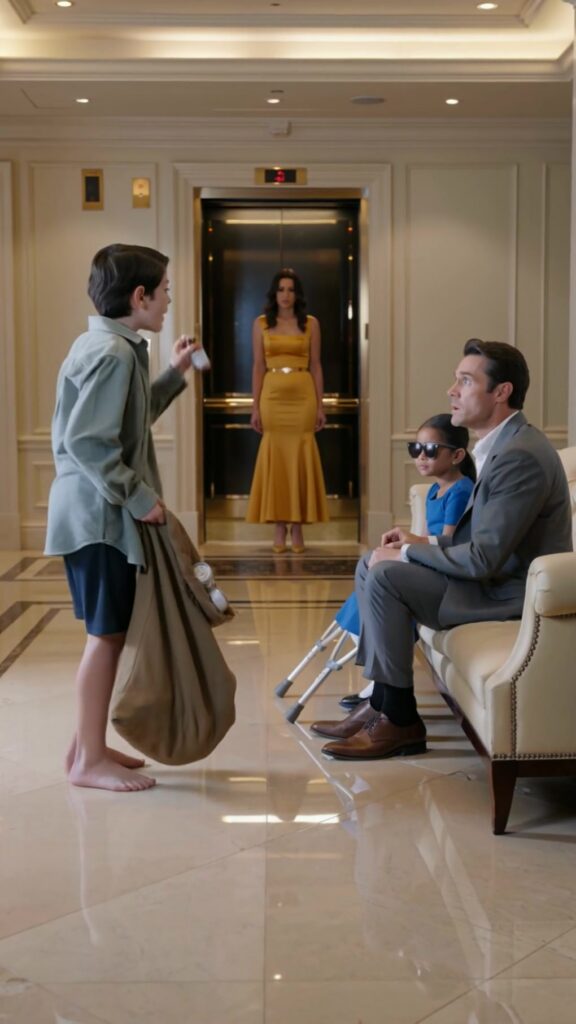
His daughter sat beside him on the cream sofa, her small hand resting on a crutch like it was a prop she’d borrowed from a school play. Dark sunglasses covered half her face. She wore her hair in a neat braid, the kind his wife insisted made her look “tidy.”
His wife stood near the elevator in a bright yellow dress that looked like sunshine and felt, suddenly, like a warning sign. She was angled toward her phone, pretending to scroll, pretending not to hover.
And in front of him—barefoot on marble cold enough to make adults wince—stood a boy with a dirty sack in one hand. He couldn’t have been more than ten or eleven. His toes were gray from the city. His shirt hung off one shoulder like it had given up mid-shift.
No one was hidden. No one was out of frame. No one could later say they’d been in the bathroom or on a call or looking the other way.
Daniel had come down to the lobby because he couldn’t stand another minute in the suite. The air up there smelled like expensive soap and quiet fights. His company’s attorney had asked him to “review” the paperwork again, which meant hurry up and sign. His wife had insisted their daughter needed to rest. Their daughter, Lena, had sat in bed with her sunglasses on even in the dark, turning her face toward the TV audio like she was listening to a ghost.
Daniel had needed something normal—coffee, noise, strangers. He’d gotten marble silence and a kid who’d walked right up to him as if the lobby belonged to him.
The boy pointed straight across the room. Not vaguely. Not generally. Like an arrow.
“She is not blind!” he shouted.
The sentence ripped through the lobby. It bounced off the columns and made even the fountain sound like it was embarrassed to be running.
Daniel jolted so hard his coffee sloshed over the rim. His first instinct was ridiculous—look behind him, like the kid was talking to someone else. But there was no one else. Only Lena beside him, still for a beat too long, and his wife near the elevator, suddenly very still.
“Excuse me?” Daniel managed. His voice came out flatter than he wanted, like a man at a customer service desk.
The boy took a step closer. The cans in the sack clinked softly. He smelled like rain and pavement and something sour that could have been fear.
Then he said the second sentence. The one that didn’t just accuse, but rewrote the entire room.
“Your wife did it.”
Daniel didn’t turn to his wife first. That was the thing he’d never forget about himself—the order of his attention. The loyalty of his eyes.
He looked at Lena.
And Lena, without thinking, tilted her face toward the boy’s exact position.
Too exact. Too fast. Too natural.
Her chin lifted like she was answering someone she could see. The sunglasses hid her pupils, but they couldn’t hide the precision. Daniel felt his stomach drop as if the sofa had turned into an elevator shaft.
His wife—Marisol—went pale in the background. Not the “I’m offended” pale. The “I’m caught on camera” pale.
“What are you doing?” Marisol said. She laughed once, a quick strange sound. “Daniel, this is ridiculous. This is some kid—he’s trying to—”
The boy rummaged in his sack and pulled out a tiny bottle. Clear glass, no label, the kind of bottle you’d buy in bulk for homemade vanilla extract or essential oils. The lid was scratched up like it had been opened and closed too many times.
Daniel snatched it without asking. His hand shook so hard the bottle clicked against his ring. He stared at it as if it might confess on its own.
Lena’s mouth opened. She didn’t speak right away, like she was deciding whether she was allowed to. Then she whispered, almost relieved, like someone had finally asked the right question.
“It tastes bitter…”
A bellhop paused mid-step. The concierge’s smile died, then rebooted into a blank expression. Somewhere behind the front desk, someone quietly stopped typing.
Marisol took one slow step backward, toward the elevators, like the doors might open and swallow her without questions.
Daniel held the bottle up between thumb and forefinger. He thought about the last three months: the specialist appointments, the dim rooms, the tests Lena cried through, Marisol’s constant, gentle hand on Lena’s shoulder guiding her like she was made of glass. He thought about how quickly Marisol had found a “new therapist” and a “new supplement” after the second doctor suggested Lena’s symptoms didn’t match any diagnosis neatly.
“It’s vitamins,” Marisol said too quickly. “It’s… it’s from a naturopath. People do that. It’s harmless.”
The boy shook his head. He’d been brave to shout, but now his bravery settled into something steadier, like he’d practiced this part.
“I heard her,” he said. Lower now. Clearer. “I was in the service hallway. I take cans out back. She didn’t see me.”
Daniel’s throat tightened. “You… you were listening to my wife?”
“She was yelling at the nanny,” the boy said. “The nanny was crying. Your wife said it only had to last until you signed. Then you could all go back to normal.”
Daniel’s ears rang like someone had slapped him. He looked at Marisol again, really looked, as if she’d been someone new wearing his wife’s face.
“Signed what,” Daniel said, though he already knew.
Marisol’s jaw worked, trying to rearrange reality. “Daniel, don’t do this. Don’t listen to—”
“The papers,” Daniel said. “The ones you keep leaving on my nightstand like they’re bedtime stories.”
Lena shifted. The crutch slid slightly across her lap. For the first time in weeks, she reached for Daniel’s hand, finding it without fumbling. The touch made him want to sob and scream at the same time.
“Daddy,” she said quietly. “Mom said if I was… if I was like this… you’d stay. She said you were going to leave and I needed to help.”
Marisol flinched as if Lena’s voice had physically hit her.
“I didn’t mean—” Marisol began, then stopped, realizing every version of that sentence sounded bad.
Daniel’s mind flashed through moments he’d dismissed: Lena refusing to take the drops unless Marisol watched, Marisol switching cups, Marisol insisting Lena’s sunglasses were “comforting.” The therapist’s note about “secondary gains.” The way Marisol’s tone always sharpened when Daniel talked about separation. The way she’d called it “abandonment,” as if a marriage ending was a crime scene.
He stood up slowly, because sudden moves felt like they might shatter whatever fragile truth had finally appeared.
“Why?” he asked, and it was the only question that mattered and also the most useless. “She’s our kid.”
Marisol’s eyes filled, and for a second Daniel almost recognized her again—until he realized she was crying for herself, for the plan collapsing.
“I was scared,” she said. “I was tired. You were always gone. You were always choosing your company over us. And when you said you wanted space, I—” She laughed again, small and ugly. “I thought if you had to take care of her, you’d remember we’re a family.”
The boy shifted his weight, suddenly looking like a kid again, not a messenger. “She paid the nanny extra,” he added, like he hated being part of this but couldn’t stop now. “The nanny didn’t want to do it. She said no. Your wife said she’d replace her and ruin her papers.”
Daniel’s grip tightened around the bottle. He could feel the ridges of the cap biting into his skin. He could also feel, sickeningly, how close he’d come to signing away more than money. If he signed, Marisol could argue full control of Lena’s care, full custody, full story.
He looked down at his daughter. “Can you… can you see me right now?” he asked.
Lena nodded. Slowly, like she was afraid of making anyone angry. “Yeah.”
“How long?”
Lena pressed her lips together. “Most of the time,” she admitted. “Sometimes it got… fuzzy. After the drops.”
Daniel’s knees went weak. He sat back down hard, the sofa creaking like it disapproved of all of them.
Marisol took another step toward the elevator. The doors pinged softly open as if on cue. She looked at the gap between the doors the way people look at an exit in a burning building.
Daniel’s voice came out quiet, which surprised him. “Don’t,” he said. Not as a plea. As a command.
Marisol froze again, caught between leaving and being seen leaving.
Daniel turned his head slightly, still keeping all three of them in view. That was the new rule. No more letting anyone slip out of sight and rewrite what happened later.
“Someone call security,” he said, to no one and everyone. “And call the police.”
The concierge blinked, like his program had finally received the correct input. He picked up the phone.
Marisol’s face went sharp. “Daniel, you can’t do this to me.”
Daniel looked at her, and the strangest part was how calm he felt. The panic had moved into a colder place, a place that made decisions.
“You did it to her,” he said. He held up the bottle, the tiny glass thing that had rearranged their entire life. “You did it to all of us.”
Lena slid her sunglasses down, just a little, not fully off. Her eyes were there. Brown. Watchful. Very much not gone.
She looked at her mother, and Daniel watched his daughter’s face as if it were a map out of a storm. “Mom,” Lena said, voice thin, “why did you make me pretend?”
Marisol opened her mouth, then shut it. Whatever story she’d built didn’t fit in this lobby anymore. It didn’t fit under the bright chandelier, the security cameras, the boy’s bare feet on the marble, the truth that wouldn’t stay quiet.
Security approached from the hallway, two men in dark suits moving fast but trying to look slow. One of them looked at Daniel, then at Marisol, then at the child with the crutch, then at the barefoot boy clutching his sack like it was armor. The same triangle. The same frame.
Daniel realized the boy was shaking now. The adrenaline had worn off. The fear had clocked in for its shift.
“What’s your name?” Daniel asked him softly, without taking his eyes off Marisol for too long.
“Eli,” the boy said, barely audible.
Daniel nodded. “Thank you, Eli.” The words felt too small, like trying to pay for something priceless with pocket change. “You… you did the right thing.”
Eli swallowed. “She yelled at me once,” he muttered. “For standing too close to the doors. Like I was dirt. I figured… if people like that can lie, then maybe people like me can tell the truth.”
Marisol made a sound—half scoff, half sob. “Oh, don’t act like a hero,” she snapped at him, and then immediately seemed to realize how awful that sounded, how it confirmed everything.
Daniel felt Lena’s fingers tighten around his. She leaned in against his arm, not because she couldn’t walk, not because she couldn’t see, but because she was a child and the world had just cracked open.
The doors of the elevator stayed open, waiting. But Marisol didn’t move. Security stepped in gently, professionally, like they’d done this before with different types of disasters.
Daniel watched them position themselves. He watched Marisol’s yellow dress, bright as a warning. He watched Eli’s bare feet, grounded. He watched Lena’s face, finally turned toward the truth without having to fake anything.
And he hated that he could see all three of them at once.
Because it meant there was no place left to hide from what he’d almost missed. No corner of the story he could pretend hadn’t been lit up. No comforting blur at the edges.
Just a clean, cruel frame: the boy who spoke up, the child who’d been used, and the woman who’d tried to turn love into leverage.
Daniel squeezed Lena’s hand and, for the first time in months, stopped wondering what was wrong with his daughter.
He started understanding what was wrong with his marriage.