The bell above the laundromat door didn’t even get a full jingle. It did this strangled half-chime, like it was as shocked as everyone else, when the kid slid in on the wet tile and smacked down hard enough to make a sound you could feel in your teeth.
He was barefoot, shirt stuck to him, water streaming off his hair and dripping off his elbows. He didn’t cry out. He just scrambled—hands and knees, frantic—and wedged himself behind the nearest adult like her body was a wall that could stop whatever was chasing him.
The nearest adult happened to be Mrs. Calder, who always came on Tuesdays with a rolling cart full of towels from the assisted living place down the street. She had a permanent look like she’d smelled a bad melon, but she was steady on her feet. She froze with a towel halfway folded, the boy’s fingers tangling in the hem of her skirt.
“Please,” he rasped, voice small and cracked. “Hide me.”
Mrs. Calder’s eyes flicked to the door. The rain outside was coming down sideways, slapping the big front windows hard enough that the world beyond looked like it was melting. Behind her, machines thumped in their steady rhythm, a chorus of spinning metal and the occasional squeak of a dryer that needed oil. A couple of customers looked up from their phones. One guy paused with a scoop of detergent mid-air.
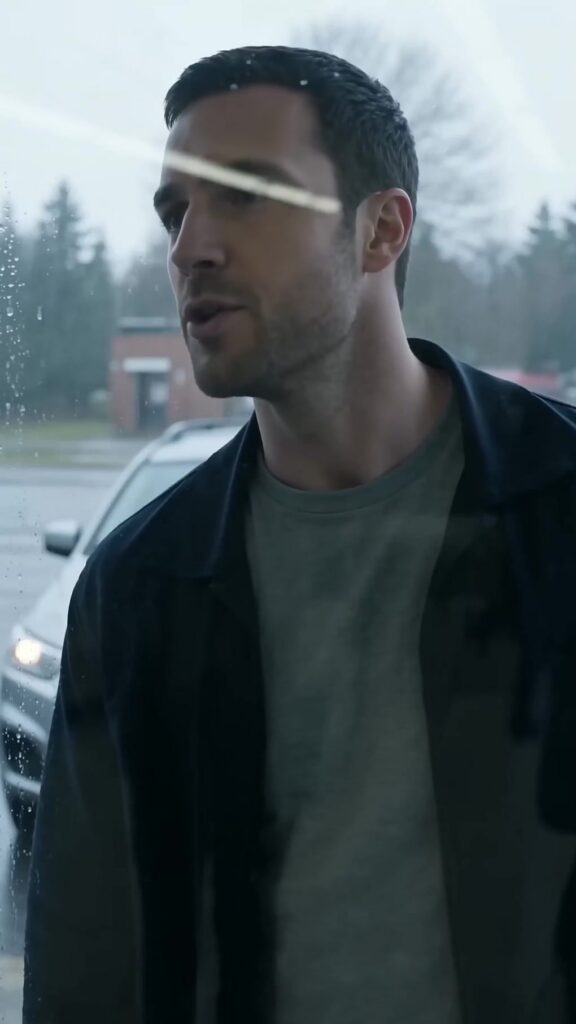
Then a man appeared on the other side of the glass. Clean-cut. Dark coat. Hair neat like he’d had time to fix it before strolling out into a storm. He smiled calmly, like he’d wandered over to pick up a forgotten sock. He raised a hand and knocked once—firm and polite. No rush. No panic.
“Open up,” he said, and even through the glass, the words landed heavy.
The boy’s grip tightened so hard Mrs. Calder felt the tremble in his knuckles. She looked down, ready to scold him out of reflex—kids shouldn’t grab strangers, kids shouldn’t drag drama into public places—then she saw his wrist.
Not just damp skin. Angry marks, red and bruising, like someone had clamped down with fingers and held on when he tried to pull away. Mrs. Calder’s mouth pressed into a line. Her towel dropped back into the cart like it suddenly weighed nothing.
“Who’s that?” she asked, keeping her voice low. Not gentle exactly, but controlled. The kind of tone that made kids answer.
The boy’s lips quivered. He glanced at the door like it might bite him. “He said… he said not to tell.”
Mrs. Calder crouched just enough to be in his space without pulling him into a hug. She wasn’t a hugger. “Tell me,” she said, and there was no room to argue. “Right now.”
The boy swallowed. His eyes were too wide for his face. “He locked my sister in the car.”
That did it. The laundromat changed. The air shifted, like everyone in the room had inhaled at the same time and forgot to let it out. A woman folding baby onesies stopped mid-fold. The guy with the detergent set it down quietly, like loud movements might break something.
Outside, the man leaned closer to the glass, smile still hanging on like it was painted there. He cupped his hands around his eyes to see inside better, peering through the glare of fluorescent lights. His voice cut through the rain. “I can see you,” he said, not loud, just certain. Like the fact itself was a threat.
Mrs. Calder stood up slowly. Not because she was scared. Because she was deciding. She took one step toward the front counter, the boy shuffling with her like a shadow, and she said, “Maria.”
Maria was the attendant—a college kid with pink streaks in her hair and an oversize hoodie that said ASK ME ABOUT MY CAT. She looked up from the register, eyes snapping from the boy to the man outside.
Mrs. Calder didn’t ask a question. She gave an order the way she probably used to give them when she worked as a nurse, back when her knees didn’t ache. “Call 911. Tell them there’s a child in danger and a possible abduction. Now.”
Maria’s fingers were already fumbling for her phone. “Okay—okay.”
Mrs. Calder reached behind the counter where the laundromat kept the lost-and-found and the spare change machine keys. There was a red button there, half hidden behind a jar of mints nobody ever bought. Mrs. Calder knew it was there because she read signs, even the boring ones. EMERGENCY ALERT CONNECTED TO SECURITY. She pressed it with her thumb.
Nothing dramatic happened. No sirens. No lights. Just a quiet click, like a decision being filed somewhere official.
Then she turned to the front door.
“Don’t,” Maria whispered, eyes huge.
Mrs. Calder didn’t open it. She just unlocked it. A simple motion. The boy made a tiny sound, half gasp, half whimper.
Mrs. Calder leaned close to the glass, close enough the man could see every line in her face. Her reflection overlapped his smile. She stared straight at him with a look that said she’d lived through worse men than him, and she wasn’t in the mood.
“You can see us,” she said through the door, voice calm. “And so can we.”
The man’s smile wavered for the first time, like a curtain tugged by a sudden draft. His eyes flicked behind Mrs. Calder—to the customers watching, to Maria on the phone, to the guy quietly stepping to block the aisle like he was building a human barrier.
“Ma’am,” the man said, still polite, “that’s my nephew. He gets… dramatic.”
“Funny,” Mrs. Calder replied. “He doesn’t look dramatic. He looks hurt.”
The man’s gaze dropped, just a fraction, to the boy’s bruised wrist. His jaw tightened. The smile slid off his face like it had never really belonged there.
In the parking lot, through the sheet of rain, a car sat angled weirdly across two spaces, engine running. The headlights were on even though it was daytime. The man turned his head toward it—quick, involuntary. Like he’d forgotten it was visible.
Mrs. Calder saw it too. She saw a small shape in the back seat, movement behind fogged glass. A little hand smearing a clear arc in the condensation, then pressing flat like it wanted to push through.
“That your nephew too?” Mrs. Calder asked.
The man’s nostrils flared. For a second, he looked like he might try something dumb—like he might yank the door open, like he might drag the boy back into the rain with that calm smile forced back on his face.
But then the laundromat’s security alarm finally did what it was built to do: somewhere nearby, a distant siren answered. Not close yet, but coming. The sound curled into the room like a promise.
The man’s eyes snapped toward the street. He muttered something under his breath and pivoted, coat whipping around his legs as he ran toward the car.
“Lock it!” Maria hissed, still on the phone. “He’s moving!”
Mrs. Calder relocked the door and slid the deadbolt across with a final, satisfying thunk. She turned to the boy, who was shaking so hard his teeth clicked.
“What’s your name?” she asked.
“Eli,” he whispered.
“Eli,” she said, as if anchoring him to the tile and the humming machines and the people who were now a wall around him. “How old is your sister?”
“She’s four,” he said, and his voice broke on the number. “He said he’d take her if I yelled.”
Mrs. Calder’s throat tightened, but her hands stayed steady. “You did the right thing,” she told him. Not sweetly. Firmly. Like she needed him to believe it right away.
Outside, the man yanked at the car door. It didn’t open immediately—maybe the locks had clicked, maybe the kid inside had pushed something, maybe the universe finally decided to be difficult for him. He slammed his palm against the window, anger flashing across his face.
And in the laundromat, with rain rattling the glass and sirens growing louder, Mrs. Calder planted herself between Eli and that door like she’d been built for this exact moment. Not the last door left in the world, maybe. But the one that mattered right now.