The first thing people noticed about Luca wasn’t the white cane or the milky film over his eyes. It was the way he moved through Le Cygne like he’d built the place himself. He slid between tables without brushing a coat sleeve, turned corners without slowing, and always seemed to arrive exactly where a guest needed him. New diners would whisper, like it was a magic trick: How does he know?
Luca never answered. He didn’t need to. He’d learned the restaurant the way you learn a song—by repetition, by rhythm, by listening for the small cues. The hiss of the espresso machine meant the bar was busy. The faint hum of the ceiling fan told him he’d drifted too close to the window seats. The floor changed from smooth oak to a slightly rougher tile near the kitchen door. The world wasn’t dark for him; it was textured.
That Thursday, Le Cygne had the kind of crowd that made the air feel expensive. A tech founder laughing too loud. A couple celebrating something with matching watches. A birthday table with sparkly candles and a woman in a dress that sounded like satin when she moved.
The woman everyone watched, though, was seated in the center like the evening had been arranged around her. Maris Delaunay. Old money, new headlines. Luca didn’t recognize faces, but he recognized energy, and hers had the sharp, tidy edge of someone used to being obeyed. She spoke in a low voice, each word placed carefully, like chess pieces.
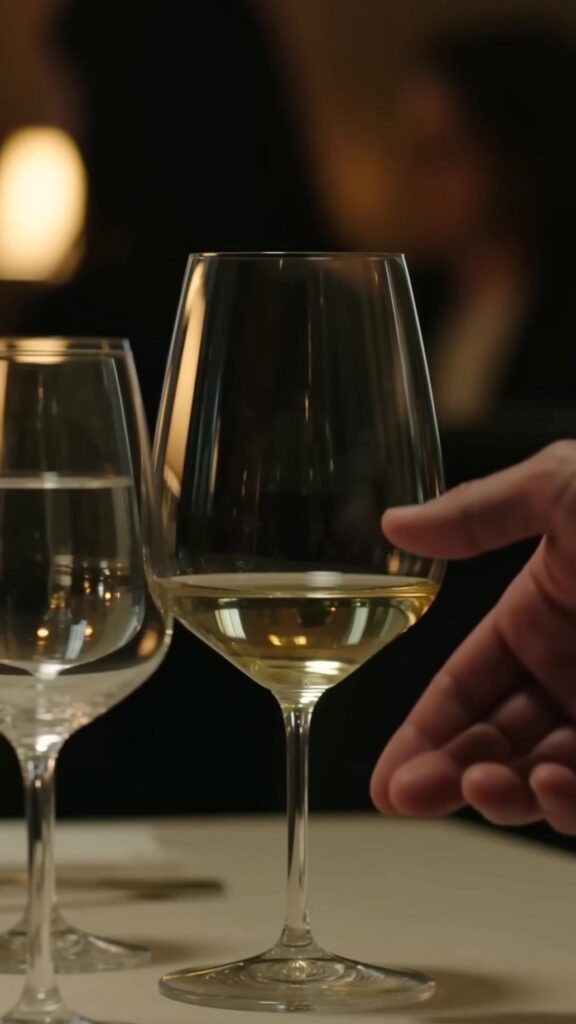
Her party had ordered a bottle of red—something showy. Luca heard the sommelier’s proud little speech about the vineyard’s fog and the winemaker’s stubbornness. Luca carried the bottle to the table after the presentation, careful with the weight, the angle, the slow glide of service.
But when he set the first glass down in front of Maris, something tugged at him. Not a thought, not a warning siren. More like a note in a song that was slightly out of tune.
It wasn’t the wine’s smell exactly. It was what the wine was pushing aside.
Luca’s nose had become a library. Garlic, lemon zest, perfume, metal from cutlery, the faint bitter of char on steak. Wine belonged in its own particular corner—dark fruit, tannins, oak, sometimes a whisper of smoke. This glass had that… and also something else, thin and sharp, like the clean bite of a freshly wiped counter. Like solvent. Like a coin held too long in your mouth.
His hand hovered near the rim as he poured, and he listened. A good pour sounded consistent, liquid meeting glass with a smooth, steady tone. This one had a stutter, a tiny hiccup, as if the liquid’s thickness changed mid-stream.
Luca didn’t say anything yet. He’d made a career out of not embarrassing guests. He finished the pour and stepped back, cane angled lightly against his leg, head tilted as if he was listening to their conversation. He was. And he wasn’t.
Maris lifted the glass. Luca heard the soft clink of her rings against crystal, the small inhale people took when they prepared to taste something pricey. Then the first sip.
The room changed in a half-second.
Maris made a sound that wasn’t a word. Her chair scraped back hard. She grabbed at her throat, the way people do in movies, except this was ugly and real. Her glass slipped from her hand and hit the floor, shattering with a sharp, bright crash that silenced the whole dining room.
“I can’t—” she tried, and then couldn’t finish.
Chairs bumped. Someone yelped. A server dropped a tray somewhere near the kitchen, the clatter echoing like cymbals. Luca was already moving, cane tapping faster, counting steps in his head: three to the left of the service station, five forward, a slight turn around the table corner.
A man near the aisle—Luca had heard him earlier making snide comments about “special accommodations”—shifted abruptly and blocked Luca’s path. “Hey,” the guy snapped, voice tight with panic and entitlement. “Don’t come over here. You’ll step in the glass.”
Luca didn’t argue. He angled his cane, found the edge of the chair leg, and slid around him like water. His face stayed calm, focused, almost blank. He knelt at the edge of the mess, one hand hovering above the shattered crystal, the other reaching toward Maris’s wrist.
Her pulse was frantic, fluttering too fast to count. Her breathing came in shallow, strangled bursts.
“Don’t drink,” Luca said, loud enough for the table and the nearest guests to hear. It wasn’t a suggestion. It was a command.
Someone scoffed, close enough that Luca felt the puff of their breath. “You can’t even see. How would you know what’s wrong with the wine?”
Luca leaned in, not toward Maris’s face, but toward the spill itself. He inhaled once—slow and deliberate. The sharp note punched harder now that it was spread across the floor. Not cleaning product. Not exactly. Something that wanted to hide behind alcohol and failed.
“This glass was swapped,” Luca said.
Maris managed a rasp, terrified and furious at the same time. “Swapped? With what?”
Luca’s head turned slightly, like he was tracking a sound no one else had registered. People assumed blindness meant absence. Luca knew it meant focus. He listened for feet that didn’t match the moment—shuffling when everyone else was frozen, fabric shifting when bodies were trying to look innocent.
Across the table, a man cleared his throat too many times. Luca had noted him earlier because his laugh never reached his breath. He’d been quiet through dinner, letting Maris’s attention stay on others, but his little noises were constant: a knee bouncing under the table, a fingertip tapping a glass stem.
Now Luca heard the tiniest crinkle of fabric near the man’s jacket and the faint clack of something small against a belt buckle, quickly stifled.
“Check his pocket,” Luca said, pointing with two fingers, steady as a compass needle.
The man barked a laugh that sounded like a lid slammed on a pot. “That’s ridiculous. You’re making things up.” But his chair squealed as he pushed back, too fast, and his breathing went thin.
One of Maris’s companions—an older woman with a voice that carried—stood. “Sir,” she said, sharp and cold, “don’t move.”
The man moved anyway.
He didn’t bolt like in the movies. He tried to be casual, the way guilty people do when they think casualness is camouflage. He reached for his jacket like he was simply adjusting it. Luca heard the quick scrape of plastic against lining. A small bottle. The kind hotels put shampoo in. The kind people use for… whatever they don’t want found.
“Luca,” the manager hissed from behind him, terrified. “What is happening?”
“Call emergency,” Luca said. “And security. Now.”
The man’s hand closed tight around the hidden bottle. Luca couldn’t see it, but he could hear the difference between an empty palm and a palm clutching something. Fingers didn’t close the same way around nothing.
Two diners jumped in, braver once they weren’t the first. One grabbed the man’s wrist. The bottle popped free and hit the floor with a dull thud, not breaking. A cap rolled somewhere under a nearby table.
“Don’t touch it,” Luca warned, and the way he said it made everyone freeze like kids caught reaching for the cookie jar.
Maris was making wetter, louder breaths now, as if air was finally squeezing through whatever had tightened inside her. Luca stayed with her, holding her wrist, speaking softly so only she could hear.
“You’re okay,” he told her, and for the first time that night his voice lost the crisp formality of service. It sounded like a person. “Keep breathing. Slow. Follow me.”
She tried. She nodded once, eyes wide, tears slipping down her cheeks and landing on the tablecloth with tiny taps Luca could hear.
Sirens began as a distant whine and grew quickly, weaving through the city outside. The dining room filled with murmurs and phones lifted to record. Luca didn’t pay attention to any of it. He was still listening to the spill on the floor, the sharp chemical note that didn’t belong in a glass of red.
The manager crouched beside him, voice shaking. “How did you know?”
Luca exhaled, careful. “Because the wine wasn’t the loudest thing in the glass,” he said. “Something else was.”
When security arrived, then paramedics, then police, the story would become a hundred different versions of itself by the time it hit social media. People would argue about whether Luca was a hero or just lucky. Someone would claim it was staged. Someone else would say the bottle contained something harmless, that everyone overreacted.
But Luca knew what he’d smelled. He knew what he’d heard in that man’s breathing when the glass shattered.
And when Maris, hoarse and shaken, reached for his hand as they wheeled her out, he knew something else too: in a room full of people staring hard, the first person to notice had been the one who couldn’t see a thing.