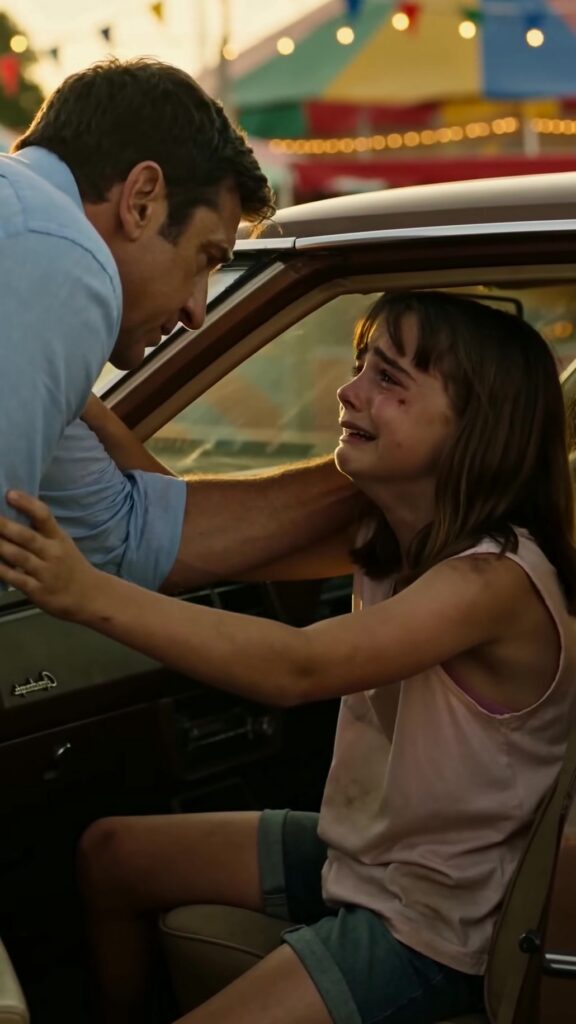
The fairground lights were glowing behind them, soft and blurry, but the little girl wasn’t looking at the rides anymore. She sat sideways on the cracked vinyl of the passenger seat like she’d forgotten cars were meant for sitting forward, her bare knees drawn up, dress smudged with whatever the ground at a county carnival was made of—dust, spilled soda, and the ghost of fried dough. Her face had the kind of streaks you only got when you cried and then tried to pretend you hadn’t.
Behind the windshield, the Ferris wheel kept turning. Music from the tilt-a-whirl drifted over in cheap little waves. Every now and then a burst of laughter floated past the open windows, like the fair itself was breathing and didn’t know it was allowed to be happy.
Her dad, Ben, leaned in through the open door, one hand finding her shoulder with the careful gentleness he used when he was trying not to startle a wounded animal. “Hey, Peanut,” he said, voice soft. “Talk to me.”
She sucked in a breath and it turned into a hiccuped sob. “Dad,” she whispered, like the word was a secret she wasn’t sure she was allowed to say. “Can we go home? Please. Right now.”
Ben’s face tightened, worry pinching the skin around his eyes. “What’s wrong?” He glanced past her toward the glow of rides and tents. “Did you lose your tickets? Did someone—” The sentence stumbled and turned careful. “Did someone do something?”
She shook her head fast, too fast, and it made her ponytail slap her cheek. The motion didn’t calm him. If anything it lit him up with new fear, the kind that made a person’s thoughts sprint. He crouched down so his eyes were level with hers. “Then tell me what happened.”
For a second she just stared at her own hands. They were trembling, little fingers curled tight like she was holding on to a ledge. Under her nails was a dark grit, and her palms had faint red lines like she’d gripped something rough. She wiped her nose with her sleeve and stared past him, not at the fair, but at the narrow strip of shadow where the chain-link fence met the trees. “I… I need to show you,” she said, words coming out thin. “But you can’t be mad. Promise?”
Ben’s stomach sank. He’d promised a lot of things since becoming a dad—no needles, no scary clowns, no leaving her alone in the dark. None of those promises felt as heavy as this one. Still, he nodded. “I’m not mad,” he said, which was not the same as promising he wouldn’t be. “I’m listening.”
She slid out of the seat and the night air wrapped around her shoulders, cooler than the warm chaos of the midway. Her feet hit the gravel and she winced, but she didn’t complain. She grabbed his hand with both of hers like she was afraid she’d float away if she didn’t anchor herself. Then she started walking, pulling him around the front of the old brown sedan and toward the edge of the lot where the lights didn’t reach.
As they moved away from the music, the sounds changed. The carnival noise thinned, replaced by crickets and the distant hum of a generator. Their footsteps crunched on gravel, and somewhere nearby a plastic bag rustled like a whisper. Ben kept his eyes scanning—trash bins, the fence line, the row of port-a-potties with their doors like grim blue mouths. He didn’t like this part of any fair, the part where the fun ran out and all that was left was temporary buildings and dark corners.
“Peanut,” he started, trying to keep his voice steady, “where are we going?”
She didn’t answer until they reached the fence. Here the chain-link sagged a little, bent from years of kids climbing it for a better view of the fireworks. A warning sign hung crookedly, half hidden by ivy. The trees beyond were thick enough to make a wall of black. She slowed, swallowed hard, and pointed down.
“I found her,” she said, and her voice cracked the same way a cheap glow stick breaks before it lights.
Ben’s gaze dropped to the ground near the fence post. At first all he saw was a mound of leaves and carnival litter—cup lids, torn paper, the corner of a napkin. Then his brain rearranged it into something else: a purse. A small white purse with a broken strap, half buried, the kind a teenager might carry. Next to it lay a phone with a spiderwebbed screen, face-down in the dirt.
He went cold. He’d seen the flyers taped to light poles near the entrance—MISSING: LILA MORROW, 16, last seen Saturday night at the fair. A smiling girl with a dimple and a bright purple streak in her hair. Ben had stood at the ticket booth and pretended not to stare at the mother in the photo because it felt too much like inviting tragedy in. Now tragedy was sitting at his feet like a dropped coin.
“Sweetie,” he said carefully, “what do you mean you found her? Where?”
Mara’s lower lip wobbled. “I didn’t… I didn’t find her like—like a movie,” she blurted, words tumbling. “I was looking for you and I got lost and I went behind the cotton candy trailer because I heard a cat. And there was this gap in the fence, and I crawled through because I’m not supposed to but I thought maybe the cat was stuck.” She squeezed his hand hard enough to hurt. “And then I saw… stuff.”
Ben’s mind flashed with horrible images, but he forced his voice to stay gentle. “What stuff?”
She pointed again, farther into the trees. “There’s a ditch. Not deep, just… like where rain goes. And there was a sneaker. And a jacket. And I thought someone dropped them, but then I saw the purple hair.” She burst into fresh tears. “I didn’t touch her. I swear. I just ran back. I didn’t know what to do. I didn’t want you to be mad that I left the fair.”
Ben’s throat tightened. Anger tried to rise—at the rule she’d broken, at himself for letting her get out of sight, at the entire stupid fair for pretending the world was a safe place because it had lights and music. But he swallowed it down. Mara was shaking like a leaf. She didn’t need anger. She needed a grown-up who could be steady.
He crouched, turning her face gently toward his. “Hey. Listen to me. You did the right thing coming to get me. You understand? You did the right thing.” He took a deep breath, then pulled his phone from his pocket with fingers that didn’t quite want to work. “We’re going to call for help. We’re going to get someone who knows what to do.”
Mara sniffed. “Are the police gonna think I did something?”
“No,” Ben said, immediately and firmly, though he didn’t know what the police would think of anything. He only knew what his job was right now: to protect his kid and to make sure whatever had happened didn’t get buried under a carnival’s noise. “You’re a kid who got scared and told her dad. That’s it. I’m right here.”
He dialed 911, stepping between Mara and the gap in the fence as if his body could block what she’d already seen. When the operator answered, Ben’s voice sounded like it belonged to someone else—calm, detailed, measured. He gave their location, described the items near the fence, said the name from the flyers because the fair had made sure everyone knew it. He didn’t say the word “body.” He couldn’t make his mouth form it while his daughter stood beside him, small and trembling.
While he spoke, the fairground music drifted faintly on the wind again, tinny and cheerful, like it had no idea what was happening at its own edges. Ben watched the Ferris wheel lights through the trees, those soft blurry circles spinning over and over, and he realized something that made his chest ache: Mara wasn’t looking at the rides anymore because she’d just learned what grown-ups try so hard to hide from kids—that bright places still cast shadows, and sometimes the shadows have teeth.
When he ended the call, he knelt and wrapped Mara in his arms. She pressed her face into his shirt, and he felt her breathing start to slow. “You’re safe,” he said, over and over, like he could make it true by saying it enough times. “I’ve got you. You did good.”
Somewhere beyond the fence, in the dark, a branch snapped. Ben tightened his hold and stared into the trees, waiting for headlights, sirens, anything that would bring the world back into order. The fair kept spinning behind them, glowing and blurry, but now it felt like a different planet—one he’d driven to for funnel cake and laughter, and somehow ended up leaving with a terrible secret tucked between his ribs.