The jewelry shop was warm, quiet, and almost too beautiful for a boy like him. Milo felt that the second he stepped off the gritty sidewalk and into the hush. The air changed—less exhaust, more polish and something faintly sweet, like old cedar. Warm amber lights floated above glass cases so clean they looked like solid blocks of ice. Everything inside them—rings, thin chains, earrings shaped like leaves—seemed like it belonged to people who didn’t count pennies in their heads.
Milo’s sneakers squeaked on the smooth floor. He hated that sound. It made him feel like the room was watching. He tugged at the hem of his worn gray t-shirt, trying to make it longer, trying to make himself smaller. Outside, he could still hear the street, muffled like it was happening behind a thick blanket: a bus sighing at a stop, a car horn, someone laughing too loud.
He almost turned around. He’d practiced what he’d say, but now his mouth felt dry. His mom’s face flashed into his mind—pale, sweaty, pretending she wasn’t scared. Pretending he didn’t hear her crying quietly in the bathroom at night. The medicine was expensive, and the clinic lady had said “payment plan” like it was something people like them had the luxury to think about.
The bell over the door had already announced him, though, a soft chime that sounded polite enough to apologize for him. Milo forced his feet forward until he reached the counter.
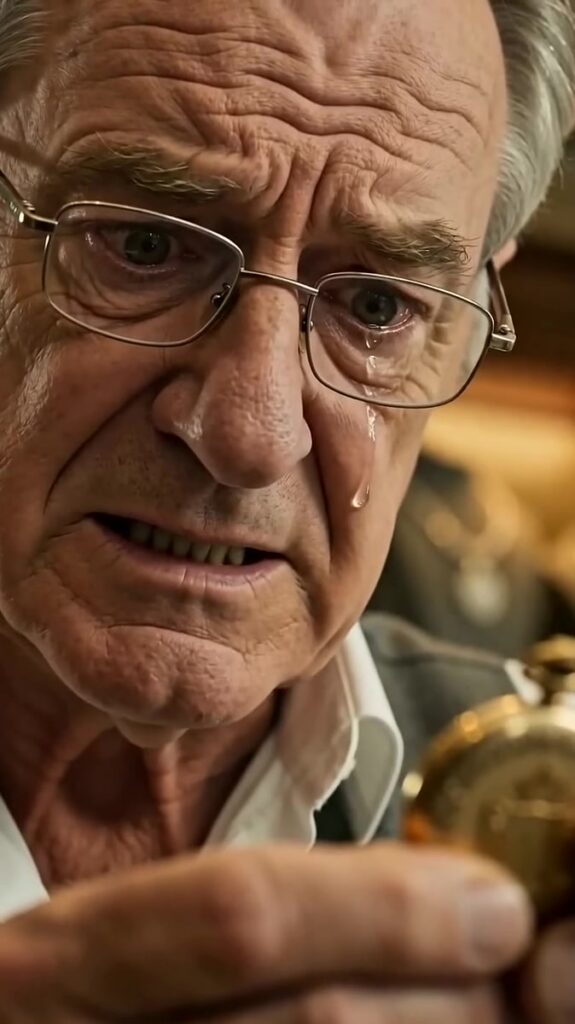
Behind it stood an old man wearing glasses that made his eyes look bigger and kinder than Milo expected. The man’s hair was silver, combed back, and he wore a vest like someone’s grandpa at a wedding. His hands were on a folded cloth, mid-wipe, as if Milo had walked into a still photograph and made it move again.
Milo swallowed, reached into his pocket, and pulled out the pocket watch. It was heavier than it looked, ornate with swirling patterns that his fingers traced without meaning to, like touching it might make the moment go smoother. He placed it on the glass.
The sound—soft metal against hard surface—was small, but it made the entire shop feel like it held its breath.
“My mom is sick,” Milo said, surprised his voice came out at all. He tried to look tough, like he wasn’t twelve and terrified, but his eyes burned. “She needs medicine. She said to sell this.”
The jeweler didn’t grab the watch like it was a prize. He reached for it slowly, the way Milo’s mom reached for hot soup, careful not to spill. He turned it over once, then twice. His gaze flicked to Milo’s face, then back to the watch.
Something on the back caught the man’s attention—an engraving. Milo had seen it a million times, though he couldn’t read cursive well. It looked like a little river of letters. He only knew the first part because his mom had once traced it and whispered it like a spell: “For El—” and then she’d stopped, like her throat had closed on the rest.
The jeweler’s mouth shifted. Not quite a frown, not quite a smile. Just… a change. Like someone had turned a knob inside him.
He pressed the clasp.
Click.
The watch opened. Milo leaned forward before he could stop himself. He’d never been allowed to open it. “It’s delicate,” his mom always said, and her hands always trembled a little when she held it.
Inside the lid, tucked neatly where a plain piece of metal should’ve been, was a tiny faded photograph. Milo had not known it was there.
The jeweler froze so completely Milo thought the man might topple over. His breath caught, visible in the way his shoulders lifted and didn’t fall. The fingers holding the watch started to shake.
It wasn’t like the man recognized a nice heirloom. It was like he’d seen something impossible.
“Sir?” Milo asked, then hated how small it sounded.
Silence spread through the shop, thick and awkward. The old man’s eyes shone suddenly. A tear slid down his cheek like it had been waiting behind a dam.
He looked up at Milo, but it felt like he was looking through Milo, at the outline of something else. “Where did your mother get this?” he asked. The words came out cracked, like an old door.
Milo blinked. “She always had it.”
The jeweler flinched, the way people flinch at bad news even if they were expecting it. He leaned over the counter, staring at Milo’s face like he was solving a puzzle with shaking hands.
“I gave this to my daughter,” he whispered, more to himself than to Milo. “She vanished eighteen years ago.”
Milo’s brain tried to stack the facts like blocks and couldn’t keep them from falling. Daughter. Vanished. Eighteen years. His mom was… his mom. She was just his mom who smelled like dish soap and cheap shampoo, who sang off-key when she did laundry, who got quiet whenever people mentioned “family.”
The jeweler’s lips trembled. “Boy…” he said, and then stopped as if the next word might shatter the glass cases around them.
Milo’s heart hammered. The shop was warm but his hands had gone cold. “What?” he blurted. “I don’t—my mom… she’s sick. I just need money. Please.”
The old man’s eyes squeezed shut for a second. When he opened them again, he looked older than before, as if the memory in the watch had added weight to his bones. “What is your mother’s name?”
Milo hesitated. His mom didn’t like her name said out loud. She always introduced herself as “Milo’s mom” at school events, like her name belonged to some other life. Still, he knew it. “Lena,” he said. “Lena Hart.”
The jeweler made a sound that wasn’t quite a sob, wasn’t quite a laugh. His hand went to the counter to steady himself. “Lena,” he repeated, and the way he said it sounded like he had been calling that name into empty rooms for years.
Milo stared. “Are you… are you saying you know her?”
The old man swallowed hard and nodded once. “My name is Arthur,” he said. “Arthur Hart.” He glanced down at the watch again, at the engraving Milo couldn’t read. “It was supposed to say, ‘For Elena, so you’ll always have time to come home.’ She was fifteen and furious with me and the whole world. She wanted to be an adult overnight.”
Milo’s throat tightened. His mom never talked about being fifteen. She barely talked about being anything before she became “Mom.” “She never told me,” Milo said, and his voice shook with something that wasn’t just fear now. “She told me her dad was… gone.”
Arthur’s shoulders sagged, and for a second he looked like a man who had carried a bag of rocks across eighteen years and finally set it down. “I was gone,” he admitted. “Not dead. Just… not there when I should’ve been. I thought keeping rules would keep her safe. I pushed too hard.”
Milo’s eyes filled, and he hated it, hated crying in a place this clean, hated feeling like he was leaving stains just by standing there. “Then why didn’t she come back?”
Arthur stared at the photo inside the watch—two people in it, a younger Arthur with darker hair and a girl with a stubborn chin and bright eyes. The girl smiled like she was trying not to. “Because sometimes pride builds a wall, and by the time you’re ready to knock it down, you don’t know where the door is anymore,” he said quietly.
Milo wiped his face with his sleeve, smearing tears. “I don’t know what you want me to do,” he said. “I just need medicine.”
Arthur snapped into motion like the sentence yanked him back into the present. He gently closed the watch, but he didn’t let go of it. “Yes,” he said. “Yes, you do.” He disappeared into the back room, moving faster than his age suggested. Milo stood frozen, half-expecting the shop to turn into a dream and dissolve.
Arthur returned with a small paper bag and an envelope. He set them on the counter. The bag had a pharmacy logo Milo recognized from down the street. “I called ahead,” Arthur said. “They have what she needs. This is enough for the first month, and the clinic fee.” He slid the envelope closer without opening it. “And this is… extra. For groceries. For rent. For whatever you’ve been juggling alone.”
Milo stared at the bag as if it might bite. “But I—this watch—”
Arthur held up a hand, gentle but firm. “The watch isn’t for sale,” he said. “Not today. Not ever. It’s… it’s family.” His voice wavered on the last word like he was testing it to see if it could hold his weight.
Milo’s breath came out in a shaky rush. “You’re serious?”
Arthur nodded. “I’m serious. And I’m coming with you,” he added before Milo could argue. “Not to barge into her life. Not to demand anything. Just to see her. To say one sentence I’ve owed her for eighteen years.”
Milo clutched the paper bag to his chest. It was warm from having been inside, like the shop itself had given it heat. “What sentence?” he asked, voice small again.
Arthur’s eyes shone, but he didn’t let the tears fall this time. “That I’m sorry,” he said. “And that she doesn’t have to be alone anymore—if she’ll let me try.”
Milo looked at the door, at the street beyond it where everything was loud and sharp. Then he looked back at the warm quiet of the shop, at the old man who suddenly looked like a question mark made of bones and regret.
“Okay,” Milo said, because he didn’t know what else to say, because his mom needed medicine, because maybe time wasn’t just something you lost. Maybe it was something you could find again, ticking softly inside an old gold watch, waiting for someone brave enough to open it.
Arthur reached for his coat. “Lead the way, Milo,” he said, and his voice didn’t break this time. Milo pushed open the door, and the bell chimed like a small promise following them out.