The restaurant was quiet, expensive, and full of people pretending not to notice each other. It had that expensive hush—like the air itself had signed an NDA. Every fork clink sounded like a mistake. People spoke in careful, soft edits, laughing with their mouths but not their eyes. Even the piano in the corner seemed to be playing on tiptoe.
Sunlight leaned through tall windows and slid across white tablecloths like it had paid for the privilege. Glassware winked. Silverware sat aligned like it had been measured. The kind of place where you could tell someone’s job title by their posture.
Near the center, where the room naturally gave itself space, a man in a sharp blue suit sat with a boy in a wheelchair. The man was all crisp edges—perfect hair, perfect watch, perfect impatience. He spoke to a waiter with the polished certainty of someone used to being right.
“The risotto is under-seasoned,” he said, as if delivering a quarterly report. “Have the chef fix it.”
The waiter nodded too many times, apologizing with his whole spine.
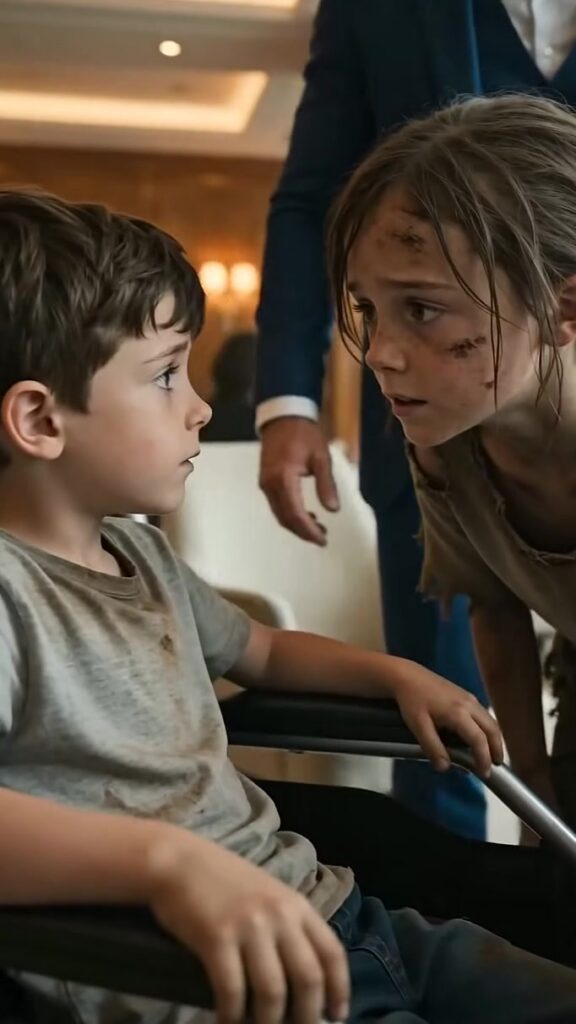
The boy—maybe nine, maybe ten—stared at his own hands. Not out the window. Not at the room. Just at his fingers, like they belonged to somebody else. His eyes were open, but his face was turned down, quiet as a folded napkin.
Across the room, a couple discussed real estate like it was weather. At another table, a woman scrolled through her phone beneath the tablecloth’s edge, as if ashamed of needing anything at all. Everyone pretended their bubble was airtight.
Then a small dirty hand smacked down onto the perfect white cloth at the wealthy man’s table.
Plates rattled. A wine glass quivered, deciding whether to fall. The sound cut through the restaurant like someone ripping a silk curtain.
A ragged little girl stood there—thin, dust-streaked, wearing clothes that had given up a long time ago. Her hair was a tangled halo, and her eyes held hunger, yes, but also something stranger: certainty. Like she’d walked in not to beg, but to do business.
She pointed straight at the boy.
“Feed me,” she said, loud enough to make every head turn, “and I’ll heal him.”
The entire restaurant pivoted as one organism, every person suddenly interested but trying not to look interested. The quiet didn’t leave; it just re-formed into a tighter, sharper quiet.
For a beat, the father stared at her like his brain was buffering. Then he laughed.
Not kindly. Not even politely. It was the laugh of someone who had paid too much to be disturbed.
He shoved back his chair so hard it scraped the floor. Heads flinched. The pianist missed a note and pretended it was jazz.
“You’ll heal my son?” the man repeated, leaning over the table toward her, his smile a weapon. “What is this—some street performance?”
He laughed again, louder, to recruit the room to his side. A couple people gave tiny, nervous chuckles, like they were tipping him with sound.
“Go away,” he said. “Now.”
But the girl didn’t flinch. She didn’t even look at him.
She moved around the table with a calm that didn’t match her torn sleeves, and she lowered herself until she was eye level with the boy. Her knees pressed into the carpet like she’d done this before—like she knew where to place her body so the world would stop swinging and focus.
The boy lifted his eyes.
Not with belief. With desperate hope, the kind that makes your chest hurt to witness. It was the first real expression anyone had seen on his face all afternoon.
The father’s smile faltered—not gone, but cracked. He stepped forward, hand already reaching, ready to peel her away like dirt from a sleeve.
“Touch him and—” he began.
But before he could grab her, the boy lifted one hand off the wheelchair armrest.
It wasn’t dramatic. It wasn’t a miracle trumpet blast. It was a small, trembling movement—fingers rising like they were testing gravity for the first time in years. But in that room, full of people who believed only in what they could purchase, it was an earthquake.
Somebody’s fork hovered halfway to their mouth. A woman lowered her glass so slowly it looked choreographed. The waiter froze, holding a plate like a shield.
The father stopped mid-reach. His face drained of the practiced smugness, replaced by something raw and startled.
“What did you do?” he asked, voice suddenly thin.
The girl looked up at him for the first time, and there was no triumph in her face—just focus.
“Nothing yet,” she said. Then she turned back to the boy as if the father’s panic was background noise.
She held out her hand, slow and steady, like offering a bird a place to land.
“Do you want to stand?” she asked the boy.
The boy swallowed. His lips moved around a word that came out almost soundless.
“Yes.”
The father took a sharp breath, like he’d forgotten how. “This is ridiculous,” he tried again, but it didn’t have its old bite. It sounded like a man insisting a fire wasn’t hot while smoke curled around his ankles.
The girl’s voice softened. “Then trust me,” she whispered.
The boy’s fingers closed around hers.
And one foot slipped off the wheelchair footrest.
The father lunged forward on instinct—half to stop the girl, half to catch his son, half to catch his own heart as it tried to sprint out of his chest. His hands hovered uselessly, afraid to touch either of them, as if contact might shatter whatever fragile thing was happening.
“Careful,” he breathed, suddenly not a man in a suit but simply a dad.
The girl nodded once, like she’d heard this warning her whole life.
She put her other hand on the boy’s shin—gentle, not pushing, more like reminding. “Feel where you are,” she murmured. “Not where you think you are. Not where you’re told you are.”
The boy’s leg trembled. His ankle wobbled like it belonged to a newborn deer. But the foot touched the floor. The carpet compressed beneath it. The boy’s eyes widened with shock, and he sucked in a breath that sounded like the first breath of a different life.
Across the room, someone whispered, “Oh my God.” Another person shushed them, out of habit, like silence could control this.
The father’s face twisted—hope battling fear, pride battling panic. “How are you doing that?” he demanded, but there was no cruelty left. Only need.
The girl didn’t look up. “It isn’t a trick,” she said. “It’s a trade.”
“A trade?” the father echoed.
She glanced at the table. The untouched bread basket. The butter that sat like a little golden square. The plates arranged like art. “You feed me,” she said simply. “And you stop pretending you don’t see people like me. That’s the part that makes it work.”
The father blinked, thrown. “That’s not how medicine—”
“It’s not medicine,” she cut in, still calm. “It’s attention. It’s being real. Your son is drowning in a room full of air.”
The boy’s other foot slid down. His knees shook, but they were alive. His hands clung to the girl’s like she was the only thing anchored in the world.
The father’s mouth opened and closed. For once, he didn’t have the right words ready.
The waiter—who had been frozen in apology mode—moved first. He set the plate down on the table, hands trembling. “What… what would you like?” he asked the girl, voice unsteady but kind.
The father looked at the waiter like he’d forgotten waiters had names and choices. Then he looked at the girl. Then at his son, whose cheeks had gone pink with effort and astonishment.
He swallowed hard. “Bring her whatever she wants,” he said, and the command came out different—less like a demand, more like a plea. “And… and bring another chair.”
The girl didn’t smile. She stayed focused on the boy, guiding him inch by inch. “Stand with me,” she told him. “Not for them. For you.”
Slowly, painfully, like lifting a whole new body into existence, the boy rose from the wheelchair. His legs shook so hard the tableware chimed with tiny vibrations. The father stepped closer, hands ready now, not to control but to support.
When the boy finally straightened—even just a little—his eyes filled with tears he didn’t wipe away. He looked down at his feet like they were magic.
And the restaurant—still full of people pretending not to notice each other—forgot, for a moment, how to pretend at all.
The girl finally glanced around, taking in all the staring faces. “See?” she said quietly, not triumphant, just stating a fact. “You can look.”
The father’s voice cracked. “What’s your name?”
She paused, as if names were a luxury. “Mara,” she said at last. Then, softer, to the boy: “And yours?”
“Eli,” he whispered, like sharing a secret.
Mara squeezed his hands once. “Okay, Eli,” she said. “Now take one step.”
The father held his breath. The room held its breath. Even the sunlight seemed to pause mid-fall.
Eli’s knee bent. His foot lifted—just a fraction—and for the first time in a long time, he chose forward.
And the father, watching his son lean into that terrifying, beautiful possibility, realized the most expensive thing in the room wasn’t the wine or the chandelier or the suit he wore.
It was the moment he finally stopped looking away.