The bakery smelled like butter, cinnamon, and warm bread, the kind of smell that makes your stomach remember it has feelings. It was also the kind of place where the chairs were cute-but-uncomfortable on purpose, where the music was soft enough to pretend you weren’t eavesdropping, and where people bought almond croissants like they were signing a lease.
I was there for a meeting I didn’t want to have, which is basically most of my meetings. I’d picked the spot because it made everyone act civilized. Nobody yells under pendant lights. Nobody says terrible things while a barista is drawing a leaf in foam.
I had my coffee, my laptop open to a document with a title like “Q3 Strategy,” and my head already halfway out the door when I saw the kid.
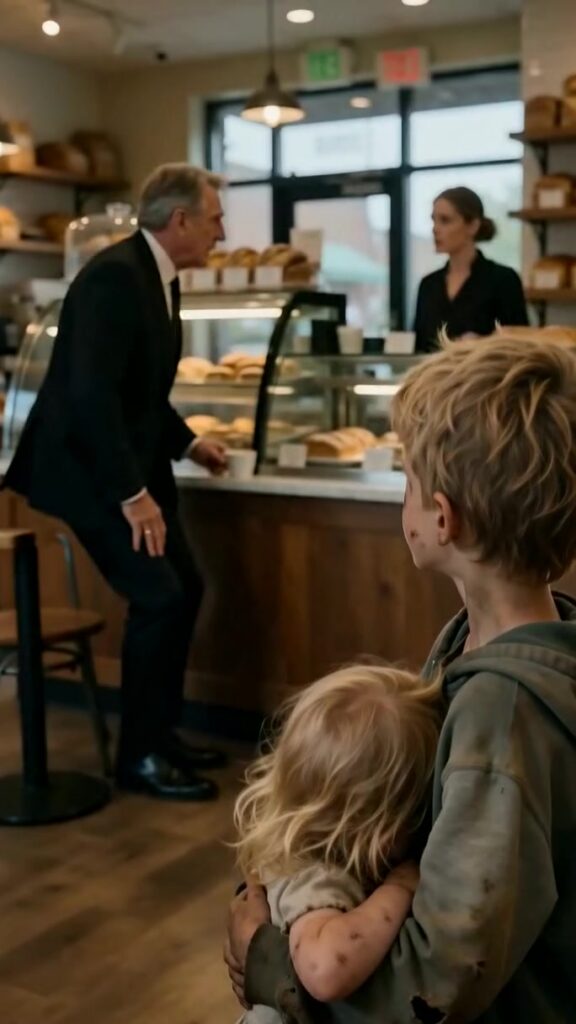
He wasn’t “begging kid” dramatic. No outstretched hands, no cardboard sign. He was just… too thin to be inside a place like this. A hoodie that hung off him like it belonged to an older brother. Shoes that had seen arguments with puddles and lost. And in his arms, a toddler girl was pressed against his chest like she was a precious package he’d promised not to drop.
She was crying in that hiccupy, exhausted way toddlers cry when they’ve moved past tantrum and into pure survival. Her little dress—beige, once nice—was smudged at the hem. She buried her face into his shoulder and said, in a voice so small it somehow still filled the room, “I’m hungry.”
The boy’s throat bobbed. He took one step toward the pastry case like it required permission from gravity. Then he looked up at the woman behind the counter with eyes that didn’t ask for kindness so much as check whether it existed here.
“Do you have,” he started, then stopped and swallowed, “anything from yesterday? Like… bread that’s cheaper?”
The worker—mid-twenties, neat bun, name tag that said MARA—hesitated long enough for her heart to show. Her mouth opened like she wanted to say yes. Then she glanced at the line, at the cameras, at whatever rules were pasted in the back room, and her face snapped into trained politeness.
“We don’t sell day-old items,” she said, gently but final. “I’m sorry.”
The boy didn’t argue. That was the part that made it worse. Adults at least know how to make a scene; kids either fight or fold. He folded. His gaze dropped to the tiles like he was counting them to stay steady, and he squeezed the toddler closer while she cried harder, little fists clutching fabric.
At my table near the window, my hand froze around my cup. I told myself I was watching because I was curious. That was a lie. I was watching because something in his voice had pulled a memory out of me—my daughter’s voice from years ago, sharp with hope and anger, telling me I didn’t get to buy my way out of being a father.
My chair scraped the floor when I stood up. It was loud enough that a couple of heads turned. I heard a spoon clink against a saucer. Someone’s laugh cut off halfway.
I walked to the counter, suit jacket still on, wallet already in my hand like I’d rehearsed the move. I didn’t think. Thinking is how you negotiate yourself into doing nothing.
“Box it up,” I said. My voice sounded calm, which surprised me because my heart had started acting like it wanted to climb out through my throat. “Everything you’ve got ready. Bread, pastries, whatever’s in the case.”
Mara blinked. “Sir—everything?”
“Everything,” I repeated. “And grab some milk. Fruit. Anything that could help.”
Behind me, the room went quiet in that way rich places do when something real walks in.
I turned toward the kids. “Come on,” I said, softening my voice. “We’ll get you fed.”
The boy’s entire body shifted back, defensive. Not grateful. Not relieved. Suspicious. He tucked the toddler higher on his hip like he was ready to run.
“Why?” he asked, and the question wasn’t rude. It was practiced. Like he’d learned that help usually came with a hook.
I opened my mouth to say something simple—because you’re hungry, because you’re kids, because I’m not a monster—but then the toddler turned her face, and the world tilted.
Her eyes were tear-bright and dark, with a familiar shape. Her mouth had a little dip in the center of the top lip. And near her temple, half hidden by messy hair, was a small crescent mark.
A birthmark. A tiny curve like a fingernail moon.
My knees went watery. I didn’t touch her. I couldn’t. It felt like if I reached out, the truth might shatter.
The boy saw my expression and his voice sharpened. “What are you looking at?”
I stared at the toddler like she was a photograph I’d carried too long. “What’s her name?” I heard myself ask.
The boy hesitated, eyes flicking to the door. Escape routes. He was mapping them. Then, like answering was safer than not, he said, “Lily.”
My lungs forgot what their job was. Lily. The name my daughter used to joke about, back when she was young enough to believe the future was a thing you could pick. She’d sit on my kitchen counter, swinging her legs, and say, If I ever have a girl, that’s her name. Lily. Like something that survives winters.
My voice came out raw. “And your mom?”
The boy went stiff, like I’d jabbed a bruise. He looked down at Lily, then back at me. “She’s… not here anymore.”
“Not here,” I echoed, because I was suddenly afraid of every possible version of those words. “What happened?”
His jaw trembled, and he clamped it tight like he hated that his face was betraying him. “She got sick when it got cold. We tried shelters but they were full. She… she told me to keep Lily warm.”
Something inside me cracked with a sound I felt more than heard. I pressed my fingers against the edge of the counter to keep from swaying.
“What was her name?” I asked, and I already knew. I just needed the world to say it out loud.
The boy watched me like he was deciding whether I was safe enough for the truth. Then he whispered, “Elena.”
My daughter. The one I’d pushed out of my life five years ago because she’d loved a musician with a beat-up guitar and a smile I didn’t trust. The one I’d told to come back when she was done playing poor. The one who’d looked at me through tears and said I’d end up with a big house and nobody in it.
Mara had stopped boxing pastries. The whole staff had, like the air itself had turned heavy. Nobody in line complained. Nobody checked their phones. Even the espresso machine seemed to hush.
The boy adjusted Lily on his hip and reached into the inner pocket of his oversized hoodie. He pulled out an envelope that looked like it had been folded and unfolded a hundred times, the paper worn soft at the edges.
He held it out but didn’t let go. “Mom said… if we got too hungry,” he said quietly, “and if a man looked at Lily like he already knew her… I should give him this.”
My hands shook as I took the envelope. On the front, in faded handwriting I’d recognize in any lifetime, were four words: For my dad.
I opened it like it might bite me. The first line hit like a slap and a hug at the same time.
Dad, if you’re reading this, the kids found you the hard way.
The letters swam. My vision blurred. I could feel the bakery around me, the cinnamon and butter and warmth, but it all seemed far away compared to the weight of that paper.
I looked at the boy—my grandson, though the word felt too big and too late—and I saw more than dirt and hunger. I saw my daughter’s stubbornness in his chin. I saw her protectiveness in the way he held Lily like a promise.
“What’s your name?” I managed.
He hesitated, then said, “Noah.”
Noah. Of course. My daughter always liked names that sounded like survival stories.
I swallowed, forcing my voice steady because kids like him can hear cracks. “Noah,” I said, “I can’t fix what I did to your mom. But I can make sure you and Lily never have to ask for yesterday’s bread again.”
He didn’t nod. He didn’t soften. He just watched me like trust was a language he’d forgotten.
Mara set two big boxes on the counter and slid them forward. She added a small bag of cookies, the kind shaped like stars. No receipt, no speech. Just a quiet act of rebellion against policy.
I took one box in each hand, then realized the obvious problem and set them down again. I crouched to Noah’s level, careful, slow. “Will you let me help you carry this out?”
Noah stared at me for a long moment. Lily’s crying had calmed to tired sniffles, her cheek stuck to his hoodie. She looked at the cookies, then at me, like she was considering whether I was real.
Noah finally nodded once, small and sharp. “But you don’t take her,” he said, voice low. “You don’t take Lily.”
My throat tightened. “I won’t,” I promised, and I meant it in the most literal way. “I’m not here to take. I’m here to bring you home—if you’ll let me earn that word.”
Outside, the day was cold and bright. Inside, the bakery still smelled like comfort people paid for. I picked up the boxes, and Noah stepped beside me with Lily on his hip, wary but moving forward. For the first time in years, I walked out of a warm place with something more important than coffee in my hands.
And in my pocket, Elena’s letter pressed against my heart like it had been waiting there all along.