The street was quiet in the way old streets often are—not empty, just holding their breath. Warm evening light poured down the narrow lane, catching on cobblestones worn smooth by centuries of feet and wheels. Dust drifted lazily through the air like it had nowhere else to be. On either side, old stone walls held the day’s heat and gave it back in a soft glow, as if the whole alley had decided to be gentle for once.
Julian walked straight through that gentleness like it didn’t apply to him.
He wore a dark suit that didn’t match the weather or the neighborhood, the kind of suit that belonged in offices with glass doors and people who spoke in careful sentences. His tie was loosened, not because he’d relaxed, but because he’d gotten tired of the sensation of being strangled by his own choices. His jaw looked locked in place. His eyes were aimed somewhere ahead and slightly above the street, like if he kept looking far enough away he wouldn’t have to see what was right in front of him.
Every few steps, his hand hovered near the inside pocket of his coat. A nervous check. A reflex. Like the pocket contained the only thing anchoring him to the world.
And then the anchor slipped.
A small photograph wriggled free and drifted down behind him, flipping once in the warm air before landing face-up near a crack between stones.
Julian didn’t notice.
Eva did.
She sat on a low step outside a door that looked older than most of the city. Her legs swung above the street, sandals tapping the stone in a private rhythm. She was supposed to be waiting for her mother to finish “one quick thing,” which in grown-up time meant anything from two minutes to forever. Eva had been entertaining herself by naming the shapes in the shadows and watching ants navigate the uneven grout like tiny explorers.
When the photograph landed, it was like the street handed her a secret.
She hopped down, scooped it up with both hands the way she handled fragile things, and looked.
At first, her face stayed blank. It wasn’t because she didn’t understand pictures; it was because she couldn’t place what she was seeing. A woman, smiling. Dark hair swept back. A tiny dimple at the corner of her mouth. The background looked like a park, maybe, or a place with trees.
Then something clicked so hard in Eva’s mind it almost felt like hearing a door latch.
Her brows pulled together. Her mouth opened a little. Recognition moved across her face like a wave.
“Oh,” she whispered, more to herself than anyone else.
She looked up at the man’s back. He was already several paces away, still moving like he was chasing a thought.
“Mister!” she called.
Her voice was small, but the alley carried sound the way it carried heat. It traveled cleanly between stone walls.
He didn’t turn.
Eva stood up straighter, a little annoyed that grown-ups sometimes acted like they could just ignore the world.
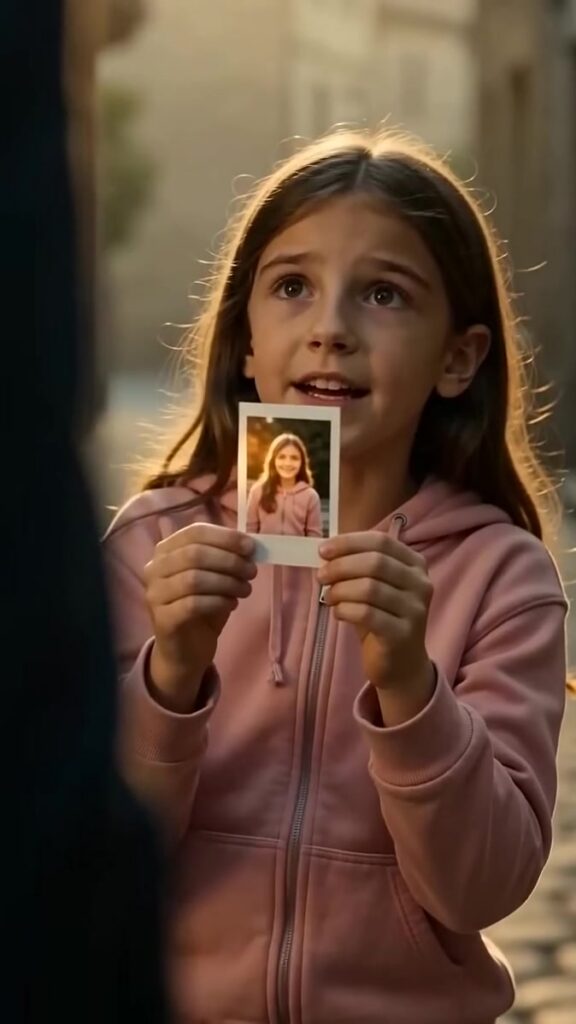
“Mister… why do you have a picture of my mommy?”
The street seemed to tighten around the words. Even the faint clink of dishes from a nearby café faded, as if the neighborhood itself leaned closer.
Julian stopped mid-step.
Not with drama. Not with a theatrical spin. Just a halt so sudden it made the moment feel wrong, like the film of his life had snagged on a bad edit.
His shoulders rose. Slowly, like he didn’t trust his own spine, he turned around.
The little girl stood by the step holding a photograph out in front of her like an offering. Her expression wasn’t scared. It wasn’t even careful. It was certain, the way children can be when they’ve decided something is true.
Julian’s eyes found the photo.
His heart did something stupid and physical, like tripping over a curb.
The image was a woman laughing at the camera, sunlight in her hair. He knew that smile the way you know the smell of a room you grew up in. It didn’t matter how long you’d been gone—you’d recognize it in the dark.
For a second his face held, like plaster resisting a crack. And then it broke anyway.
His voice came out rough, scraped raw. “What did you say?”
Eva blinked at him, confused that he didn’t understand something so obvious. “My mommy,” she repeated, as if saying it slower would help. “That’s my mom.”
Julian took a step toward her. Then another. Not fast—careful, as if any sudden movement might cause this entire moment to vanish. His breathing went shallow. His hand lifted, then hovered in the air halfway to the photo, fingers trembling slightly.
“That’s…” He swallowed hard. The word felt wrong in his mouth. “That’s my wife.”
Eva’s forehead wrinkled. She didn’t argue the way adults did, with defense and anger. She argued like a kid who simply needed you to correct your mistake. “No,” she said, polite but firm. “That’s my mom.”
Julian’s laugh came out like it hurt. “My wife died years ago.” He heard himself say it and hated the way it sounded—final, heavy, rehearsed. A sentence he’d repeated so many times it had become a wall he leaned on just to stand up.
Eva clutched the photograph to her chest for a brief second, as if she needed to protect it from the air, from his disbelief, from the sharpness in his voice. Then she held it out again.
“No,” she insisted, softer now, because she could see he was about to fall apart. “My mom is alive.”
Julian stared at her as if she’d said the sky was green.
Alive.
The word went through him like cold water. If she was alive, then the funeral, the papers, the condolences, the black suit he’d worn until it hung off him—none of it meant what he’d been told it meant. He felt his knees threaten to give. His fingers finally touched the edge of the photograph, not taking it, just confirming it was real paper and not some cruel trick of memory.
“Who… who is your mother?” he managed.
Eva tilted her head, studying him the way she studied ants, like she was trying to see where he fit in the pattern. “Mama’s name is Lina,” she said. “But sometimes she doesn’t like when people say it loud. She says it’s safer if we’re quiet.”
Lina.
Julian’s mouth went dry. He knew that name in a different voice, in a different life. He hadn’t heard it in years, not spoken out loud. It had become something he kept locked away, the way people keep letters they can’t throw out but can’t reread either.
Eva watched his face and added, almost like she was offering him a bandage, “She cries when she looks at your picture.”
Julian’s chest tightened. “My… my picture?”
Eva nodded. “In the drawer,” she said. “The one she thinks I don’t know about. Sometimes she takes it out and she just sits. Like she’s listening to something.”
Julian couldn’t breathe properly. He tried to make his mind work, to line up facts like numbers in an equation. The last time he’d seen Lina, the last conversation, the last argument—how he’d left the house that morning thinking he’d come back to fix things. How the call had come instead. How they’d told him there’d been an accident. How he’d believed it because grief makes you agree to anything just to stop thinking.
He crouched slowly in front of Eva so he wouldn’t tower over her. His suit creased at the knees. His voice dropped to a whisper without him choosing it. “Where do you live?”
Eva pointed down the alley, toward a turn where the light thinned. “There,” she said. “With the blue door. Mama says it used to be a bakery a long time ago.”
Julian followed the direction with his eyes. The alley narrowed, then bent, like it didn’t want to reveal what waited beyond. His hand hovered again near his coat pocket. This time it wasn’t checking the pocket. It was checking himself, making sure he didn’t dissolve on the spot.
Just then, a woman’s voice called from deeper in the alley. Not loud, but edged with the kind of worry that makes every syllable sharp.
“Eva!”
Eva’s face brightened like the sun had personally returned. “Here!” she called back, turning to wave. “Mama!”
Julian’s head snapped toward the sound. He stood too quickly, then steadied himself with a hand against the stone wall. His pulse roared in his ears. Footsteps approached—hesitant, then faster, then slowing again like the person walking them was trying to decide whether to run or hide.
A figure appeared at the bend.
At first Julian only saw the outline—hair pulled back, a simple dress, a grocery bag held too tightly. Then she stepped into the warmer light and his whole body forgot how to be clever.
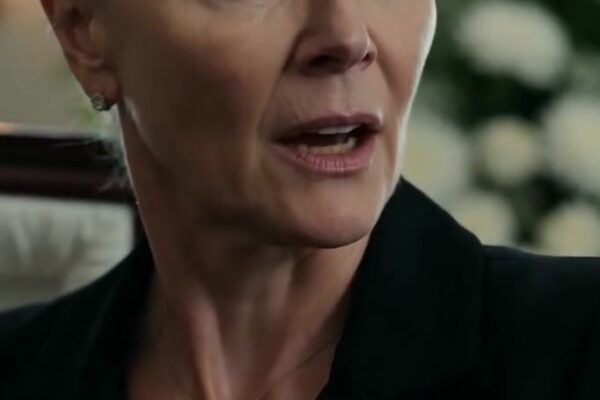
She was older, yes. The softness of youth had tightened into something cautious. There were faint lines around her eyes that hadn’t been there before. But it was her. It was her the way a song is still the same song even if you hear it years later on a different radio.
Lina’s gaze darted to Eva, checking for injury, for danger. Then her eyes landed on Julian.
The grocery bag slipped a little in her grip. An orange rolled to the curb of the cobblestones and stopped against Eva’s sandal.
Lina went completely still. Her face drained of color, like someone had pulled the plug on all her warmth.
“Julian?” she said, and the name sounded like something she’d promised herself never to say again.
He took one step forward and stopped, afraid that if he moved too fast she’d vanish, or scream, or both. “Lina,” he breathed. “They told me you were dead.”
Lina’s eyes flicked down to the photograph in Julian’s hand—his hand, because at some point he had taken it from Eva without remembering. Her expression tightened, not with anger exactly, but with a deep, exhausted sorrow. “They told you that on purpose,” she said quietly.
Eva looked between them like she was watching two adults finally arrive at the same page of a story she’d been stuck in alone. “See?” she said, to no one in particular, proud of herself. “I told you.”
Lina’s throat moved as she swallowed. She set the grocery bag down, slowly, like sudden noises might shatter the moment. Her eyes stayed on Julian, wary and aching. “You shouldn’t be here,” she whispered.
Julian’s voice cracked. “I didn’t know where ‘here’ was,” he said. “I didn’t know there was an ‘anywhere’ to find you.”
For a long second, neither of them moved. The old street held its breath harder, like it was afraid to interrupt.
Then Lina’s gaze shifted to Eva, and something gentle broke through her fear. She reached out and rested a hand on her daughter’s shoulder like an anchor. “Eva,” she said softly, “go inside. Close the blue door and wait by the table. Okay?”
Eva hesitated. “But—”
“Please,” Lina added, and that one word carried enough weight to end the argument.
Eva nodded, though she looked deeply offended at being removed from what was obviously the most interesting moment of her life. She slipped past Julian, pausing only to point at the orange. “Don’t forget that,” she told him seriously, then padded down the alley toward the blue door.
Julian watched her go, his mind snagging on the shape of her—her hair, her walk, the way her certainty filled a space. When the door clicked shut, the quiet returned, heavier now with everything unsaid.
Lina exhaled like she’d been holding air for years. “If anyone followed you—”
“No,” Julian said quickly. “I came alone. I’m here because… because I couldn’t stay in my office one more day pretending grief was the only thing that happened to us.” He looked at her, pain sharpening into something else. “Why?”
Lina’s eyes glistened, but she didn’t let the tears fall. “Because someone wanted you to stop looking,” she said. “Because I learned things I wasn’t supposed to. And because the easiest way to erase a person isn’t to kill them.” She glanced toward the blue door, then back at him. “It’s to make everyone believe they’re already gone.”
Julian’s fingers tightened around the photograph until the edges bent. The evening light kept spilling down the stones like nothing in the world had changed. But he knew, standing there in that old, breathing street, that his life had just split open—again. This time, though, it wasn’t only loss pouring out of it.
It was a path.”